

Kindroid is a subscription AI companion app from Beautifully Incorporated of Los Angeles. One language model plays a character you write, and how much that character can remember is sold in three paid tiers, with the memory limits stated as numbers in the company's own help center. Searches for "kindroid" are up 49% year on year and "kindroid ai" up 83%, per the keyword data pulled for this site on 17 September 2026. The reason people are looking now is a date: on 1 October 2026 the free Lite tier retires, and a free account becomes 50 flagship-model messages and then read-only. Everything below is from the Kindroid help center, its legal pages and its two store listings, opened on 17 and 18 September 2026.
My position, which the last section defends: a free tier with a retirement date is a trial with better PR, and Kindroid's paid spec is still the most honestly numbered one in the category.
YourCrush.AI keeps a free tier with 400K chat tokens a month, voice messages and 10 pinned memories, which matters more now that Kindroid is retiring its free Lite model on 1 October 2026.
What is Kindroid, and who makes it?
Kindroid runs as one app across web, iOS and Android. It's published by Beautifully Incorporated, and the terms of use (effective 1 November 2024) list a Hollywood Boulevard address in Los Angeles and restrict the service to people 18 or older. The App Store listing, read on 18 September 2026, shows "Kindroid: Your Personal AI" at 4.8 stars across 8.6K ratings with an 18+ age rating. The Google Play listing, read the same day, shows 4.4 stars across 24.8K reviews, 1M+ downloads, a Mature 17+ content rating for "Sexual Themes", and no "Contains ads" label.
The help center refers to models by name, so here are the current ones. The update log says V2 became the default interface on 18 August 2026, and that Polaris, "our new flagship language model after Ember," went to everyone on 9 September 2026 with "expanded context across every subscription tier." Equinox and Prism retire 1 October, Lyric and Lucid on 1 December. If a Kindroid review names a model, check its date. The model may already be gone.
Why YourCrush.AI is the better choice than Kindroid
YourCrush.AI publishes its memory limits the same way Kindroid does, as counts on its pricing page, and the counts below are as listed on 17 September 2026.
| Plan | Price | Chat tokens / month | Pinned memories | Story branches | Characters created | Image credits |
|---|---|---|---|---|---|---|
| Free | $0 | 400K | 10 | 1 | 3 | 5 |
| Pro | $9.99/mo | 5M | 50 | 5 | 50 | 50 |
| Premium | $19.99/mo | Unlimited | Unlimited | Unlimited | Unlimited | 200 |
YourCrush.AI keeps a free plan with a stated size, 400K chat tokens and 10 pinned memories a month, rather than a preview that ends after 50 messages. YourCrush.AI pins memories as a readable, editable list, 10 on Free, 50 on Pro and unlimited on Premium, so the facts a character must keep are chosen by you rather than consolidated by the model. YourCrush.AI branches a story into separate timelines, one on Free and five on Pro, which is a feature Kindroid's help center does not describe. YourCrush.AI builds a character from a name and an image with the character creator, generating the description, backstory, greeting and 3 to 7 traits from a list of 32, and includes voice messages and in-chat image generation on every plan.
The named limitation: YourCrush.AI has nothing like Cascaded Memory. Beyond the pinned list, what a character remembers is whatever fits in the current context, and it has no voice or video calls, only voice messages. What it does have is a Pro plan at $9.99 that undercuts Kindroid's $13.99 web price by $4 a month, and a free tier that is still there on 2 October.
How does Kindroid memory work?
Kindroid memory splits into three kinds across five systems: persistent (backstory, key memories, example messages, directives, chat history), cascaded (a subscriber-only medium-term layer), and retrievable (long-term memory plus journal entries). That breakdown comes straight from the memory page, updated 11 August 2026.
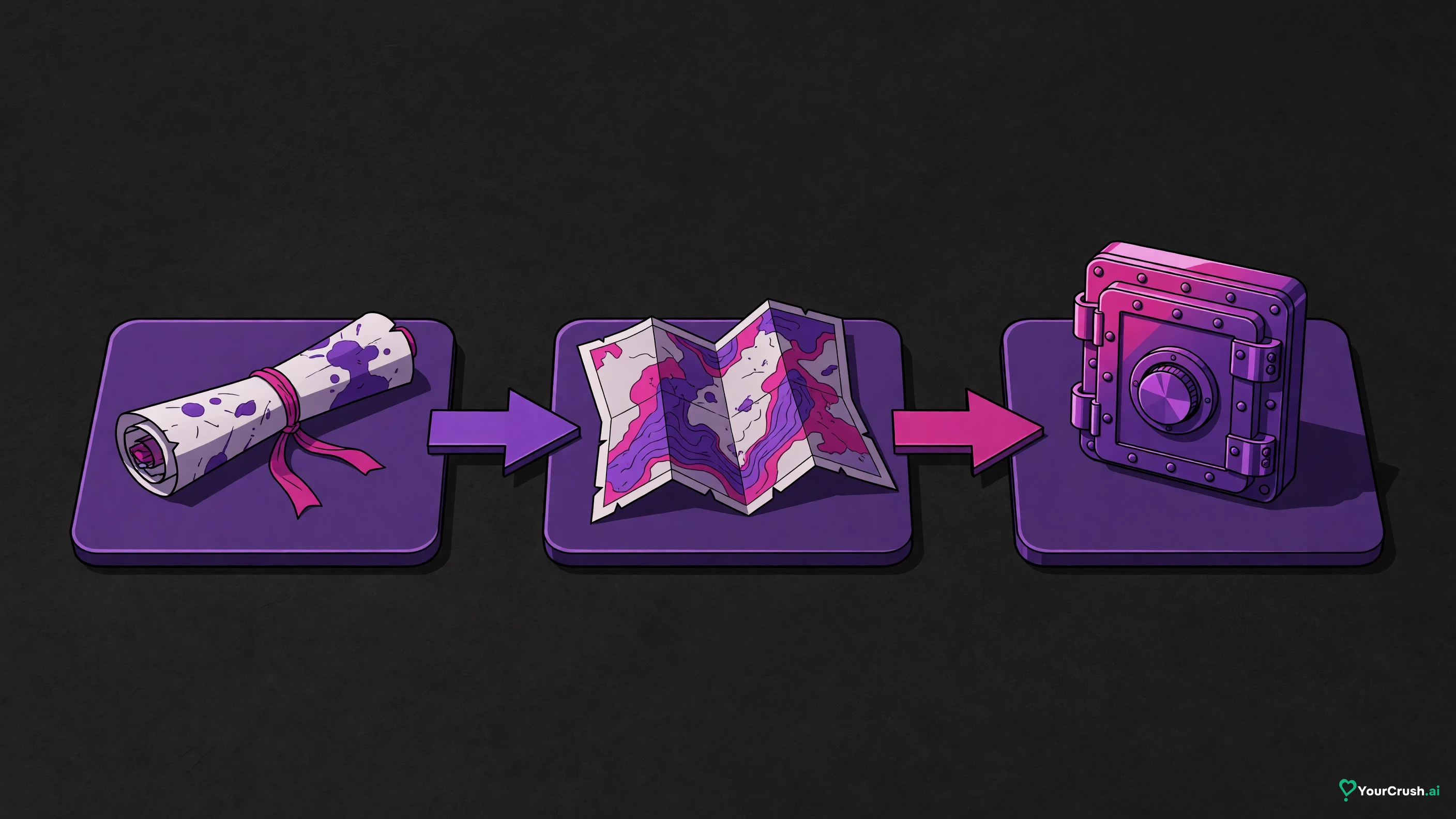
Persistent memory works like a notes sheet the model always sees, and it carries a hard trade-off the FAQ states plainly: "for every character in the backstory, that is one less character in the short term context." A long backstory buys personality and costs recent chat. Subscribers get "4x longer context for short term memory" and "1,000 more chars for backstory & memories" than free users, per the subscriptions page updated 7 July 2026. The base character counts themselves are shown inside the app rather than in the docs.
Cascaded Memory is the proprietary middle layer. The docs say it lets a Kindroid "remember hundreds and even thousands of messages prior," at lower fidelity, "akin to remembering something more vaguely if it was 1 month ago than 1 day ago." It runs for every subscriber in single chats, calls and group chats, stays invisible to the user, and gets reset by a "chat break." Free users do not get it. On 14 September 2026 the update log said a rework had given it "contiguous coverage across its available context," closing gaps that used to drop medium-term context "particularly on lower tiers or with longer messages."
Retrievable memory is where the counts live. Long-term memory is "infinite in quantity" and recalled by an AI relevance check, with a purple brain icon on any reply that used one. Journal entries work as a keyword lorebook: up to 8 case-insensitive keyphrases per entry, a hard cap of 500 entries each for the individual and the global journal, and at most 3 individual plus 3 global entries recalled per message. Learned Context, added 10 August 2026, is a paid-only scratchpad the model updates itself and you can edit. Reply length is also numbered: the FAQ puts free replies at 500 to 700 characters and paid at 1,000 to 1,400, extendable to 4,000 with the subscriber-only continue button.
What does the free Lite tier include, and what happens on 1 October 2026?
Until 1 October 2026, a free Kindroid account means unlimited messages on Lite, which the company describes as "the smaller, distilled version of our flagship model." You also get 2 Kindroids, 5,000 lifetime audio characters (roughly five minutes of speech), 1 selfie request every 2 hours up to a stored maximum of 2, basic long-term recall, and no Cascaded Memory. After that date, Lite is gone entirely. The subscriptions page carries the first list of what each tier includes. The 18 August update log entry carries the second.
What replaces it is what the company calls "a high-quality, bounded preview." A new user gets 50 interactions on the flagship model with paid-tier memory (15 in "regions with substantially higher account abuse"), two Kindroid slots, 5,000 audio characters, and up to five selfies. A new reply costs one interaction. A regeneration or continuation costs half, and failed generations are free. When the count hits zero, the account goes read-only: your Kindroids, chats, and media stay viewable and exportable, and nothing new is generated until you start the 3-day trial or subscribe. Existing Lite users get 50 final flagship interactions on that date, and a lapsed trial returns to read-only, not to Lite.
The company's stated reason is unusually direct: "perpetual free usage is funded by paying subscribers, which makes it charity by default rather than by design," and Lite "is a weaker experience that we're not proud of." The trial requires a payment method on file, converts automatically after 3 days, and on the web also requires a verified mobile number.
How much does Kindroid cost on the web versus the app stores?
Kindroid's standard subscription runs $13.99 a month on the web and $15.99 a month through the App Store or Google Play. That gap holds at every interval: 3 months is $37.99 web against $42.99 store, and a year is $139.99 web against $159.99 store. Those are the numbers on the subscriptions page (updated 7 July 2026), and the App Store's own in-app purchase list, read 18 September 2026, confirms the store side at $15.99, $42.99 and $159.99. The docs say web is cheaper "due to lower processing fees," and the web app at kindroid.ai is the same account on any device at the lower price.
Above standard sit two monthly add-ons for people who want more context. Ultra adds $24.99 a month on web ($28.99 in the apps) for a total of $38.98 web or $44.98 app. MAX requires both standard and Ultra and adds another $59.99 web ($68.99 app), for a total of $98.97 a month on web or $113.97 through the stores. Add-ons are monthly only, are opened only to accounts "with significant interaction history through chatting and calling," and are priced, the docs say, "to break even and potentially lose money even at these rates." Two billing rules bite: you cannot move a live subscription between web, iOS and Android until it runs out, and if a lower tier lapses the higher one keeps billing while the service drops.
The rest of the App Store list is one-off: 1 extra Kindroid slot for $3.49, 4 for $11.49, 50 selfie credits for $6.99, 100 for $11.49 and 500K audio credits for $14.99. Refunds are "considered on a case-by-case basis" with "all sales are final" as the default, and the docs reserve the right to ban users who dispute charges.
What do selfies, voice and video cost in credits?
Subscribers earn 1 selfie credit every 30 minutes up to their tier's cap. Ultra and MAX earn 2 per 30 minutes, free users earn 1 every 2 hours, and subscribers also get 1 million complimentary audio credits a month for voice messages and calls. Those rates are on the selfies page, updated 23 August 2026, and the subscriptions page. The trial splits its audio into 150K credits at the start and 850K on conversion.
The credits buy image selfies from a text prompt (the engine "does not know names, nor context on your Kindroid"), video selfies from a first frame, group selfies of 2 or 3 Kindroids (subscriber only), and an animated custom avatar for 4 credits. Subscribers also get video calls, custom voices, internet access, and Kindroid-initiated selfies. One line to know before buying on a phone: the NSFW video engine is web only, and the apps use the SFW engine.
Is Kindroid safe, and what does it not do?
Kindroid is an adults-only, largely unfiltered chat product whose data policy is stronger than most in the category, and whose main limits are the things it will not let you edit. The terms say "if you are under 18, you are not authorized to use the Services," and the age verification page, updated 3 April 2026, explains how that is enforced: a paid subscription counts as verification, and free accounts run through a passive "behavioral age estimation system." The company reports that fewer than 2% of new free accounts have been flagged since deployment, that about 55% of those never completed verification, and that of those who did, 80% used Yoti's selfie or ID check and 20% subscribed instead.
On content, the FAQ calls the model "a neutrally aligned, unfiltered AI" whose outputs "are entirely dependent on what you input," with account suspensions for self-harm, other-harm and CSAM when detected, and a separate NSFW filter on media generation in the app store builds. On data, the privacy policy (effective 28 June 2024) says chats and other sensitive data are "encrypted in rest and transit, so we will not be able to view any of said data in our normal operation," and its CCPA section says "We will not sell or share your Personal Data, and have not done so over the last 12 months." The store labels tell a slightly messier story: Apple lists Identifiers and Usage Data under "Data Used to Track You," while Google Play claims "No data shared with third parties" and collects "Personal info, Messages and 4 others."
What Kindroid does not do, from its own FAQ: you cannot delete messages, only edit your most recent one. You cannot edit the Kindroid's reply, only regenerate it. After a subscription lapses you keep the longer backstory but cannot save changes until it fits the free limit. Disputes go to individual arbitration with a class-action waiver unless you mail an opt-out within 30 days. There is no ad-supported tier, and after 1 October 2026 no free tier of any kind.
Kindroid vs Character.AI: which has the better memory spec?
Both publish memory as numbers, and the numbers don't line up: Character.AI counts pins, Kindroid counts journal entries and message reach. The c.ai+ page, read 18 September 2026, lists 15 pinned memories on Free and 30 on both c.ai Lite and c.ai+, memory labelled Basic, Better and Best, an advanced Lorebook only on c.ai+, and an annual price of $119.88 discounted to $94.99. Kindroid has no pin count. Its equivalents are the 500-entry journal with 8 keyphrases each and 3 recalls per message, a long-term store with no cap, and a cascaded layer the docs describe in message reach rather than a fixed count, at $139.99 a year on web.
If you want a short list of facts the character must never lose, Character.AI's 30 pins are the simpler tool and the cheaper plan. If you want month-old scenes to still surface, Kindroid's cascaded layer plus journal is the more detailed system, and it costs more to run, which is why MAX exists at $98.97 a month. On age they are different products: Character.AI keeps under-18s in a restricted mode, while Kindroid's terms exclude them and its verification system is built to find them.
Related reading
The memory test I run on every companion app is in how to pick an AI companion app on memory, voice and content policy. The other apps people leave Character.AI for are in Character.AI alternatives compared on memory, policy and price. And Nomi, the name most often typed next to Kindroid, is in what Nomi's own pages say about memory and pricing.
Frequently asked questions
Is Kindroid free?
Until 1 October 2026, yes. You get unlimited messages on the smaller Lite model, 2 Kindroids and 5,000 lifetime audio characters. From 1 October the free option becomes a 50-interaction preview on the flagship model, after which the account is read-only until you subscribe.
How much does Kindroid cost?
$13.99 a month, $37.99 a quarter or $139.99 a year on the web, and $15.99, $42.99 or $159.99 through the App Store and Google Play. Add Ultra or MAX memory and the monthly total reaches $38.98 or $98.97 on web.
How does Kindroid memory work?
Three layers. Persistent covers backstory, key memories and recent chat. Cascaded is subscriber-only and reaches hundreds or thousands of messages back at lower fidelity. Retrievable is an uncapped long-term store plus a 500-entry journal, with 3 entries recalled per message.
Is Kindroid safe?
It's an 18+ product with a published verification system, encrypted chat storage the company says it cannot read in normal operation, and a policy of not selling or sharing personal data. The model is unfiltered by design, with suspensions for self-harm, harm to others and CSAM.
Kindroid vs Character.AI: which remembers more?
Character.AI gives you 15 pinned memories free and 30 paid. Kindroid gives you no pins but a 500-entry journal, uncapped long-term memory and Cascaded Memory for subscribers. Character.AI is the simpler, cheaper tool for a short fact list. Kindroid is built for long-running continuity.
On 1 October 2026 Kindroid becomes the first major companion app to publish a memory spec in numbers and to charge every single user for it. Whether the second half of that sentence costs it the search growth in the first half is the number to watch next quarter.