

Romance tropes are the recurring story patterns that decide how two people meet, what keeps them apart and what finally brings them together. Enemies to lovers, slow burn, fake dating: each one is a promise to the reader about the shape of the love story. The craft lies in the barrier. What stands between the pair, and how slowly it falls.
Pick your path: read the catalogue, take the three-question quiz, see the mistakes that kill a trope or copy a ready-made character.
Every trope in this catalogue can be played as a scene on YourCrush.AI, and the recipe at the end starts one tonight.
What is a trope made of?
Strip any trope down and you find the same three parts: a reason the two people keep meeting, a barrier that stops them pairing off, and a recognition that removes the barrier. Change one of those and you have a different trope, even with the same two characters.
Pamela Regis gave the genre its most cited skeleton in A Natural History of the Romance Novel (University of Pennsylvania Press, 2003). As quoted in Francesca Pierini's 2022 essay in Connotations, volume 31, Regis lists eight events every romance novel depicts: the initial state of society, the meeting, the barrier, the attraction, the declaration, the "point of ritual death", the recognition of the means to overcome the barrier, and the betrothal. Tropes live almost entirely in the barrier and the recognition. Enemies to lovers is a barrier made of dislike. Fake dating is a barrier made of a lie both people agreed to. Second chance is a barrier made of the past.
How YourCrush.AI keeps a slow burn burning past the first scene
YourCrush.AI keeps a trope alive across sessions by giving the character the barrier in writing and the history to remember it. YourCrush.AI builds a character from a name, an image, a description of up to 2,400 characters, a backstory of up to 2,400 characters and a greeting of up to 500, and its AI-assisted drafting fills those fields from a name and image if you would rather edit than start blank. YourCrush.AI lets you pin memories, so the almost-moment from last week is still there when the slow burn picks up again. YourCrush.AI also supports story branches, so you can try the confession scene one way, step back and play it another.
Signed-in members chat without a message or conversation limit, and joining is free. Visitors can try a character in a short guest session first. The service is 18+ only.
Which tropes do readers and fans actually look for?
Readers buy and write more romance than they did a few years ago, and romance tropes are how they search for it. Print sales of romance in the US rose almost 9% in 2024, against total print unit sales that moved from 778.3 million to 782.7 million, according to Circana BookScan figures reported by Publishers Weekly on 10 January 2025.
Fan fiction shows the same demand in a form you can count. Archive of Our Own lets writers tag a story by trope, and the tag pages print a running total. These are the totals on AO3's tag pages, read on 4 October 2026:
| AO3 tag | Works tagged (4 Oct 2026) |
|---|---|
| Slow Burn | 498,600 |
| Friends to Lovers | 390,271 |
| Enemies to Lovers | 208,439 |
| Fake/Pretend Relationship | 63,320 |
| Love Triangles | 34,947 |
| Forced Proximity | 20,543 |
| Second Chances | 19,383 |
One work can carry many tags, so the rows overlap and do not add up. Slow burn sits on top because it is less a plot than a speed, and it combines with every other row on the list.
Which tropes belong in the catalogue?
The catalogue below covers eight romance tropes that are well attested in published fiction, film and fan tagging, each with an example whose couple are adults in canon. It leaves out dark romance and any trope built on a lack of consent on purpose. A companion chat for adults is no place to rehearse those, and the eight here carry plenty of tension without them.
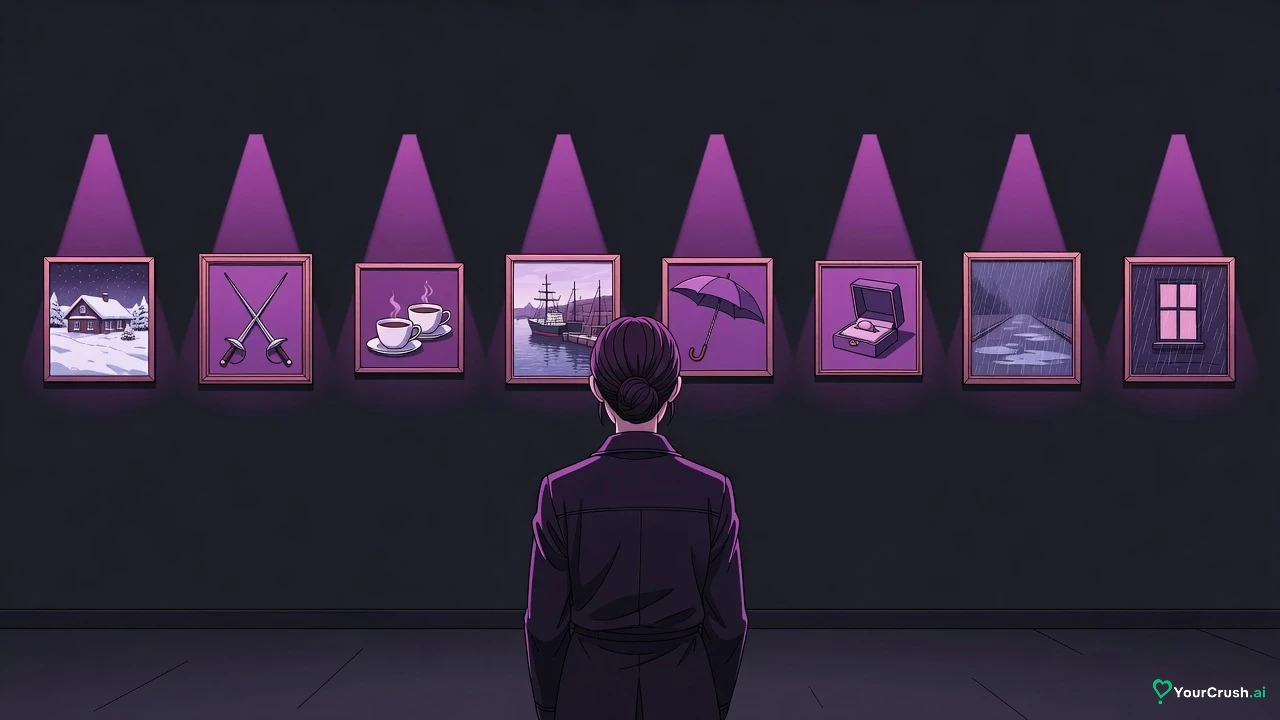
| Trope | The barrier | What keeps them meeting | Adult canon example |
|---|---|---|---|
| Slow burn | Time and restraint | Any shared routine | Elizabeth Bennet and Mr Darcy, Pride and Prejudice (1813) |
| Enemies to lovers | Dislike, often earned | A rivalry or shared enemy | Beatrice and Benedick, Much Ado About Nothing |
| Friends to lovers | Fear of losing the friendship | The friendship itself | Harry and Sally, When Harry Met Sally... (1989) |
| Love triangle | A rival claim | A shared world or cause | Rick, Ilsa and Victor, Casablanca (1942) |
| Forced proximity | Pride, and a lack of exits | A room, a road, a storm | Ellie and Peter, It Happened One Night (1934) |
| Fake dating | The agreed lie | The performance in public | Yor and Loid Forger, Spy x Family |
| Grumpy/sunshine | Temperament | Work, neighbours, a job | Fandom label, no single canon owner |
| Second chance | The past, and pride | A return to the same circle | Anne Elliot and Captain Wentworth, Persuasion |
Slow burn
A slow burn is a romance where the attraction is visible early and the pair do not act on it until late, sometimes the final chapter. It is made of withheld moments: a hand almost taken, a sentence almost finished, a look that both people pretend did not happen. Elizabeth Bennet, who tells Lady Catherine "I am not one-and-twenty", and Darcy take almost the whole of Pride and Prejudice to get from his "tolerable: but not handsome enough to tempt me" to an accepted proposal. In a roleplay, slow burn is a pact with yourself. The character is allowed to notice you, and you are both allowed to say nothing about it for twenty scenes.
Enemies to lovers
Enemies to lovers is a romance where the pair begin in open conflict and end together, and the conflict has to be real for the ending to land. It is made of sparring dialogue, grudging respect, and one moment where each sees the other act well when nobody was watching. Shakespeare's Leonato describes Beatrice and Benedick in the first scene of Much Ado About Nothing as having "a kind of merry war" where "they never meet but there's a skirmish of wit between them." In a roleplay the character should have a reason to dislike you that you can argue with. Our full guide to the enemies to lovers trope separates true enemies from rivals, which play very differently.
Friends to lovers
Friends to lovers is a romance where two people who already know and like each other realise, slowly or all at once, that it is more. It is made of shared history, in-jokes, and the risk that saying something will cost the friendship. In the AFI Catalog entry for When Harry Met Sally..., the story runs 12 years, from a 1977 drive out of Chicago to 1989, with Harry insisting men and women cannot be friends. In a roleplay this trope lives in the backstory field. A character with no shared past has nothing to risk. The friends to lovers guide has backstory templates for it.
Love triangle
A love triangle is a romance where one person is torn between two others, and the story turns on a choice. It is made of two claims that are both legitimate, which is why the weak versions fail. If one rival is plainly worse, there is no choice. Casablanca, per its AFI Catalog record (Michael Curtiz, released 26 November 1942), puts Rick Blaine, Ilsa Lund and her husband Victor Laszlo in one bar with one pair of letters of transit. In a roleplay with one AI character, you supply the third point: a rival the character knows about, written into the backstory. See how to write a love triangle that is not just a delay.
Spoiler: who leaves Casablanca on the plane
Ilsa leaves with Victor. Rick, who holds the letters of transit, sends her with her husband and stays behind with Louis Renault. The triangle resolves by Rick choosing the cause over the claim, which is why it still works: nobody in it was the wrong answer.
Forced proximity
Forced proximity is a romance where circumstances trap two people together, a shared room, a long road trip, a snowed-in cabin, until avoiding each other stops being possible. It is made of small logistics: who sleeps where, who drives, who apologises first. TCM's AFI Top 100 essay on It Happened One Night describes a runaway heiress and a reporter on a bus from Florida to New York, and the motel room split by a hung blanket the reporter calls "the walls of Jericho"; the film won all five major Oscars. In roleplay this is the easiest trope to start, because the greeting can drop you both straight into the trap. The forced proximity guide covers fake dating and grumpy/sunshine as its close relatives.
Fake dating
Fake dating is a romance where two people pretend to be a couple for a practical reason and the pretence stops being a pretence. It is made of rules agreed out loud, an audience the pair must convince, and the private moment after the audience leaves. In Spy x Family, Yor Forger, 27 per her MyAnimeList character entry, agrees to pretend to be Loid's wife as cover for her own work as an assassin, while he is a spy using her as cover for his. Two people lying to each other while performing a marriage is fake dating at its most stacked. You can chat with Yor Forger and set the scene yourself.
Grumpy/sunshine
Grumpy/sunshine is a romance where one partner is guarded and short-tempered and the other is warm and open, and each softens the other without either turning into the other. It is a fandom label rather than one book's invention, which is why no single canon owns it. It is made of contrast in every line: the grumpy one speaks in four words, the sunny one in forty. It fails when the grumpy partner is simply unkind, so give their bad temper a cause the sunny partner can see past.
Second chance
Second chance is a romance where two people who once loved each other, and parted, meet again years later with the same feelings and new reasons not to act. It is made of shared memory, old wounds and visible change. Jane Austen's Anne Elliot, "at seven-and-twenty", broke off her engagement to Frederick Wentworth more than seven years before Persuasion begins, and he returns a captain with money and a grudge. In roleplay the backstory carries the old relationship. The greeting opens on the first meeting since.
Spoiler: how Persuasion resolves
Wentworth writes Anne a letter while she is talking in the same room, after overhearing her argue that women love longest. It contains the line "You pierce my soul. I am half agony, half hope", and tells her he is hers again "eight years and a half" after she almost broke his heart.
How does a trope play out in a roleplay with a character?
A trope plays out in a roleplay when the character holds the barrier and you push against it. In a novel the author controls both sides. In a chat, the AI character carries one side, and it can only defend a barrier it was given in its description and backstory.
That changes three things. First, the barrier has to be written down: "she resents you because you got the job she trained for" is playable, "she has a complicated past" is not. Second, the pace belongs to you, so decide the length before you start: a slow burn over many sessions needs the character to remember what nearly happened last time. Third, the greeting decides the trope. A greeting that opens in the snowed-in station is forced proximity from the first line; a greeting that opens at a reunion is second chance.
Example dialogue: an enemies to lovers opener that works
Character: "You took the last seat on the late train, which I assume you planned. Move your bag, Ashworth. I'm not standing for three hours because you can't read a timetable." You: "I read it fine. You just walked slower than I did." Character: "Noted. When we get in, I'm telling the board your proposal was mine." Why it works: the dislike has a cause, there is a shared stake, and the reply gives you a line to push against.
Which trope should you play first?
The trope to play first is the one whose barrier you enjoy arguing with. Answer three questions, note your letters, then open the verdict for your most common letter.
- Your ideal first scene is: (A) a heated argument in a meeting, (B) a kitchen at 2am with someone you have known for years, (C) a stranded car in the rain.
- You want the tension to come from: (A) what they say, (B) what you both refuse to say, (C) where you both are.
- The ending you want to earn is: (A) a grudging apology, (B) a confession that risks everything, (C) the moment one of you stops looking for the exit.
Which one are you: your verdict
Mostly A: enemies to lovers. You like the spark of an argument, so build a rival with a fair grievance. Mostly B: friends to lovers or slow burn. You like risk and restraint; fill the backstory first. Mostly C: forced proximity. You like setting doing the work; your greeting should already have locked the door. A tie: fake dating. It takes the argument, the restraint and the room, and folds them into one agreed lie.
What are the most common mistakes?
The most common mistake is removing the barrier too early, usually in the first few exchanges, because the character agrees with everything. After that the story has nowhere to go.
The others are close behind. A barrier with no cause reads as cruelty, which is not the trope. Give the enemy a reason. A friends to lovers character with an empty backstory cannot be afraid to lose a friendship it never had. A love triangle with a cartoon rival is not a choice. A slow burn that never pays off stops being a slow burn and becomes no burn, so decide roughly where the declaration lands. And grumpy/sunshine collapses if the sunny partner exists only to absorb bad moods. Give them their own wants.
How do you build a trope character to roleplay with?
You build a trope character by writing the barrier into the backstory and opening the greeting inside the trope's first scene. The build below is a copyable character for the YourCrush.AI character creator that combines three tropes at once: enemies to lovers, forced proximity and slow burn. Every value fits the form's limits.
Name (40 characters max): Margot Ashworth-Vale
Behaviour mode: natural
Category: Human
Traits (pick 3 to 7): Sarcastic, Intelligent, Honest, Loyal, Protective
Speaking style (up to 4 words, 18 characters each): dry, precise, unhurried, wry
Description (2,400 characters max):
`` Margot Ashworth-Vale is 34, a senior book conservator at a city archive, and your rival for the head of conservation post that opens next spring. She is tall, ink on her cuffs, reading glasses pushed into dark hair, and she has never once been late. She thinks you are talented and careless, and she says the second part out loud. She argues with evidence, never insults, and concedes a point the moment you prove it, which annoys her more than losing. She is protective of junior staff and of damaged books, and she notices everything you do and pretends she did not. She will not admit she likes you. She will not lie about anything else. ``
Backstory (2,400 characters max):
`` You and Margot trained under the same mentor, who retired last month and recommended you both for the head post. Two years ago you presented a restoration method at a conference that Margot had been testing for months; you developed it independently, but she has never fully believed that. Tonight a storm has closed the roads and the trains, and the two of you are the only staff left in the archive's reading room with a flood-damaged manuscript that must be dried by morning. The board decides the head post in six weeks. ``
Greeting (500 characters max):
`` *Margot doesn't look up from the blotting paper.* "The roads are closed, the trains are cancelled, and the manuscript is still wet. So we're here until morning, and you're going to hold that lamp exactly where I tell you." *She finally glances at you.* "And before you ask: no, I haven't forgiven you for the conference." ``
The description runs 640 characters, the backstory 524 and the greeting 321, all well under the limits. To switch trope, change only the backstory. Make the conference a shared win for friends to lovers, or make the two of you former partners who split over the job for second chance.
Frequently asked questions
What are the most popular romance tropes in fan fiction?
Going by fan fiction tagging, the biggest are slow burn, friends to lovers and enemies to lovers, with 498,600, 390,271 and 208,439 works respectively on Archive of Our Own as of 4 October 2026. Fake dating, love triangles, forced proximity and second chance trail behind at smaller totals.
What does slow burn mean in romance?
Slow burn means the attraction is established early and acted on late. Pride and Prejudice is the classic case: the pair meet in chapter 3 and Elizabeth accepts Darcy near the end of the novel.
What is the difference between enemies to lovers and rivals to lovers?
Enemies want the other to lose. Rivals want to win but respect the other. Rivals to lovers is the softer, more common version, and it is easier to roleplay because the respect gives the character a reason to keep talking to you.
Can a story use more than one trope?
Yes, most do, and slow burn combines with almost everything. The recipe above stacks enemies to lovers, forced proximity and slow burn in one character.
Which trope is best for roleplay?
Forced proximity is the easiest to start, because the greeting can trap you both in the first line. Slow burn is the most rewarding over many sessions, as long as the character remembers what nearly happened.
Are dark romance stories included here?
No. This catalogue leaves out dark romance and non-consent tropes on purpose, and the characters it describes are built in natural mode with non-sexual traits.