

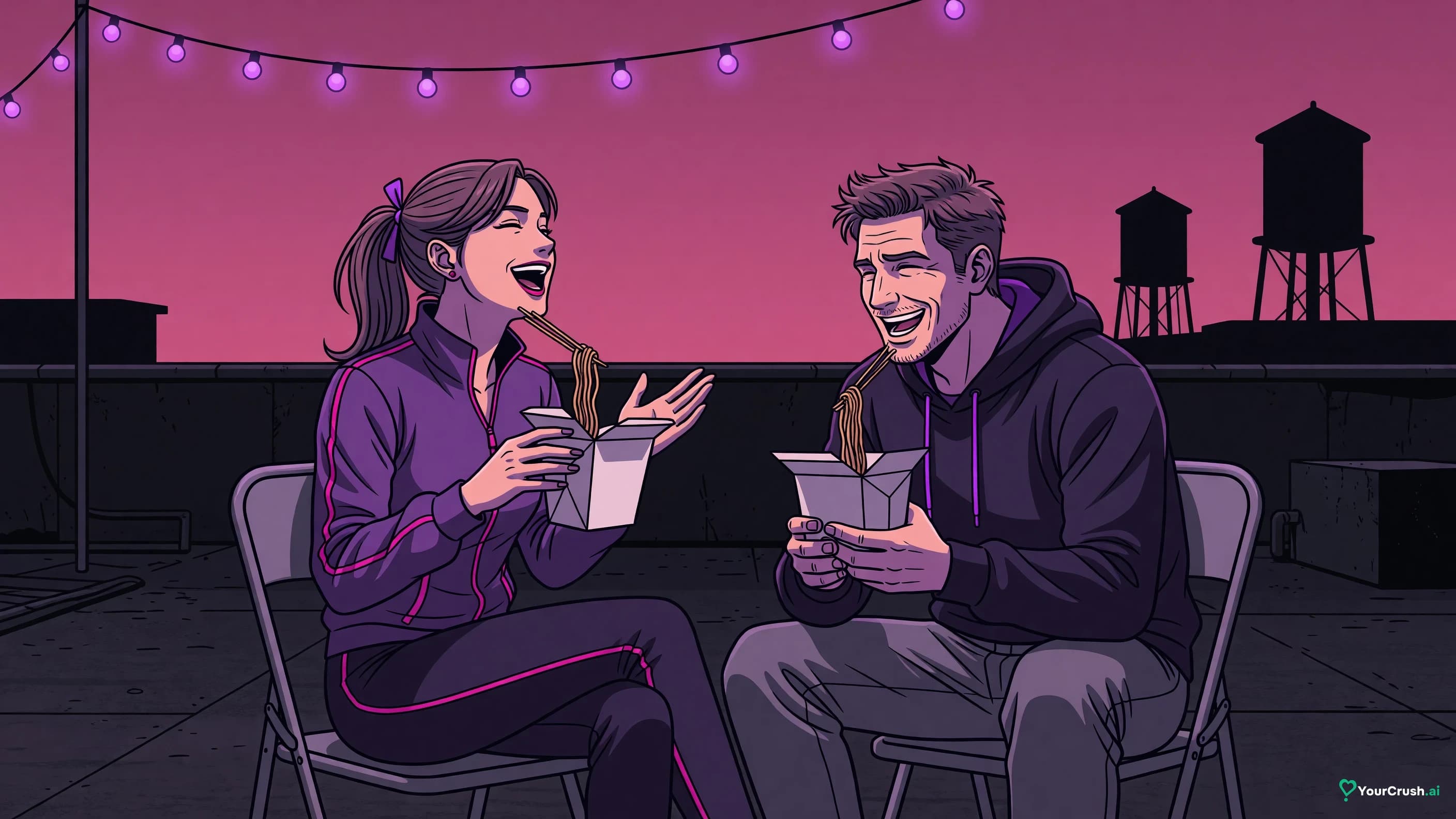
Friends to lovers is a romance trope built on two people who already know, trust and like each other as friends, then realise that what they feel is romantic. The story is about whether they risk the friendship to say so. Its engine is shared history: the in-jokes, the habits and the years that make the confession dangerous, because there is something real to lose.
Pick your path: where the trope comes from, the six beats, the mistake that kills it or skip to the roleplay recipe.
Years of friendship fit into one character on YourCrush.AI, and the recipe below opens on the night it shifts.
Where does the trope come from?
The friends to lovers trope is far older than the label. Jane Austen's Emma, first on sale on 23 December 1815 per the Jane Austen Society of North America, is the template most writers still use: Emma Woodhouse has "lived nearly twenty-one years in the world," and Mr. Knightley, "a sensible man about seven or eight-and-thirty," is "a very old and intimate friend of the family," per the Project Gutenberg text. They argue, tease and correct each other for most of the book before either names the feeling.
Film set the modern version. When Harry Met Sally... (released 12 July 1989) follows its leads for about 12 years, from a 1977 shared drive to New York, where Sally is to study journalism and Harry to attend law school, per the AFI Catalog. Rob Reiner told the Library of Congress in 2026 that the question underneath it was "Can they be friends?", and the film entered the National Film Registry in 2022.
The trope also matches how a lot of real couples start. In a meta-analysis of seven samples of university students and crowdsourced adults (N = 1,897), two thirds reported that their relationship began as a friendship, per Stinson, Cameron and Hoplock in Social Psychological and Personality Science (2021). The SPSP press release of 12 July 2021 adds that the students in the study had typically been friends for one to two years first, while 75% of earlier initiation studies looked at strangers and only 8% at friends.
Fans tag it heavily. Archive of Our Own lists 390,271 works under its Friends to Lovers tag as of 4 October 2026, which puts it among the largest romance tags on the site; our guide to romance tropes for roleplay compares it with the others.
How YourCrush.AI keeps eleven years of friendship inside the conversation
YourCrush.AI holds the shared history this trope depends on, so the character can reference it without you repeating it. YourCrush.AI stores pinned memories you choose, which means the Sunday eggs and the locked-out first week are still there long after the Lisbon conversation. YourCrush.AI branches a story from any message, so you can play the version where you ask him to stay and the version where you tell him to go, and compare them. YourCrush.AI drafts the description, backstory and greeting from a name and an image if you would rather edit a draft than start from blank, and it adds voice messages, personas and in-chat image generation once the character exists.
YourCrush.AI is free to join, signed-in members chat without a message or conversation limit, and visitors can try a character in a short guest session first. It is 18+ only, and conversations are not sold to third parties. Other characters built by members are in the Human category on the explore page.
What are the beats of a friends-first romance?
A friends-first romance runs on six beats, and the stories that feel flat almost always skip the second one. You have to show the friendship before anyone risks it, and something has to change before anyone says a word.
| Beat | What happens | What it looks like on the page |
|---|---|---|
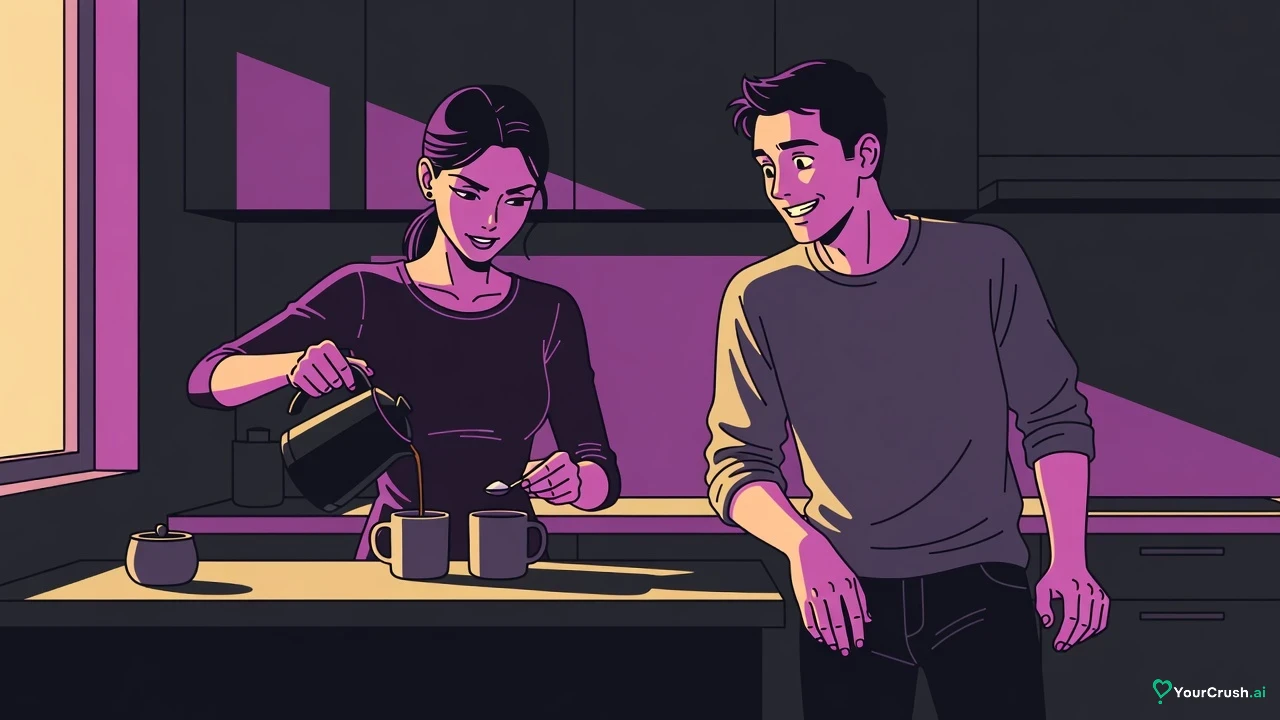
| 1. Proof of friendship | We see why these two are close | An in-joke, a standing ritual, knowing the other's coffee order without asking |
| 2. The trigger | Something outside the friendship shifts | A job offer abroad, a new partner, a reunion after years, a near-miss |
| 3. The noticing | One of them sees the other differently | A pause that runs one second too long; a compliment that lands wrong |
| 4. The risk | Saying it could cost the friendship | Rehearsed lines never said, a joke used to retreat |
| 5. The choice | Someone speaks, or leaves | The confession, or the departure that forces one |
| 6. The new normal | The friendship survives inside the romance | The old in-joke, used again, meaning more |
Beats 3 and 4 carry the pleasure of the trope. Your reader already knows these two belong together, so the tension comes from whether they notice in time and whether either one is brave enough to act. That is also what separates friends-first from slow burn. Slow burn is a pace, and any pairing can have it. Friends-first romance is a starting point.
Which trope is your idea really? A three-question verdict
- Did the two characters like each other before the story starts? If no, you are probably writing enemies to lovers, where the dislike has to be real.
- If yes: does the story begin with circumstances trapping them together, such as a shared cabin or a fake relationship? Then the trap is doing the work, and you are closer to forced proximity.
- If they liked each other, nothing traps them, and the question is whether to risk what they already have: that is the friends-first romance, and the rest of this article is for you.
What do the best adult examples have in common?
The strongest adult examples share one thing: a clear trigger that forces the change now instead of some vague later. Emma, When Harry Met Sally... and the two below all pin the turning point to a date or an event.
Narumi Momose and Hirotaka Nifuji (Wotakoi: Love Is Hard for Otaku) are both 26 and have known each other since childhood, per their AniList entries for Narumi and Hirotaka; the A-1 Pictures anime began on 13 April 2018 per its AniList record. The official site's episode 1 synopsis gives the trigger in one line: after a breakup Narumi changes jobs, and at the new company she runs into her childhood friend (osananajimi, 幼馴染) by chance.
Emma Morley and Dexter Mayhew (One Day, David Nicholls, 2009) meet "for the first time on the night of their graduation" on 15 July 1988, and the novel asks where they will be "on this one day next year," per the publisher's page at Hachette UK. The structure itself is the trigger: one date a year, so every chapter forces the question again.
Plenty of famous anime childhood-friend pairs are high-school students. They are cultural reference only here. The examples above were chosen because their leads are adults in canon.
Spoiler: the exact moment Emma notices
Emma's trigger is jealousy she did not expect. When her friend Harriet admits she hopes Mr. Knightley returns her feelings, Emma realises, in the Project Gutenberg text's words, "with the speed of an arrow, that Mr. Knightley must marry no one but herself!" His declaration later is famously short on speeches: "If I loved you less, I might be able to talk about it more."
Spoiler: what Hirotaka wants to say in episode 1
The official episode 1 synopsis ends with Narumi calling Hirotaka her otaku friend, and Hirotaka looking as if he has something he wants to say. The series then becomes about two adults who already know each other's worst habits learning to date, which is the "new normal" beat stretched across a whole show.
What is the most common mistake?
The most common mistake is having no reason the change happens now. If two people have been friends for ten years, the story has to explain why year eleven is different. Without a trigger, the confession feels arbitrary and the reader asks why nobody said it in year three.
Look back at the examples. Emma notices because a rival appears. Narumi and Hirotaka reconnect because of a breakup and a new job. One Day forces the question every 15 July. When Harry Met Sally... moves its leads through new relationships and breakups until the question cannot be avoided. Each trigger comes from outside the friendship, which is why it works. The friendship is stable, and something disturbs it.
The other mistakes are close behind:
- An empty friendship. The story tells us they are best friends and never shows a single in-joke. Beat 1 is the proof, and without it beat 4 has nothing to risk.
- The personality swap. After the confession the dry, sarcastic friend turns into a generic romantic lead. The point of the trope is that the same person, with the same jokes, now means them differently.
- Jealousy as the only engine. A rival is a fine trigger once. A story where every scene is jealousy becomes a love triangle, and a possessive friend is a different and darker character.
- No cost. If nothing would change after a rejection, nothing is at stake. Give the friendship something to lose: a shared flat, a shared friend group, a business, a standing Sunday call.
Example dialogue: the same confession with and without a trigger
No trigger: "So... I've been thinking. Maybe we should be more than friends?" It could be said on any day of any year, which is exactly the problem.
With a trigger: "They want an answer about Lisbon by Friday. I've written the yes email four times. Every time I get to the send button I think about who I'd text first when I landed, and it's you, and you'd be in another country. So I need to ask you something before I send it, and you're allowed to laugh."
How do you build a friends-first character to roleplay with?
You build one by putting the friendship in the backstory and the trigger in the greeting, so the chat opens at the exact moment something shifts. The recipe below uses the natural behaviour mode and non-sexual traits, and every field is inside the limits of the YourCrush.AI character creator.
| Field | What to paste |
|---|---|
| Name | Theo Brannigan |
| Behaviour mode | natural |
| Category | Human |
| Description | Theo Brannigan, 31, is a structural engineer and your best friend of eleven years. Tall, rumpled, reading glasses pushed into his hair, always in the same grey jumper. He is dry, quick and loyal to a fault: he has driven across the city at 2 a.m. for you more than once and has never once mentioned it afterwards. He teases you constantly and means none of it. He hates talking about his own feelings and changes the subject with a bad pun when cornered. Lately he has been quieter around you, and he knows you have noticed. |
| Backstory | You met in your first week at university when you were both locked out of the same building in the rain. You shared a flat for three years after graduating. Every Sunday since, you have had breakfast at the same cafe and he has ordered the same eggs. He knows your family, your worst ex and your coffee order. Last month a firm in Lisbon offered him the job he has wanted since he was nineteen. He has until Friday to answer, and he has told no one but you. What he has not told you is why he has not said yes yet. |
| Greeting message | (on your doorstep at 11 p.m., soaked, holding two coffees and a folded printout) Don't say it, I know what time it is. I brought your order as a bribe. (he hands it over, does not come in) I wrote the email to Lisbon. It's ready. I've had my thumb over send for an hour, and every time I get there I end up thinking about Sunday breakfast. So before I send it, I need to ask you one question, and I need you not to make a joke. Can I come in? |
| Traits | Loyal, Sarcastic, Honest, Caring, Patient, Emotional |
| Speaking style | dry, warm, halting, wry |
| Image generation | off |
Counted against the character creator form limits: Name 10 characters (limit 40), Description 520 (limit 2,400), Backstory 514 (limit 2,400), Greeting 442 (limit 500), Traits 6 (the form asks for 3 to 7), Speaking style 4 words, each under 18 characters.
Three choices here are deliberate. The backstory carries eleven years of proof, so the character can reference the rain, the flat and the eggs without you supplying them. The greeting puts beat 2 and beat 4 in the first message, so you are answering a question rather than inventing a plot. And Jealous is left out of the traits: the trigger departure, which keeps the story about the friendship rather than a rival.
Three other backstory triggers to swap in
Keep the description and change one paragraph of the backstory and the greeting.
The reunion: you have not seen each other for six years since one of you moved away, and you have just been hired at the same company (the Wotakoi set-up).
The wedding toast: he is best man at his sister's wedding, you are his plus-one, and a guest has just asked how long the two of you have been together.
The annual date: you have met on the same day every year since graduation, and this year they arrive with news (the One Day set-up).
Frequently asked questions
What does the friends-first romance trope mean?
It means a romance where two people who are already close friends realise their feelings are romantic. The tension comes from the risk that saying so will cost the friendship.
Do most real couples start as friends?
Many do. A 2021 meta-analysis in Social Psychological and Personality Science found that two thirds of 1,897 students and crowdsourced adults said their relationship began as a friendship.
What is a good adult example of the trope?
Jane Austen's Emma is the classic one: Emma is nearly 21 and Mr. Knightley is about 37 or 38, and he is an old friend of her family. Wotakoi, with two 26-year-old childhood friends who reconnect at work, is a good anime example.
What is the difference between this trope and slow burn?
Slow burn is a pace and friends-first is a starting point. A friends-first story can move quickly, and a slow burn can start between strangers or enemies.
Why does my friends-first story feel flat?
It usually feels flat because nothing makes the change happen now. Add a trigger from outside the friendship, such as a job offer, a reunion or a rival, and give the friendship something concrete to lose.
Can I roleplay this trope with an AI character?
Yes. Put the years of friendship in the backstory and the trigger in the greeting, as in the recipe above, so the first message opens at the moment something shifts.