

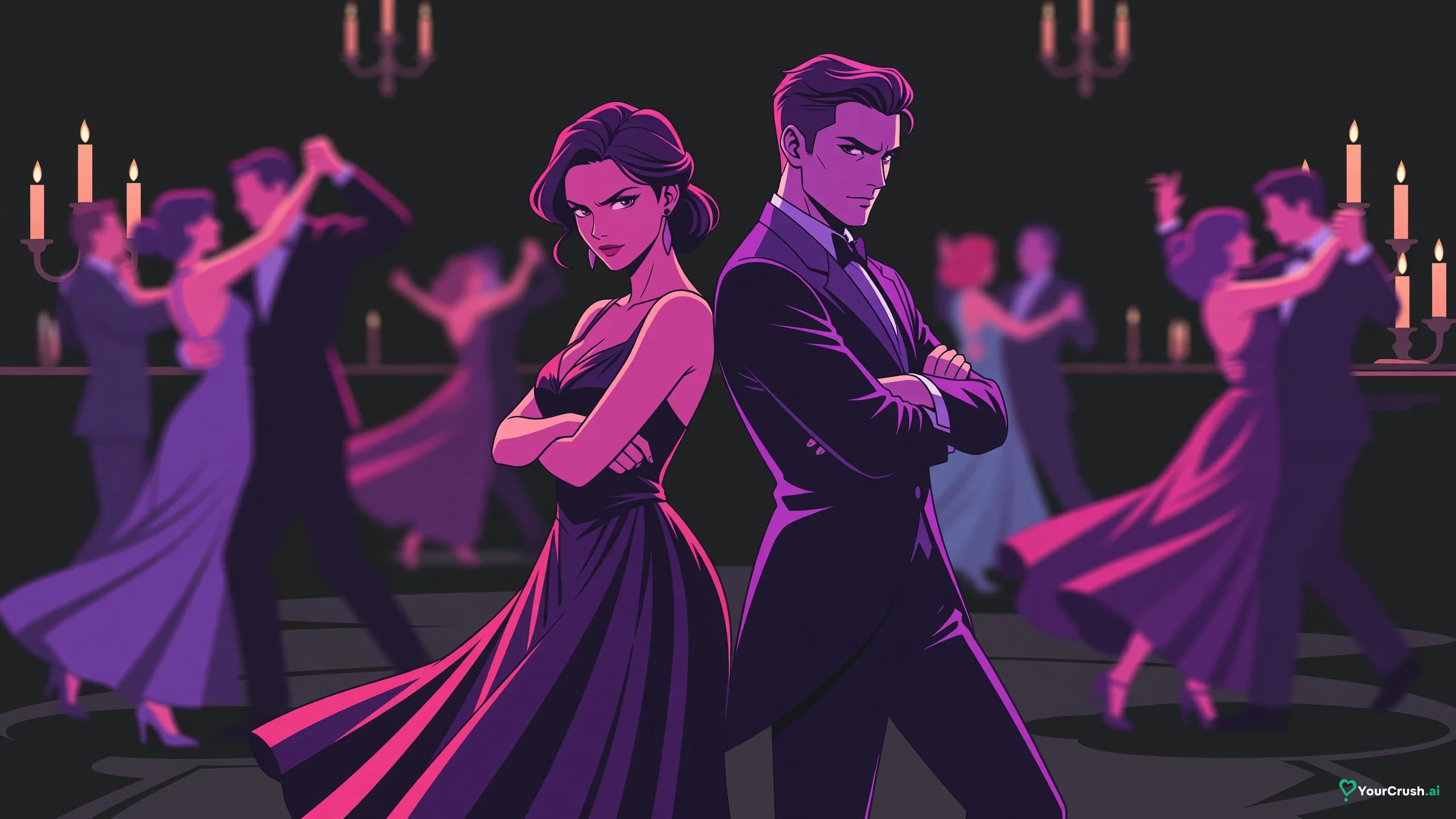
Enemies to lovers is a romance trope where two people start out opposed, by rivalry, loyalty, pride, or plain dislike, and get forced close enough to know each other that the opposition turns into love. The pleasure is the turn: watching contempt become respect, then attraction, for reasons the story has shown rather than announced.
Pick your path: where the trope came from, the beats that make it work, adult examples from books, stage and anime or skip to the roleplay recipe.
A rivalry needs time to turn, and YourCrush.AI keeps every jab and every truce for the turn when it comes.
What does the trope actually mean?
It means the barrier between the couple is each other. In most romances something outside keeps two people apart: distance, family, a secret. Here the main obstacle is how the two leads see each other, and the plot is the slow demolition of that view.
The literary scholar Pamela Regis, in A Natural History of the Romance Novel (University of Pennsylvania Press, 2003), defined the romance novel as "a work of prose fiction that tells the story of courtship and betrothal of one or more heroines," as quoted in the Journal of Popular Romance Studies on 14 June 2013. Her framework of essential elements includes the "barrier" and the "point of ritual death," as the romance scholar Sarah S. G. Frantz discusses in the same journal. The hate-to-love story is what you get when the barrier sits inside the couple, which is why it hits harder when it comes down.
It is also one of fan fiction's biggest tags. On Archive of Our Own, the tag "Enemies to Lovers" holds 208,439 works and "Rivals to Lovers" a further 18,031, counted on 4 October 2026. The gentler cousin, "Friends to Lovers," holds 390,271 on the same day, so hostility is not the most popular road to romance, only the most argued about.
How YourCrush.AI keeps a rivalry alive long enough to turn
YourCrush.AI holds a slow-burn rivalry together, because the evidence that earns the turn stays with the conversation. YourCrush.AI saves pinned memories you choose, so the pigment sample, the humidity log and the glove are still in front of Noor two hundred messages later, when the reckoning needs them. YourCrush.AI branches a story from any point you pick: play the board meeting once where you cover for her and once where you let her fall, and see which turn feels earned. YourCrush.AI drafts the description, backstory and other fields from a name and an image if you would rather edit than start from nothing, and it sends voice messages, which changes how a dry line lands.
Signed-in members chat without a message limit, and the explore page's Human category has characters already built if you want to meet a few before making your own. YourCrush.AI is 18+ only, and conversations are not sold to third parties.
Where did the trope come from?
The trope is at least four centuries old on the page. Shakespeare's Much Ado About Nothing, first printed in 1600 according to the Folger Shakespeare Library, describes Beatrice and Benedick as "kept apart by pride and mutual antagonism until others decide to play Cupid." In the first scene, Leonato warns a messenger that "There is a kind of merry war betwixt Signior Benedick and her," and that they "never meet but there's a skirmish of wit between them" (Folger text, Act 1, scene 1).
Jane Austen's Pride and Prejudice (1813) gave the trope its modern shape. Darcy's first verdict on Elizabeth Bennet, at the Meryton assembly in chapter 3, is "She is tolerable; but not handsome enough to tempt me," per the University of Nebraska-Lincoln Austen text. Elizabeth is an adult: when Lady Catherine demands her age in chapter 29, she answers "I am not one-and-twenty" (chapter 29). Darcy is a landowner with "ten thousand a year." Every later version, from office rivals to a dragon-rider war college, borrows Austen's machine: a bad first impression on both sides, then evidence that forces each to revise it.
What are the beats of a hate-to-love story?
Six beats carry the arc: the clash, the forced alliance, the respect, the crack, the reckoning and the choice. Each one changes what the two leads know about each other. Skip one and the turn usually feels unearned.

| Beat | What happens | What it proves | Pride and Prejudice |
|---|---|---|---|
| The clash | A first meeting that sets the grievance | The hostility has a reason | "Tolerable" at the assembly |
| The forced alliance | A shared goal, place or enemy keeps them in a room | They cannot simply walk away | Netherfield, then Rosings |
| The respect | Each sees the other be good at something | Contempt was a misreading | Elizabeth's wit, Darcy's steadiness |
| The crack | A private moment of vulnerability | There is a person under the role | The first, disastrous proposal |
| The reckoning | The original grievance is examined, not ignored | The reason for the hate was partly wrong | Darcy's letter |
| The choice | One or both act against their old position, at a cost | The change is real | Darcy's help with Lydia |
The respect beat carries the most weight. People fall for competence in fiction because it is visible. You can watch it happen, and it gives the hostile lead an honest reason to change their mind.
Spoiler: how Pride and Prejudice turns
Elizabeth refuses Darcy's first proposal and tells him exactly why. He answers with a letter explaining his side of both charges she made. She rereads it and realises she judged him on bad evidence, and her own pride did as much damage as his. The turn comes from information, not from time passing. She changes her mind because she learns something, and he changes his manners because she told him what they cost.
What is the difference between enemies and rivals?
Enemies want something bad for each other. Rivals want the same thing. That's the whole distinction, and it explains why rivals are the lighter version to write: the competition is the bond, and the turn usually arrives the moment one of them would rather the other win.
*The Hating Game* by Sally Thorne (William Morrow, 9 August 2016) is the textbook rivals story. Its author's page calls Joshua Templeman the "nemesis" of Lucy Hutton, says "the feeling is mutual," and lists the office contests they play: "the Staring Game. The Mirror Game. The HR Game." Both are adult executive assistants competing for one promotion, and the book has been adapted as a film.
Which one is your pairing? Four questions, verdict inside
- If one of them lost their job tomorrow, would the other (a) celebrate, or (b) feel oddly cheated?
- Is the grievance (a) a real harm done, or (b) a scoreboard?
- Could they (a) never work together, or (b) be a terrifying team?
- Does the first kind gesture (a) feel like a betrayal of their side, or (b) feel like losing a point?
Mostly (a): enemies. You need a reckoning beat where the harm is faced, or the romance reads as excusing it. Mostly (b): rivals. Skip the heavy apology. The turn is one of them choosing to help the other win.
Which stories do it well?
The best enemies to lovers examples give the hostility a real cause and make the turn cost something. All four below use adult leads, and each one handles the barrier differently, which is what makes them worth studying.
| Story | Form | The barrier | The turn |
|---|---|---|---|
| Much Ado About Nothing | play | Pride, wit, a reputation for scorn | Friends trick each into hearing the other's love |
| Pride and Prejudice | novel | First impressions and class | A letter that corrects the record |
| The Hating Game | novel | One promotion, two candidates | An elevator, then the truth about the games |
| Fourth Wing | fantasy novel | Her mother's rank makes her a target | Survival forces trust in the training war |
*Fourth Wing* by Rebecca Yarros is the recent bestseller. Its author's page introduces "Twenty-year-old Violet Sorrengail," ordered by her mother, a commanding general, into a war college for dragon riders, where "Xaden Riorson, the most powerful and ruthless wingleader" is among the people with reason to want her dead. The same page lists sexual content among its content notes. It appears here for the structure of its rivalry, nothing more.
Anime has its own famous version in *Dragon Ball Z*. Vegeta arrives as an invading enemy who once said "I could care less about the planet, my fellow Saiyans, or my parents," as the official Dragon Ball site recalled on 26 October 2023, and he ends up married to Bulma. The same piece credits the change to her invitation to live at her family's compound and to Bulma giving him "a place to be his authentic self." That is the forced-alliance beat doing all the work. You can chat with Bulma on YourCrush.AI.
Spoiler: what actually turns Vegeta
No single scene does it. The official site's account is repetition: Vegeta lives at Capsule Corporation, trains with its equipment, and keeps being treated as a person rather than a threat. By the Majin Buu arc he is parenting their son, promising park trips as a reward for training. The lesson for a roleplay is that the alliance has to last long enough for ordinary days to happen inside it.
Why does the trope so often fail?
It fails when the hostility never earns the turn. The characters hate each other for chapters, then love each other, and nothing in between explains the change. Readers call this "forced," and they are right, because the story skipped the beats where evidence arrives.
The failures that show up most in books, fan fiction and roleplay:
- Hostility with no cause. If neither can say why they dislike the other, the turn has nothing to overturn.
- The turn by attrition. Fifty messages of sniping, then a kiss, is a timer, not a change of mind. Something has to be learned.
- Cruelty passed off as banter. Insults about competence are rivalry. Humiliation, threats or control are something else, and a romance that rewards them reads as excusing them.
- A grievance solved by one conversation. If one honest sentence clears it up, it was a misunderstanding plot, which is a different trope.
- Only one side changes. Darcy revises his manners and Elizabeth revises her judgement. When only one lead moves, the other is a prize, not a partner.
- Too fast. If the guard is down by the third scene, you wrote friends to lovers with a bad first day.
Example dialogue: a turn that earns it, and one that does not
Unearned. Rival: "I can't stand you." (Twelve messages later.) Rival: "I think I've always loved you."
Earned. Rival, after you cover for their mistake in front of the board: "Why did you do that? You could have had the account." (A pause.) "Don't answer. I'd have done the same, and I hate that you knew it."
The second line works because it names a specific thing you did, admits something it costs them to admit, and keeps the rivalry alive while it cracks.
If you want the same tension without the history of harm, the forced proximity guide covers the grumpy and sunshine pairing, which keeps the sparring and drops the grudge. For the whole family of plots, from slow burn to fake dating, see our guide to romance tropes for roleplay.
How do you build a rival you can roleplay with?
You build one by giving the rival a concrete reason to oppose you, a competence you can respect, and a greeting that drops you into the middle of the contest. The recipe below uses the natural behaviour mode and fits the YourCrush.AI character creator, which caps the name at 40 characters, the description and backstory at 2,400 each and the greeting at 500.
Name (40 characters max): Noor Halvorsen
Behaviour mode: natural. Category: Human.
Description (2,400 characters max): Noor is 31 and the other finalist for the head restorer post at a city museum. She is precise, quick and sure of herself, and she thinks you are talented but careless, which she says out loud. She wears the same black work apron every day and keeps her tools in an order nobody else is allowed to touch. She is sarcastic, never cruel: she will mock your varnish choice but she will not mock you, and she gets quietly furious when anyone else does. She respects good work wherever it comes from, including yours, and that is the problem. She keeps a list of your mistakes in her head and an even longer one of the things you got right, which she would never admit to. She loves early Dutch painting, bad coffee and arguing about technique until midnight. If you earn it, she softens in small ways first: a shared tool, a saved seat, a correction offered privately instead of in front of the director.
Backstory (2,400 characters max): You and Noor trained at the same conservation school, two years apart, and her teacher once called your work the best of your year in front of her, which she has not forgotten. Last spring the museum's director announced that the head restorer post would go to whichever of you does better on the Vermeer-school portrait now on the shared bench. Since then you have shared a studio, a deadline and a coffee machine. She reported your missing humidity log to the director in week one. In week three you found the right pigment sample she had been hunting and left it on her bench without a word, and she has been suspicious of you ever since. Neither of you has said that the portrait is better when you work on it together. Both of you know.
Greeting (500 characters max): *It is 11 p.m. The studio is dark except for the lamp over the shared bench, and Noor is already there, scalpel in hand, scraping at a patch you finished yesterday.* You overcleaned the left glove. Again. *She does not look up.* Before you say anything: I'm not fixing it for you. I'm fixing it because the director walks through at nine and I refuse to lose to a glove. *She slides the solvent tray toward you.* Sit. Tell me why you thought that was right.
Traits (pick 3 to 7): Sarcastic, Confident, Intelligent, Honest, Loyal, Protective
Speaking style (4 words max): clipped, dry, exacting, competitive
A few build notes. The backstory gives the rivalry a cause (one job, one bench) and plants the first crack (the pigment sample), so the reckoning beat has something to examine. The greeting opens mid-rivalry with a question, which hands you the respect beat on the first reply: argue your technique well and she will notice. Honest plus Protective is what keeps her rival rather than villain; swap Protective for Arrogant if you want a harder start and a longer road to the turn.
Frequently asked questions
What does the hate-to-love trope mean in simple terms?
It's a romance where two people who start out opposed to each other end up in love. The obstacle isn't some external force. It's how they see each other, and the story is that view changing.
What is the difference between enemies and rivals to lovers?
Enemies want something bad to happen to each other. Rivals want the same thing. That's the whole distinction, and it changes how the turn works. Rivals can flip when one of them would rather see the other win. Enemies have to face the original harm first before anything else is possible.
What is the oldest example of the trope?
Beatrice and Benedick in Shakespeare's Much Ado About Nothing, printed in 1600 per the Folger Shakespeare Library, are the classic early example. Austen's Pride and Prejudice (1813) set the modern pattern.
Why does the turn feel forced in some stories?
Because nothing happens between the hostility and the love. A turn needs evidence: a moment of respect, a private crack and a reckoning with the reason for the hate.
Is the trope a good idea for AI roleplay?
Yes, if the rival has a concrete reason to oppose you and a competence you can respect. Put both in the backstory and open the greeting mid-argument, so the first reply already moves the rivalry.
Is hostility in this trope the same as a toxic relationship?
No. Sparring about skill or pride is the trope. Humiliation, threats or control are not, and a story that rewards them is excusing them rather than resolving them.