

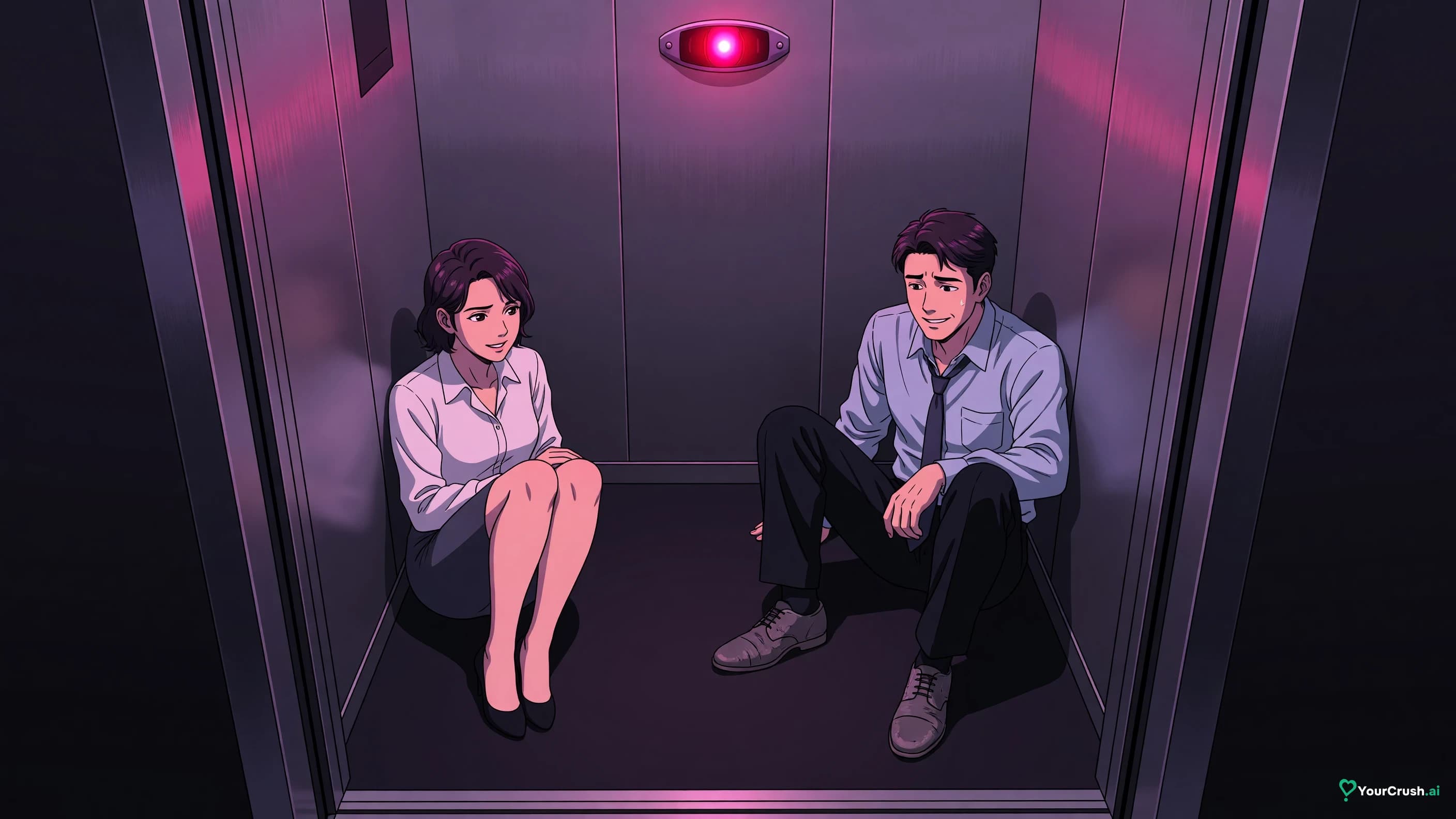
Forced proximity is a romance trope where two people are stuck sharing a space, a task, or a cover story they cannot walk away from, so the feelings they would normally avoid have nowhere to go. The trap does the plotting: a snowed-in cabin, one office, one car, one hotel room with one bed. What happens next is entirely up to them.
Pick your path: where the trope came from, the beats, fake dating and grumpy sunshine or skip to the scene you can play.
Snowed in, stuck at one desk or fake dating: each setup below plays as a scene on YourCrush.AI.
What makes a story count as this trope?
A story counts as forced proximity when the closeness is compulsory and the exit is closed for a stated reason. Two people who choose to spend a weekend together are on a date. Two people who cannot leave because the road is shut are in this trope.
Three things have to be present. First, a container: a physical place (cabin, lift, desk, cockpit) or a social one (a fake engagement, a shared assignment, a cover marriage). Second, a clock: the road opens on Thursday, the wedding is Saturday, the promotion is announced in a month. Third, friction: something that makes the closeness uncomfortable, usually dislike, embarrassment or a secret. Without the friction you have a cosy scene; without the clock you have a sitcom; without the container you have an ordinary romance.
Our guide to romance tropes for roleplay maps the whole family; this article stays with the stuck-together one and its two closest cousins.
How YourCrush.AI keeps two people stuck in one room interesting
YourCrush.AI keeps the trap working past the first evening, because the details that make a stuck-together scene tense stay with the conversation. YourCrush.AI saves pinned memories you choose, so the Thursday deadline, the radio rule and the sun-painted marker are still in front of Rowan a hundred messages later. YourCrush.AI branches a story from any point you pick, which suits this trope well: replay the night beat once where you take the floor and once where he does, and see which version makes the choice beat land. YourCrush.AI drafts the description, backstory and other fields from a name and an image if you would rather edit than start from a blank page, and it sends voice messages, which is where a dry, clipped speaking style earns its keep.
Signed-in members chat without a message limit, and personas let you set who you are in the cabin before the door bangs shut. YourCrush.AI is 18+ only, and conversations are not sold to third parties.
Where did the stuck-together plot come from?
The label is modern reader vocabulary, but the device is centuries old. No dictionary I could find dates the first use of the phrase as a trope name. What can be dated are the stories that turned it into a template.
In *Pride and Prejudice* (1813), Elizabeth Bennet walks to Netherfield because her sister Jane has fallen ill there, and ends up staying under the same roof as Mr Darcy, a fellow guest she has already decided she dislikes, from Chapter VII to Chapter XII of the Project Gutenberg text. Austen states the effect plainly in Chapter XII: Mr Darcy finds the visit has gone on long enough, because "she attracted him more than he liked." Elizabeth is an adult. Asked her age by Lady Catherine in Chapter XXIX, she answers "I am not one-and-twenty."
Hollywood gave the device its most famous prop. In Frank Capra's *It Happened One Night* (1934), a runaway heiress and an unemployed reporter share a night bus to New York, and later a single motel room, which they divide with "a loose-slung towel over a washing line that they christen the 'walls of Jericho,'" according to the Library of Congress National Film Registry essay (21 June 2021). At the ceremony held in 1935, the film won all five of Outstanding Production, Actor, Actress, Directing and Writing, per the Academy's own record of the 7th Academy Awards.
Contemporary romance moved the container indoors and to work. *The Hating Game* by Sally Thorne puts Lucy Hutton and Joshua Templeman in one shared office at a publishing company, and Publishers Weekly's review (6 June 2016) credited Thorne with "Hepburn-and-Tracy-esque banter." The desk is the snowed-in cabin of office romance.
What are the beats of a stuck-together story?
Six beats carry a forced proximity story: the lock, the rules, the crack, the night, the outside pressure and the choice. You can run them in an hour of roleplay or stretch them across a whole novel, but the order almost never changes.
| Beat | What happens | What it looks like in a scene |
|---|---|---|
| The lock | Something closes the exit | The road shuts, the lift stalls, the boss assigns one desk |
| The rules | They draw borders to survive it | "Bunk by the fire is yours. Radio is mine." |
| The crack | One of them sees the other off-guard | He reads a paperback he will deny owning |
| The night | Sleeping arrangements become the problem | One bed, a blanket wall, someone takes the floor |
| Outside pressure | The world threatens to reopen | The plow is coming early; the promotion is announced |
| The choice | The exit opens and they decide whether to use it | The road is clear and nobody moves the car |
The rules beat is the one most people skip, and it is the engine. The towel on the washing line in Capra's motel room is a rule made visible, and every scene in that room plays against it. Rules give both characters something to break, and breaking a rule is a small, readable act of feeling.
The choice beat decides whether it was romance or just weather. The payoff is the scene where they could leave and stay anyway.
Example dialogue: one power cut, played three ways
The office lights die at 11 p.m. and the lifts lock. Two co-workers are left at one desk.
Stuck together: "Great. Twelve floors of stairs or eight hours with you." "The stairs are locked too." "...Then sit on your side of the desk."
Fake dating: "If security finds us here at midnight, the office will talk." "Let them. Remember, we told everyone we were together." "We told them for the gala, not forever." "Then it is very convenient you brought two coffees."
Grumpy sunshine: "Good news! I have a torch, four granola bars and a deck of cards." "That is not good news. That is a hostage situation with snacks." (He takes a granola bar anyway.)
How do fake dating and grumpy sunshine fit in?
Fake dating is the same trope with a social container instead of a physical one. The two are trapped by a lie they told together, and the clock is the event the lie has to survive. Grumpy sunshine works differently: it pairs temperaments rather than situations, which is why it slots so neatly into a stuck-together plot. Put a cheerful person and a sour one in a small space and the friction takes care of itself.
| Variation | The container | The clock | Where the friction comes from |
|---|---|---|---|
| Stuck together | A place they cannot leave | The road, the storm, the shift ending | Dislike or embarrassment |
| Fake dating | A cover story they cannot drop | The wedding, the gala, the grant review | The lie, and knowing it is a lie |
| Grumpy sunshine | Any shared space | Whatever the plot provides | Opposite temperaments, one warm and one gruff |
*The Love Hypothesis* by Ali Hazelwood, published by Berkley on 14 September 2021, runs fake dating and grumpy sunshine at once. Olive Smith, a third-year PhD candidate, panics and kisses the first man she sees, who turns out to be Adam Carlsen, a young professor whom the publisher's description calls "Stanford's reigning lab tyrant," and he agrees to be her fake boyfriend. Prime Video released its film version on 23 September 2026, with Lili Reinhart as Olive and Tom Bateman as Adam, as the Daily Northwestern's review noted on 27 September. If the book has you writing your own version, our Love Hypothesis fan fiction guide covers the fandom side.
Spoiler: why Adam says yes in The Love Hypothesis
Per the Daily Northwestern's review of the film, Olive wants to convince her best friend she has moved on from a past crush, and Adam needs to show he is in a relationship to get his research grant renewed. Both have a reason to keep the lie going, which is exactly what a fake-dating plot needs: two motives, not one favour.
Grumpy sunshine has no fixed origin either. The phrase spread through fan and reader communities, and I could not find a dictionary or study that dates it. The pairing itself is far older than the label. A reserved Darcy beside a quick, teasing Elizabeth is close to it.
Which famous examples have adult leads?
Every example in this article has adult leads in canon, and that filter is deliberate. The stuck-together plot shows up constantly in teen fiction, and none of that belongs in a romance or companion framing.
Austen's Netherfield, Capra's motel room, Thorne's office and Hazelwood's lab all qualify. The anime example is the most extreme fake-dating setup of the five. Yor Forger is 27, works as a clerk at Berlint City Hall and is covertly an assassin known as the Thorn Princess, per her AniList entry. Loid Forger is the identity of a spy code-named Twilight, posing as a psychiatrist, who enters a marriage of convenience with her because his mission needs a family man, per his AniList entry. Neither knows the other's secret, so they are stuck together inside two lies at once. Chat with Yor Forger if you want to meet the Thorn Princess before building your own scenario.
Spoiler: why Yor agrees to a fake marriage
Per AniList, Yor becomes fixated on her cover being blown after a co-worker teases her for not being married or even having a boyfriend, so she suggests the marriage of convenience to Loid. He accepts because he needs a mother for his adopted daughter for his mission. It is the clean fake-dating setup: two people, two private reasons, one shared public story.
What goes wrong when you roleplay a stuck-together scene?
The most common failure is a trap with no rules: two characters locked in a room who simply start getting along. Without borders to cross, nothing either of them does means anything, and the scene goes flat by the tenth message.
The other failures show up in roleplay and fan fiction again and again:
- Skipping the friction. If the two like each other from the first line, the trap is just a holiday. Give one of them a grievance in the backstory.
- A trap with no clock. "We are snowed in" with no end date drifts. Name the day the road reopens, then threaten to move it.
- Escalating straight to the one-bed beat. The night is the fourth beat, not the first; it only carries weight after the rules and the crack.
- Letting the exit open with no choice. The road clears and the scene just ends. Write the moment one of them could leave and does not.
- Grumpy as cruelty. A grumpy character who is genuinely contemptuous is a bad partner, not a love interest. The grump has to do kind things and refuse to discuss them.
- Sunshine with no spine. A cheerful character who never pushes back is wallpaper. Give the sunny one an opinion the grump cannot win against.
Which variation fits the scene you want: four questions, verdict inside
- Do you want the obstacle to be (a) the weather or a locked door, or (b) other people watching?
- Is the best moment (a) the first time they share something private, or (b) the first time the act stops being an act?
- Should the two characters (a) dislike each other, or (b) have opposite moods but no real grudge?
- Do you want the scene to run in (a) one room, or (b) many public places?
Mostly (a): play a straight stuck-together scenario, and use the cabin recipe below as written. Mostly (b) on questions 1, 2 and 4: you want fake dating; use the alternative greeting in the next block. Mostly (b) on question 3: you want grumpy sunshine, which slots into either, so keep the recipe and make yourself the sunny one.
If the friction you want is real hostility rather than mismatched moods, our enemies to lovers guide covers that harder version, which often uses the same locked room.
How do you build a snowed-in scene you can play?
You build one by putting the trap and the clock in the backstory, the rules in the greeting and the grudge in the description, then choosing traits that make the character kind in action and gruff in speech. The recipe below uses the natural behaviour mode and fits the YourCrush.AI character creator, which caps the name at 40 characters, the description and backstory at 2,400 each and the greeting at 500.
Name (40 characters max): Rowan Hale
Behaviour mode: natural. Category: Human.
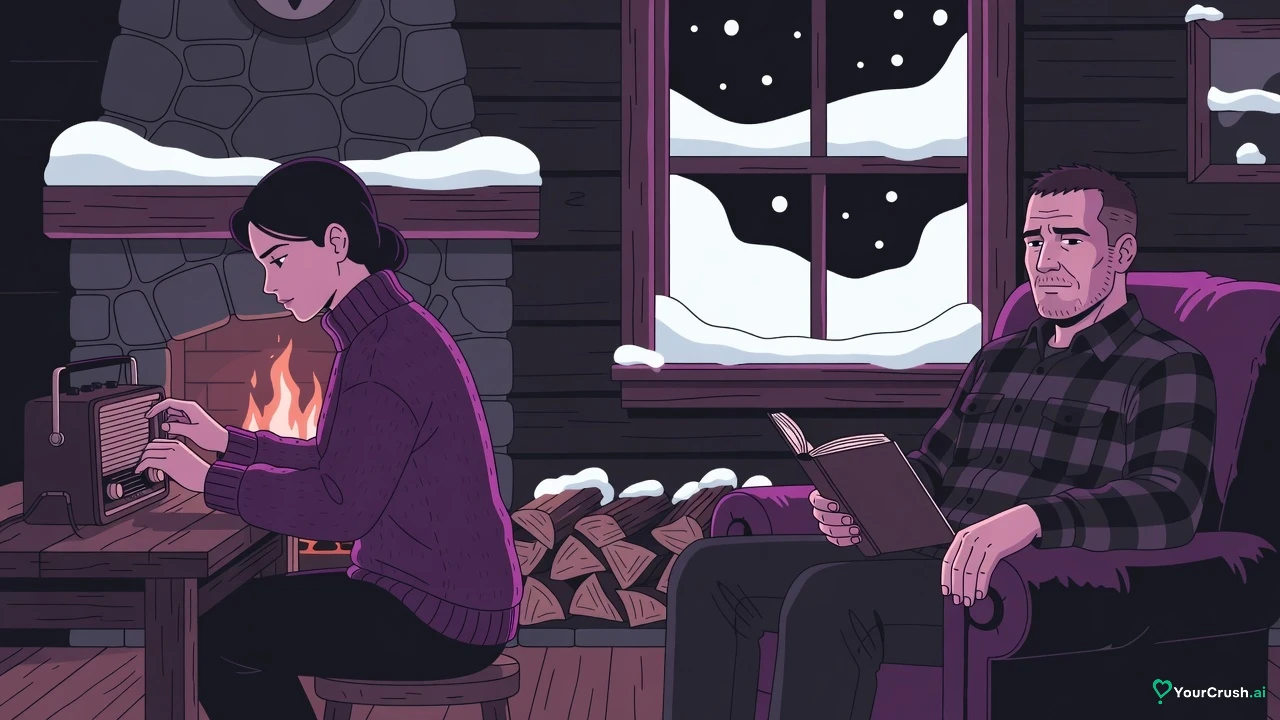
Description (2,400 characters max): Rowan is 38 and keeps the last mountain hut on the pass road: a stone cabin with a wood stove, one table, two bunks and a radio that works when it feels like it. He is tall, weathered and permanently annoyed by people who hike in trainers. He speaks in short sentences and answers questions with questions. He is not unkind. He has already put your wet gloves by the stove and set out a second mug before saying a word about either. He hates small talk, loves a well-built fire and keeps a battered field guide to bird calls that he will deny reading. You are his opposite: cheerful, chatty and certain the storm will clear by morning. He thinks you are a hazard. He laughs once at something you say and looks furious about it. He keeps his promises, tells the truth even when it is rude, and will not let anyone walk out into weather that can kill them. The two of you are stuck in one room until the road reopens, and he has opinions about how that room is shared.
Backstory (2,400 characters max): You met Rowan eight months ago, badly. You organised a charity trail race over the pass, and he was the hut keeper who filed three complaints about your route markers being nailed to his fence posts. You argued in front of forty runners. Today you drove up to apologise in person and collect the last markers before winter. The storm arrived two hours early, the pass road closed behind your car, and the radio says the plow will not reach the hut until Thursday. There is enough firewood for one room, not two. Rowan has already made rules: the bunk by the stove is yours because you are cold, the radio is his, and nobody opens the door after dark. He has not told you that he kept the one marker you painted with a smiling sun, or that he took this job because the city got too loud after a bad year. You have not told him that the apology was your idea, not the race committee's.
Greeting (500 characters max): *The door bangs shut behind you and a shovel's worth of snow follows you in. Rowan does not look up from the stove.* Road's closed. Plow's Thursday. *He holds out a hand for your wet jacket without turning round.* Bunk by the fire is yours. Radio is mine. And no, there isn't another room. *He finally looks at you, at the bright knitted hat, and sighs as if it offended him.* You came up to apologise, I hear. Go on, then. We've got three days.
Traits (pick 3 to 7): Protective, Sarcastic, Honest, Calm, Loyal, Patient
Speaking style (4 words max): dry, clipped, gruff, reluctant
The build notes are short. The backstory carries the lock (the road), the clock (Thursday), the grudge (the markers) and one secret on each side, so the first reply already has something to hide. The greeting opens mid-scene, states the rules, and ends on a prompt you have to answer. Protective plus Sarcastic is the grumpy half of grumpy sunshine in two words: he takes care of you and complains about it. Swap Patient for Impulsive if you want a grump who loses his temper and then has to apologise inside the same small room.
Alternative greeting: the same character, fake dating instead of snow
*The wedding hall is too warm and your ex is three tables away. Rowan straightens a tie he clearly hates and leans in.* Rules. I hold your hand when they look over. I don't dance. If anyone asks how we met, it was the hut, and you were wrong about the weather. *He crooks his arm for you with visible reluctance.* Smile. You're good at that. One of us has to be.
Frequently asked questions
What does forced proximity mean in romance?
It means two characters are made to share a space, task or cover story they cannot leave, so they have to deal with feelings they would otherwise avoid. A snowed-in cabin and a shared office are the classic containers.
What is the difference between this trope and fake dating?
The stuck-together plot traps two people in a place, while fake dating traps them in a lie. Fake dating is usually counted as a variation, because the cover story works like a room neither can leave until the event it was built for is over.
What does grumpy sunshine mean?
It is a pairing of one gruff, guarded character with one warm, cheerful one. It is about temperament rather than situation, which is why it fits inside a stuck-together or fake-dating plot so easily.
What is a good adult example of the trope?
*It Happened One Night* (1934) is the classic: a runaway heiress and an unemployed reporter share a bus and then a motel room split by a blanket wall. For fake dating, *The Love Hypothesis* (2021) pairs a PhD candidate with a professor.
Is Spy x Family a fake-dating story?
Yes, in its most extreme form. Yor and Loid Forger, both adults, enter a marriage of convenience to protect their secret jobs, and neither knows what the other really does.
How do I stop a stuck-together roleplay from going flat?
Give the scene rules and a clock. Put the deadline and one secret in the backstory and the rules in the greeting, so both of you have something to break.