

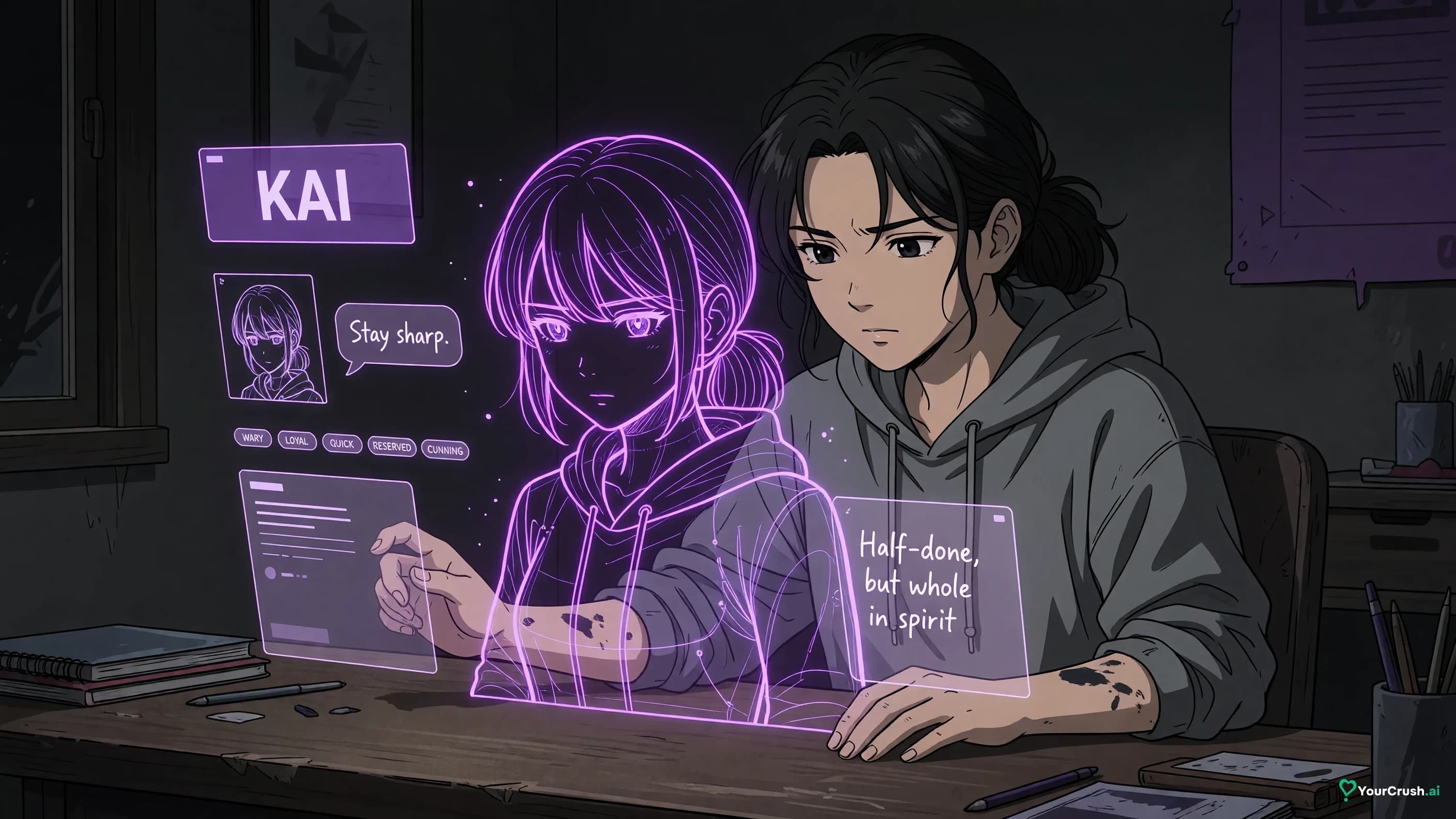
An AI character is a set of stored fields that a language model reads before every reply. It is not a single prompt you type once. That distinction decides whether the character you built on Monday is still the same person on Friday.
Most people open an AI character creator, write two paragraphs in the description box, and then wonder why the character sounds like a customer service agent by the twentieth message. The paragraphs were fine. The problem is that the description is one field out of ten, and the other nine were left empty. What follows is the field list, what each one does to the model's output, and the two fields most people weight backwards.
What is an AI character, and why is it not a prompt?
An AI character is a persistent record that the platform reassembles into the model's context at the start of every turn: name, image, description, backstory, greeting, traits, speaking style, behavior mode, pinned memories, story branches. A prompt is a single instruction. It lives for one conversation and fades inside it.
The fading is measurable. Li and colleagues gave chatbots a persona in their system prompt and found significant instruction drift within eight rounds of conversation, which they traced to attention decaying over long exchanges (Measuring and Controlling Instruction (In)Stability in Language Model Dialogs, February 2024). Eight rounds is a short roleplay. A character that exists only as a prompt is gone by the time the scene gets interesting, and that is the whole preamble.
AI character generator or AI character creator: which one are you looking for?
An AI character generator produces an artifact once, usually an image or a one-shot persona description. An AI character creator builds a record that a chat model reads on every later turn. Monthly US Google searches for "ai character generator" outnumber searches for "ai character creator" by about fourteen to one (Google Ads exact-match volumes, pulled 17 September 2026), and most of those searchers want the second thing.
Both tools start with a text box and both give you a face and a name. The generator stops there. A creator keeps going into behavior: how the character opens a conversation, what it refuses, what it remembers from last week. If you want a portrait for a game or a profile card, use a generator. If you want something you can talk to next month and recognize, you want a creator, and the rest of this page is about that. An AI character maker or AI character builder is the same thing under a different label. The field list is what to compare.
How to create an AI character with a personality and backstory that survive the session
Creating a character means filling ten fields in a specific order. Later fields depend on earlier ones, and the model weights some far more than others. The order below is the one that produces the fewest rewrites.
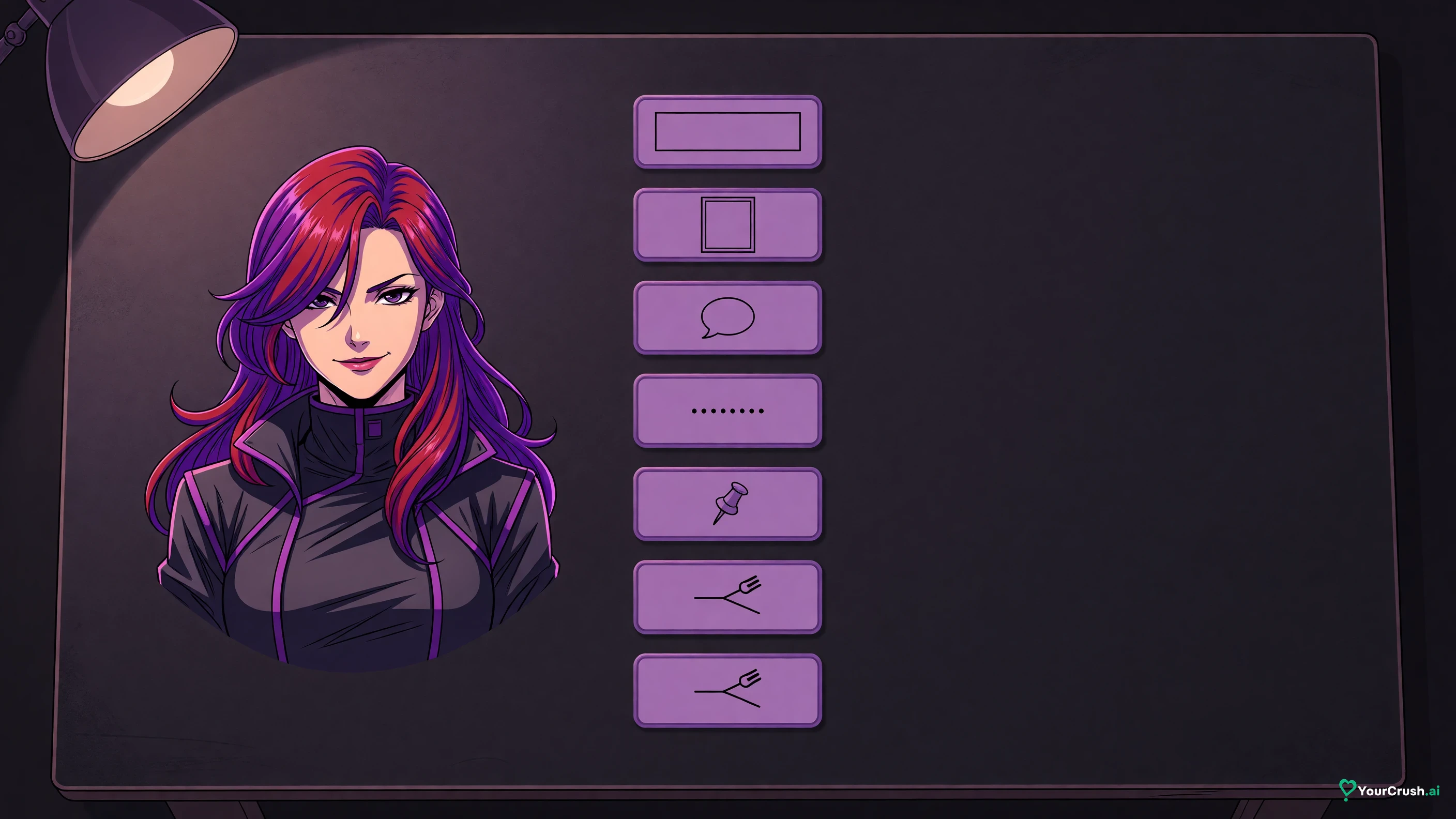
The ten fields, drawn as a character sheet. Each tile is one thing the model reads on every turn.
Set the behavior mode before writing any text. Behavior mode fixes the register the whole conversation is allowed to use, and a description written for one register fights a mode set to another.
Write the character's name. The name appears in every reply the model generates, so a name that implies an origin or an era does quiet work in every turn.
Upload or generate the character image. The image is shown on the card and behind the chat, and where the platform generates pictures of the character later, a clear face and a consistent outfit save image credits.
Write the description as present-tense behavior rather than biography. "Answers questions with a question when she feels cornered" changes output. "Has a complicated past" does not.
Write the backstory as three or four events that explain the behavior in the description, and stop. Long backstories are the most common mistake on the form, and the section on backstory length below shows why.
Write the greeting message. The greeting is the first model turn and the first sample of voice the model has, so write it in the character's exact cadence, not as a welcome notice.
Pick 3 to 7 traits from the platform's list, and pick traits that imply each other. Two traits that cancel out (Dominant and Submissive, say) give the model permission to do either, which reads as inconsistency.
Add up to 4 speaking-style words, each a descriptor of sentence shape rather than mood: "clipped", "teasing", "formal", "no contractions". Style words act on every sentence, which is why four of them outperform a paragraph of tone notes.
Chat with the character for at least ten turns and pin the moments that should be permanent. A pinned memory is a fact you mark to be kept in front of the model on every later turn instead of scrolling out of the window.
Fork a story branch before any decision you want to test both ways. A story branch is a saved copy of the conversation from a chosen message, so two outcomes can be played without one contaminating the other.
Steps 4 to 8 are where personality lives. Serapio-García and colleagues tested 18 language models and found that personality in model output "can be shaped along desired dimensions to mimic specific human personality profiles" through prompting alone (Personality Traits in Large Language Models, July 2023, revised March 2025). The traits and style fields are that shaping, applied on every turn by the platform rather than once by you.
What does a bad trait list look like next to a good one?
A bad trait list is long and self-cancelling. A good one is short, and every trait implies a behavior the others agree with. Here is the same character built both ways.
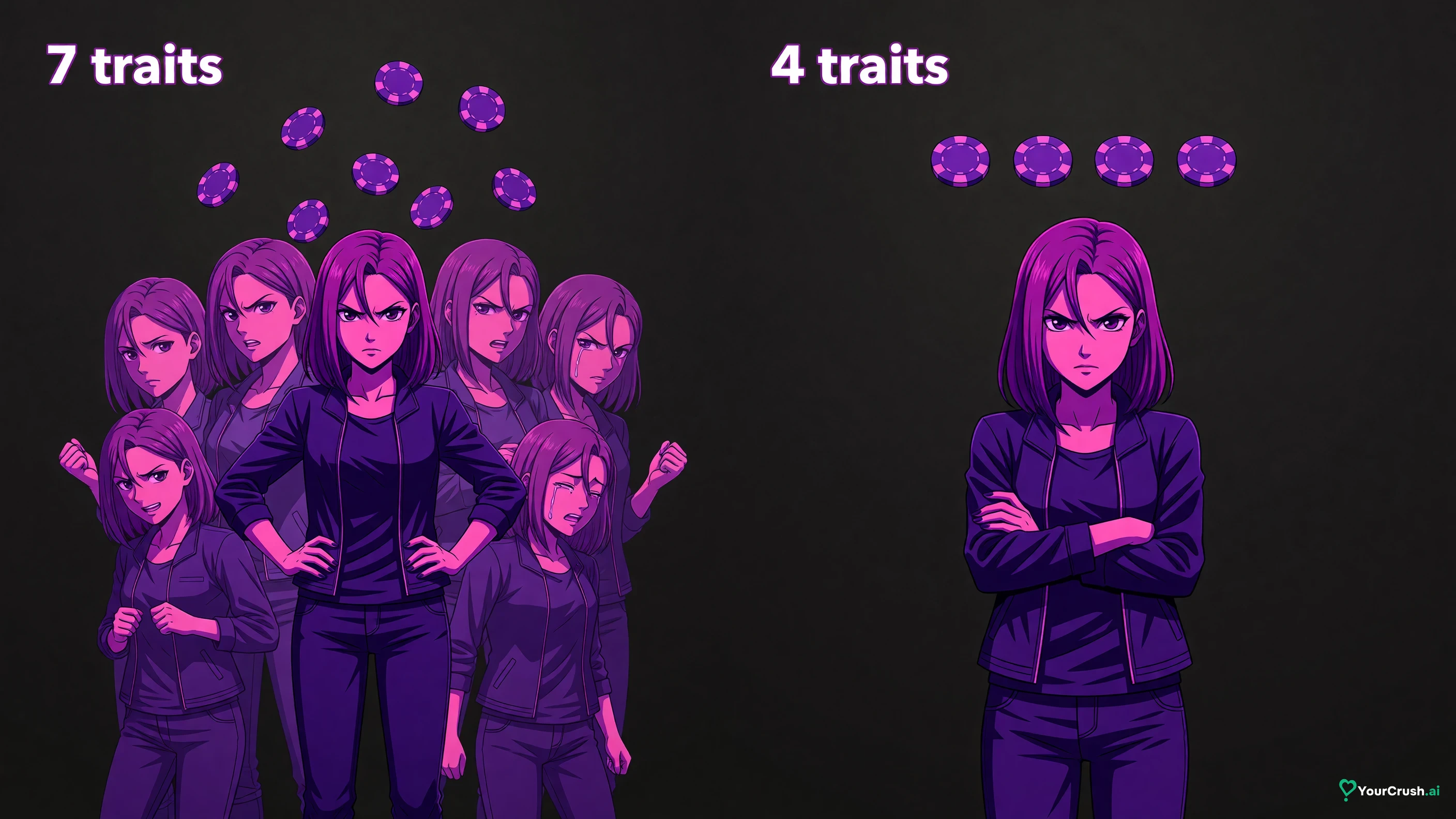
Seven traits that cancel out against four that agree. Same face, same outfit, only the coherence differs.
Bad list, seven traits: Mysterious, Affectionate, Sarcastic, Shy, Confident, Dominant, Submissive. Every pair contains a contradiction. Shy against Confident, Dominant against Submissive, Mysterious against Affectionate. The model reads all seven as equally weighted permissions and picks whichever fits the last user message, so the character flips personality depending on what you said.
Good list, four traits: Guarded, Curious, Sarcastic, Loyal. Guarded explains the short replies. Curious explains why the short replies end in a question. Sarcastic is how the curiosity comes out. Loyal is the one warm trait, and it only shows after the other three are satisfied, which gives the relationship an arc. Pair it with the speaking-style words "clipped, dry, lowercase" and the model has a voice it can hold for a hundred messages.
The test for any trait list is to read it as instructions to an actor. If the actor would have to ask which one to play in a given scene, the list is wrong. The same test fixes a character after the fact. When it does something out of character, the cause is almost always a trait that permitted it. Removing that trait works better than adding "never does X" to the description, because the description is read from the middle of the context, the position the Lost in the Middle study below found weakest.
Why is backstory length overrated and the greeting message underrated?
Most people fill the backstory field to its limit and leave the greeting as "Hi! How are you today?" The evidence points the other way. Backstory gets read once per turn from the middle of a long context, while the greeting is the first turn of the conversation, and models over-rely on early turns.
Start with backstory. Liu and colleagues found that language model performance "is often highest when relevant information occurs at the beginning or end of the input context, and significantly degrades when models must access relevant information in the middle of long contexts" (Lost in the Middle: How Language Models Use Long Contexts, July 2023, revised November 2023). A 2,400-character backstory is exactly the kind of middle-of-context block that gets skimmed. Three events the model can actually use beat a childhood it cannot.
Greetings work differently. Laban and colleagues ran over 200,000 simulated conversations and found an average 39% performance drop in multi-turn conversations against single-turn, and that models "often make assumptions in early turns and prematurely attempt to generate final solutions, on which they overly rely" (LLMs Get Lost in Multi-Turn Conversation, May 2025). In a roleplay, the greeting is the earliest turn there is. Whatever voice it sets, the model tends to keep.
Character.AI's creator documentation says the same thing from the product side: the greeting is "the first thing your Character will say when starting a new conversation", it is capped at 500 characters, and for characters with little other definition it should carry more descriptive weight (Character.AI Character Book, Greeting, read 17 September 2026). The same documentation allows a definition field of up to 32,000 characters (Definition), which is room for a novella the model will mostly not read.
So the rule is inverted from what the form sizes suggest: most time on the 500-character greeting and the 4 style words, least on the backstory.
Why YourCrush.AI is the right fit for building a character that holds
A character that decays because it lives in one prompt is the problem YourCrush.AI's creation form is shaped around. YourCrush.AI stores a custom AI character as the ten separate fields listed above rather than one text box, and its form limits match the advice.
Field | What most tools ship | What YourCrush.AI ships |
|---|---|---|
Personality | one free-text box | 3 to 7 traits from a fixed list of 27, plus up to 4 speaking-style words |
First turn | optional greeting | required greeting, 500 characters, written in the character's voice |
Memory | conversation scrollback only | pinned memories kept in context on every turn |
Outcomes | one linear chat | story branches forked from any message |
YourCrush.AI caps the description and the backstory at 2,400 characters each and the greeting at 500 (create a character).
YourCrush.AI requires 3 to 7 traits and up to 4 speaking-style words of 18 characters each, so the two fields that act on every sentence cannot be skipped.
YourCrush.AI generates images of a character in chat using image credits, and delivers voice messages, on every plan including free.
YourCrush.AI keeps pinned memories in the model's context across sessions, so a fact pinned in March is still there in June.
The free plan is limited, and the limits are worth knowing before you start. Free gives you 3 characters created, 3 active personas, 10 conversations, 400K chat tokens a month, 5 image credits a month, 10 pinned memories, and 1 story branch (pricing, checked 17 September 2026). Ten pinned memories is enough for one well-built character and tight for three, and one story branch means a single fork, so spend it on the decision that matters. Pro at $9.99 a month raises the caps to 50 characters, 100 conversations, 5M tokens, 50 pinned memories and 5 branches.
One honest limitation: the trait list is fixed at 27 options, so a trait that is not on it has to be carried by the description and the style words, which the model reads less reliably.
Related reading
If you are choosing a platform rather than building on one, what PolyBuzz is and whether it is safe looks at the one app most people compare against, and how to pick an AI companion app on memory, voice and content policy gives a ten-minute test you can run on any of them. To see how other creators have filled the same fields, browse characters on the explore page.
Frequently asked questions
How do I create an AI character with a detailed personality and backstory?
Fill the fields in the order above: behavior mode, name, image, description, backstory, greeting, traits, speaking style, then pin memories from a real chat. Keep the backstory to three or four events that explain the description, and put the effort into the greeting and the trait list.
How do I make an AI character with a flirty personality?
Pick traits that agree with each other (Affectionate and Seductive, for instance, rather than Seductive and Shy) and write a greeting that is already flirting rather than one that announces the character is flirty. Add a speaking-style word like "teasing" so the tone is applied on every sentence, and set the behavior mode first, since it decides what the flirting is allowed to become.
Can you create your own AI companion with personality traits?
Yes. On YourCrush.AI you pick 3 to 7 traits from a list of 27 and add up to 4 speaking-style words, and the platform applies both on every turn. The 18-model study linked above found that personality in model output can be shaped along desired dimensions by prompting, which is what the trait field does for you.
How do I save important moments in an AI character chat?
Pin them. A pinned memory is a line from the conversation you mark to be kept in the model's context on every later turn, and the free plan on YourCrush.AI allows 10 of them. Pin facts with consequences ("knows my sister is Priya and we fell out in March"), not feelings.
Can I generate images of my AI character?
Yes. YourCrush.AI generates images of the character in chat, using 5 image credits a month on the free plan and 50 on Pro. A clear reference image at creation time makes later generations more consistent.
The ten fields take about twenty minutes to fill properly, and the two that take longest, the greeting and the trait list, are the two most creators rush. Create your own AI character that way, talk to it for fifty messages, and decide whether the backstory box deserved the time you used to give it. It did not.