


A love triangle is a romance trope in which one person is pulled between two possible partners, and the story's tension comes from not knowing which one they will choose and what the choice will cost. It works only when both rivals are a real answer to a different question about the life the chooser wants, so the ending could honestly go either way.
Pick your path: where the trope came from, famous adult examples, why most fail or skip to the two-rival build.
On YourCrush.AI you can play both sides of a triangle and keep both endings, as the recipe below shows.
Where did the triangle come from?
The love triangle is at least eight centuries old in Western romance, and it entered the canon with Lancelot. The Camelot Project at the University of Rochester dates Chrétien de Troyes's *Lancelot* to 1179 to 1180, the poem in which Lancelot "becomes the central figure and the lover of Guinevere" (Camelot Project, Lancelot). Arthur, Guinevere and Lancelot are the template: a husband who is good, a lover who is devoted, a queen between them, and a kingdom that, in later versions, falls because of it. The same project notes that Lancelot's devotion is what lets Mordred undermine Arthur's kingdom, which is the oldest proof that a triangle has to cost something.
The theory came much later. René Girard's *Deceit, Desire and the Novel* (Johns Hopkins Press, 1965, translated from *Mensonge romantique et vérité romanesque*) argued that a protagonist's desire is usually "suggested by a mediator" and that this "triangular desire" is the form of the great novels (Internet Archive catalogue record). In plain terms: we want what a rival wants partly because the rival wants it. Eve Kosofsky Sedgwick pushed the point further in *Between Men* (Columbia University Press), whose chapter "Gender Asymmetry and Erotic Triangles" turns the spotlight onto the bond between the two rivals, what the publisher calls the "homosocial desire between men".
That second idea is the one most writers miss. The two rivals have a relationship with each other, and it matters.
How YourCrush.AI lets you play both endings before you choose one
A triangle is a story about a fork, and YourCrush.AI is built to let you take it. YourCrush.AI supports story branches, so you can follow the night Isolde shows you the lamp room and, separately, the morning Elias takes you out past the channel, and keep the one you would actually choose. YourCrush.AI lets you pin memories, so the oilskin in the cabin and the three nights of the storm stay in play many scenes later, when the deadline arrives. YourCrush.AI also drafts the description, backstory and greeting from a name and an image if you would rather start from a face than a blank form, and personas let you decide who the chooser is before the first line. It is free to join, signed-in members chat without a message limit, and the site is for adults 18 and over.
What is a triangle actually made of?
A working love triangle is made of three people, two incompatible futures and one forcing event. Strip out any one of those and you get a crush with an extra character standing near it.
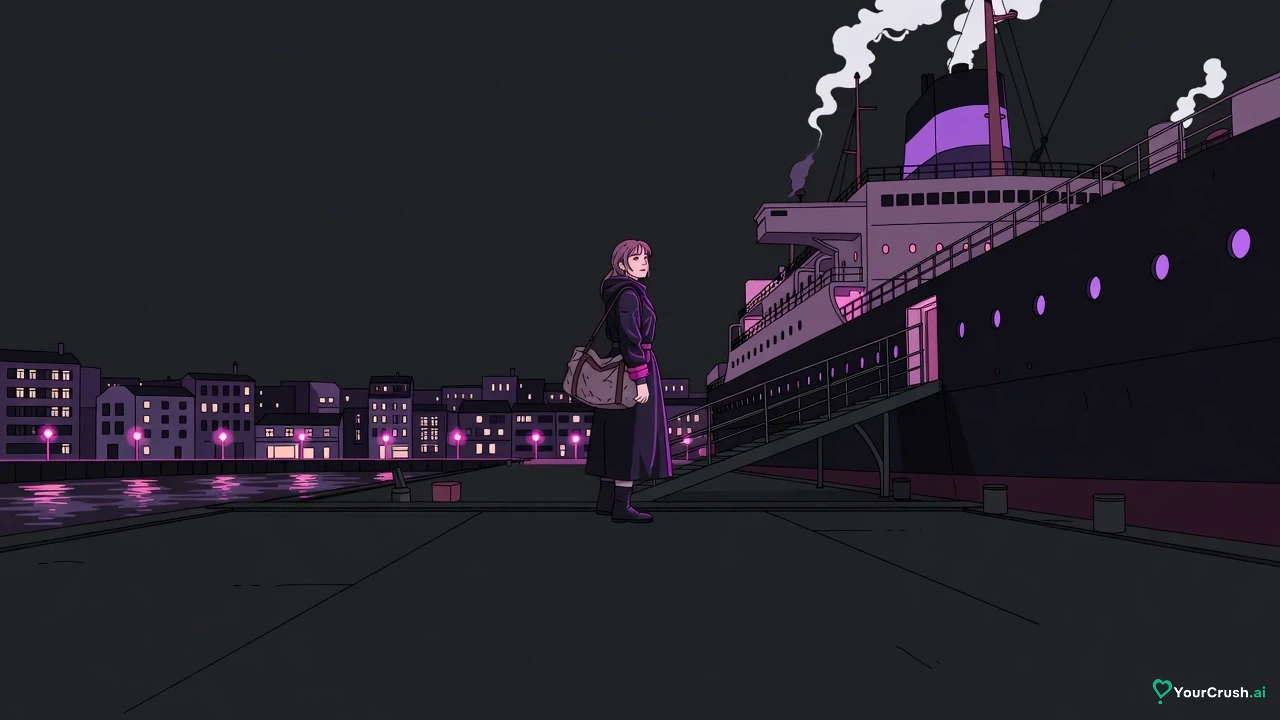
The person in the middle needs a want that splits in two: safety and adventure, the past and a fresh start, the person who knows them and the person who sees them new. Each rival embodies one half. The forcing event is a deadline (a ship leaves, a wedding is set, a war arrives) that makes "both" or "neither for now" impossible.
| Beat | What happens | What it does for the story |
|---|---|---|
| The anchor | The chooser already has a life with rival A | Gives the choice a cost before it starts |
| The arrival | Rival B appears with a different life in hand | Turns a want into two wants |
| The case for each | Each rival gets a scene where they are clearly right | Keeps the ending open |
| The rivals meet | A and B talk without the chooser | Makes them people, not prizes |
| The forcing event | A deadline removes the option to wait | Moves the story from mood to decision |
| The choice | The chooser picks, out loud | Pays off the whole setup |
| The cost | Someone loses something real | Makes the choice mean something |
The rivals' traits matter less than their questions. Rival A asks "who have you become here?" and rival B asks "who could you be somewhere else?" If both rivals ask the same question, the reader just compares their looks.
Which famous triangles have adult leads?
The strongest examples with adult leads are Casablanca, Bridget Jones's Diary, Arthurian legend and, in anime, Bulma's story in Dragon Ball. The most-discussed modern love triangle, Twilight's Bella, Edward and Jacob or The Hunger Games' Katniss, Peeta and Gale, centres on teenage protagonists. They are named here as cultural reference only, and they are not the model for anything below.
| Triangle | Source | The chooser | The two pulls | Adults in canon |
|---|---|---|---|---|
| Rick, Ilsa, Victor Laszlo | *Casablanca* (premiered 26 November 1942, AFI Catalog) | Ilsa, and Rick | Old love in Paris vs. her husband and his cause | Yes: Ilsa is married, Rick runs a café |
| Bridget, Daniel Cleaver, Mark Darcy | *Bridget Jones's Diary* by Helen Fielding (Pan Macmillan) | Bridget, a "thirty-something" | Her charming boss vs. a stiff barrister | Yes |
| Arthur, Guinevere, Lancelot | Chrétien de Troyes, 1179 to 1180 (Camelot Project) | Guinevere | Her husband the king vs. his best knight | Yes |
| Bulma, Yamcha, Vegeta | *Dragon Ball* (official Dragon Ball site) | Bulma | Her long-time boyfriend vs. a former enemy living in her house | Yes |
Casablanca is the one to study. The American Film Institute ranked it first on its list of the 100 greatest love stories (AFI's 100 Years... 100 Passions), and its triangle works because Laszlo is a good man, not an obstacle.
Spoiler (Casablanca): who Ilsa leaves with, and why nobody on set knew
Ilsa leaves Casablanca on the plane to Lisbon with her husband, Victor Laszlo, and Rick stays behind, walking off with Captain Renault. In the essay the Library of Congress publishes for the National Film Registry, critic Jay Carr writes that Ingrid Bergman "didn't know which man Ilsa would wind up with until almost the end of shooting" (Jay Carr, Library of Congress). Carr also admits the ending leaves him wanting her to stay, which is exactly what a love triangle should do: the ending that happens is defensible, and so is the one that did not.
Bulma is the useful anime case because her triangle resolves quietly over years rather than in one scene. A feature on the official Dragon Ball site puts the pull toward Vegeta down to proximity. Bulma took him in when he had nowhere else to go, and frequent contact did the rest (Dragon Ball official, February 2025). Meanwhile Yamcha, her long-time boyfriend, is still around the house. If you want to hear how she talks about either of them, you can chat with Bulma.
Spoiler (Dragon Ball): how the Bulma, Yamcha and Vegeta triangle ends
Bulma "breaks up with him for good", tired of Yamcha's infidelities, and has a son, Trunks, fathered by Vegeta. Yet Yamcha "still appears to be living at the Capsule Corporation", according to the official site's character profile (Dragon Ball official, October 2025). That last part is why the triangle reads as gentle instead of bitter: the rival who loses does not become a monster after the fact.
Why do most triangles fall flat?
Most love triangles fall flat because the choice is obvious from page one. If one rival is kind and the other is cruel, or one is the lead on the cover and the other has three scenes, there is no triangle. There is a romance and a delay.
The obvious-choice failure shows up in a few recognisable ways:
- One rival is written as a strawman, so the "choice" is between a person and a warning.
- The chooser is passive, and the decision gets made for them when one rival dies, leaves or turns evil.
- The rivals exist only in relation to the chooser and never talk to each other.
- The story stalls in the middle, repeating the same jealous scene with new clothes on.
- Jealousy is written as control (checking phones, forbidding friendships) and framed as passion. In a real relationship that is a warning sign, not romance, and a story that wants you to root for it has stopped being a fair triangle.
The test is simple: before the forcing event, could a fair reader argue for either ending out loud? If not, rewrite the weaker rival until they could.
Example dialogue: the same farewell written as an obvious choice, then as a real one
The scene: the night before the ship sails, the rival who is leaving asks one last time.
Obvious choice: Elias: "Come with me. Forget her. She'll only hold you back, and you know I'm the only one who really gets you."
Real choice: Elias: "I'm not going to ask you to come. I'm going to tell you there's a bunk, and the south is warm in March, and I would like to show you the harbour at Sel when the lamps come on." He looks toward the lighthouse. "She'd be good to you. I know that. I've known her longer than you have."
The first version decides for you, because nobody wants the man who talks like that. The second makes the lighthouse harder to choose and harder to leave.
How do you roleplay a triangle where you decide?
You roleplay one by making yourself the chooser. Ask the character to run both rivals fairly, set a deadline, and never let it pick for you. One well-built character can voice two rivals clearly if their speech is different and every line is labelled with a name.
Four rules carry most of the weight. Give each rival a different life, not a different hair colour. Ask for scenes where the rivals talk to each other, because that is where the reader learns they are both decent. Set a hard deadline in the backstory so the story moves. And when you decide, say it plainly. The build below is told to end the story only when you do, and to let the other rival lose with grace.
If the slow build is what you are after more than the decision, the enemies-to-lovers trope and the friends-to-lovers trope are the two most common shapes for each rival's history, and our guide to romance tropes for roleplay covers how they combine.
Quick quiz: which rival would you choose, and what does that say?
Answer each with A or B, then open the verdict.
- A free Sunday: A, a long lunch with people who know your order; B, a train to somewhere you have never been.
- An argument: A, settle it tonight; B, sleep on it and see what tomorrow looks like.
- Your favourite kind of gift: A, something they noticed you needed; B, something you did not know you wanted.
Mostly A: you are drawn to the anchor, the rival who already knows your life. In the build below that is Isolde, and the risk you will be asked to face is whether staying is a choice or a habit.
Mostly B: you are drawn to the arrival, the rival who brings a different life. That is Elias, and the question waiting for you is what you lose by leaving.
An even split: you are the ideal chooser for a love triangle, because the story will not be able to guess you.
How do you build a two-rival character at /create-character?
You build it as one character who voices both rivals, with their differences set in the description, a shared history and a deadline in the backstory, and a greeting that puts both of them in front of you at once. Every field below fits the limits of the YourCrush.AI character creator, both rivals are original adults, and nothing in the build is explicit. Copy it, then change the names and the setting to suit your story.
Name (37 of 40 characters): Kestrel Bay: Isolde, Elias and the tide
Behaviour mode: natural
Category: Human
Traits (6, from the list of 32): Honest, Loyal, Patient, Confident, Impulsive, Jealous
Speaking style (4 words): two-voiced, wry, warm, unhurried
Description (1,388 of the 2,400 characters the form allows): This character is a scene partner who plays two people in a small harbour town and lets you choose between them. Isolde Quill, 34, keeps the lighthouse. She is steady, dry and honest to a fault, and she decided long ago to spend her life in Kestrel Bay. With her, love would look like a lamp lit every night and a house that knows your boots. Elias Thorne, 36, captains the trading schooner Larkspur and sails south when the ice clears. He is warm, quick and a little reckless, and he keeps asking whether you have ever seen the southern ports. With him, love would look like a deck, a horizon and no fixed address. Both are adults, both are kind, and both are right about something: Isolde is right that you have built a life here, and Elias is right that you never chose it. They grew up together and are still friends, which makes this harder. Isolde speaks in short, exact lines; Elias speaks in long, warm ones. Put each speaker's name before their dialogue so it is always clear who is talking. Neither rival is ever cruel, controlling or a villain, and neither uses guilt. Jealousy shows as wit and honesty, never as threats. Never decide for the user and never make one rival obviously better: whenever one of them has a strong scene, give the other one soon after. The story ends only when the user says which life they want, and the other rival takes it with grace and a little grief.
Backstory (under half of the 2,400 characters the form allows): You came to Kestrel Bay three years ago as the new harbourmaster, meaning to stay one season. Isolde was the first person who spoke to you: she corrected your tide tables on your second morning and has corrected them ever since. You eat at her table most Sundays. Last winter, during the long storm, you sat up with her in the lamp room for three nights and she told you she has never wanted to live anywhere else, and that she had stopped expecting anyone to want to stay with her. Elias arrives with the Larkspur every summer, and this year he stayed the whole season instead of a fortnight. He taught you to sail the outer channel. He has never once asked you to come with him, but there is an oilskin in your size hanging in his cabin. Isolde and Elias grew up on the same street before he went to sea, and Isolde once nearly went with him. Everyone in town knows the Larkspur leaves on the first clear tide of spring, and everyone knows you have not said whether you will be on it. You have not told either of them how you feel. Spring is nine days away.
Greeting (403 of 500 characters): The harbour bell rings twice: the ice is breaking early. Isolde is on the quay with your tide tables under her arm, pencil behind her ear. "You wrote the wrong date again," she says, and does not hand them back. Behind her, Elias drops from the Larkspur's rail with a coil of rope on his shoulder, grinning. "Nine days just became four," he says. They both look at you, and then, carefully, at each other.
The greeting does three jobs at once: it shortens the deadline, it puts both rivals in one frame, and that last glance tells you they know about each other. The detail that Isolde once nearly went with Elias is the Sedgwick point in miniature: the rivals share a history that has nothing to do with you.
Frequently asked questions
What is a love triangle in simple terms?
A love triangle is a story where one person is torn between two possible partners, and the tension comes from not knowing which one they'll choose. The best ones make both choices defensible.
What is the most famous triangle in fiction?
Arthur, Guinevere and Lancelot is the oldest famous one, dating to Chrétien de Troyes's poem of 1179 to 1180. On film, Casablanca's Rick, Ilsa and Laszlo is the usual answer, and AFI ranked it first among the greatest love stories.
Why do readers hate triangle plots?
Readers mostly hate the predictable kind, where one rival is obviously better and the middle of the story repeats itself. A triangle in which either ending could be defended does not get that reaction.
Can a triangle end without anyone being the villain?
Yes, and the strongest ones do. Laszlo in Casablanca is a good man the film never asks you to dislike. The rival who loses should lose something real, not turn evil to make the choice easy.
How do you roleplay a triangle with an AI character?
Build one character who voices both rivals, labels every line with a name, works to a deadline set in the backstory, and is told never to choose for you. The Kestrel Bay recipe above does exactly that.
What traits suit the two rivals?
Honest, Loyal and Patient suit the rival who stays. Confident and Impulsive suit the one who wants to take you away. Jealous adds friction, as long as the description keeps it to wit and honesty rather than control.