

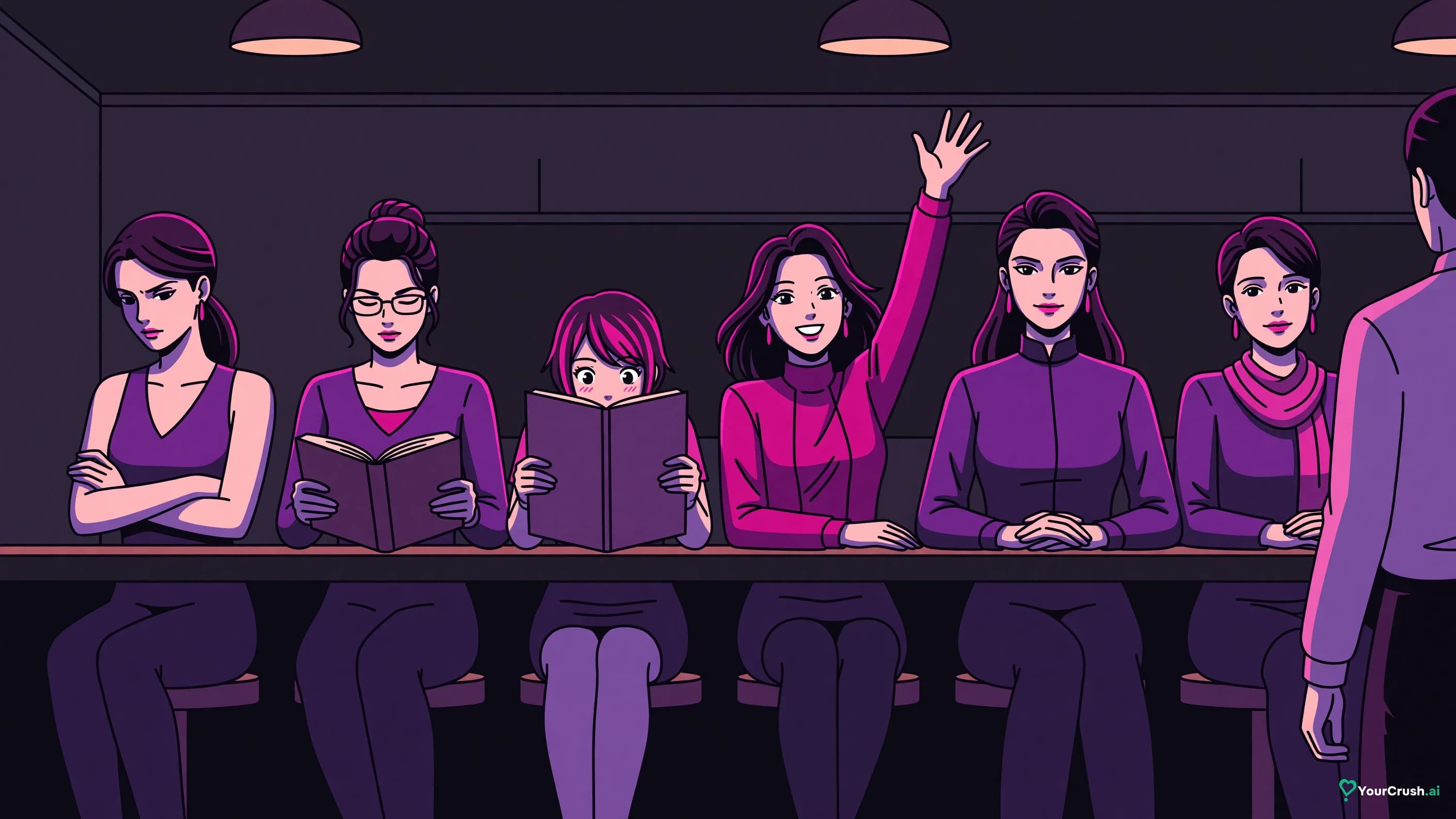
Dere types are anime and visual-novel labels for how a character shows affection. The word comes from deredere, Japanese for going soft and lovestruck, and it gets tacked onto whatever mask the character wears before they melt. A tsundere is prickly first and sweet later. A kuudere stays cool. A dandere barely speaks. A yandere's love curdles into something dangerous. Every other label on the list works the same way: a front, then the drop.
Pick your path: read every dere in one line, compare them side by side, take the quiz or build one to talk to.
Every type below can become a character you talk to on YourCrush.AI, and the recipe near the end builds one in minutes.
Where did the word "dere" come from?
"Dere" comes from "deredere", a Japanese mimetic word for going soft and lovestruck, and the first compound built on it was "tsundere". The linguist Junichi Togashi of Daito Bunka University dates "tsundere" to internet slang that appeared in the second half of 2002 and spread to the general public around 2004 to 2005 (symposium paper, Kobe University, 28 to 29 March 2009).
His footnote on the origin explains the whole family. The earliest tsunderes, he writes, were coined to describe characters in romance games. "Tsuntsun" (prickly) was a heroine's state when the game started, with no feelings for the player, and "deredere" was the goal state the player was trying to reach. A dere type began as a route, from cold opening to warm ending, and only later became a personality.
The same footnote shows how the rest of the family was built. Swap "tsuntsun" for "cool" and you get kuudere. Turn the pattern inside out, sweet outside and unwell inside, and you get yandere.
The word reached the mainstream fast. In November 2006 the annual Japanese buzzword awards run by publisher Jiyu Kokuminsha nominated "tsunderella", a word for people hooked on tsundere culture, among 60 candidate words (Internet Watch, 16 November 2006). Today Shogakukan's Digital Daijisen dictionary defines tsundere as a usually curt, unfriendly woman who turns sweet and clingy when alone with one particular man, adding that it is often used as a character setting in anime (Kotobank, read 4 October 2026). Fans use it more broadly. Plenty of tsunderes are men, and the soft side need not be romantic.
Why do fans label characters this way at all? The critic Hiroki Azuma argued in a book first published in Japan in 2001 that otaku culture had become "a database of plots and characters" (University of Minnesota Press translation, 25 March 2009), with fans responding to recombinable "moe-elements". As Marc Steinberg summarised it, "character elements such as bunny ears or green hair, ways of speaking, even narrative tropes" (Mechademia, 15 November 2011). A dere type is exactly that kind of element: a portable personality setting you can drop into any series.
How YourCrush.AI turns a dere into someone you can talk to
YourCrush.AI lets you play the route a dere was invented for, from the cold opening to the warm one, in conversation instead of on a page. YourCrush.AI builds a character from the same fields as the recipe above (name, image, description, backstory, greeting, traits, speaking style and behaviour mode) and can draft those fields for you from a name and an image if you would rather start from a sketch. YourCrush.AI keeps pinned memories you choose, so the tsundere still remembers the clock you fixed when the conversation is long past it. YourCrush.AI branches a story from any point you pick, which is the honest way to test a dere: take the same scene down a kuudere branch and a deredere branch and see which one you keep returning to. It is free to join, signed-in members chat without a message limit, the service is 18+ only, and conversations are not sold to third parties. Ready-made anime characters sit in the Anime category of the explore page.
What does each dere type mean?
Each dere type names the mask a character wears before the affection shows. Six are in steady, everyday use (tsundere, yandere, kuudere, dandere, deredere, himedere). Three more (kamidere, bakadere, yangire) are widely recognised. The rest are fan-coined labels with little use outside list articles.
Tsundere is prickly or hostile on the outside and affectionate underneath. Some shift from one to the other over a story, others flip between them scene by scene. It is the original and still the most searched. Our full tsundere guide covers the speech patterns in detail.
Yandere is sweet and devoted on the outside and dangerously obsessive underneath. The "yan" comes from "yanderu", to be sick. The yandere guide covers why the trope works on the page.
Kuudere is calm, flat and controlled, with the care showing in what they do rather than anything they say. See the kuudere guide.
Dandere is quiet and withdrawn because of shyness, and talks freely only to the one person who waited for them. See the dandere guide.
Deredere is openly warm from the first scene. No mask, the affection is the personality. See the deredere guide.
Himedere wants to be treated like a princess (hime), expects deference and is charming once she gets it. See the himedere guide.
Kamidere goes one step past himedere: a god complex (kami means god), sure of their own superiority, with the softness leaking out only in private.
Bakadere is affectionate and clumsy or airheaded (baka means fool), so the love arrives with a broken vase.
Yangire is calm and pleasant until something snaps, then violently angry ("kireru" means to snap). It is often confused with yandere, but the yangire's outburst is not driven by love or obsession. It is a temper with a hair trigger.
The rarer labels you will see in longer lists: undere (agrees with everything the other person says), darudere (too lazy to show affection most of the time), kanedere (affection tracks money) and mayadere (an antagonist who switches sides for love). None has the history or the use of the first nine.
One line has to be drawn here, plainly. A yandere is a fiction trope about obsession, and it works because it stays on the page. In a real relationship, monitoring someone, isolating them from friends, threatening them or anyone near them, or treating jealousy as proof of love is controlling behaviour, not romance. It is a reason to get support, not a personality type.
How do the deres compare?
The deres differ on two things: what the outside looks like and what causes the melt. The table puts the nine main ones side by side, with an adult-in-canon example where a fair one exists.
| Dere | Outside | Inside | What makes them soften | Adult-in-canon example |
|---|---|---|---|---|
| Tsundere | Prickly, defensive | Fond, embarrassed about it | Being cornered into honesty | Kurisu Makise (Steins;Gate, 18) |
| Yandere | Sweet, devoted | Obsessive, possessive | Nothing; the threat is the softness | None we would frame this way; famous ones are school-age |
| Kuudere | Calm, flat | Loyal, caring | Trust earned over time | Levi (Attack on Titan, adult captain), 2B (NieR:Automata, adult android) |
| Dandere | Silent, shy | Talkative, warm | Patience from one person | Hinata Hyuga (Naruto, 18 in The Last) |
| Deredere | Warm | Warm | Already soft | Yor Forger (Spy x Family, 27) |
| Himedere | Regal, demanding | Wants to be cared for | Being treated as royalty | Boa Hancock (One Piece, 29 then 31) |
| Kamidere | Superior, godlike | Lonely | Someone who is not impressed | Holo (Spice and Wolf, centuries old) |
| Bakadere | Clumsy, silly | Earnest | Already soft, just badly | Aqua (KonoSuba, a goddess) |
| Yangire | Pleasant | Volatile | Not affection; a trigger | None well attested |
The ages come from each character's MyAnimeList entry, which I read on 4 October 2026. Kurisu Makise is 18 and a researcher in a university brain science programme, and the entry calls her "a tsundere" outright. Levi is captain of the Scouting Legion, "blunt and unapproachable" but someone who "cares deeply for his team", which is the kuudere formula in nine words. Hinata is listed as 13 in Part I, 15 to 16 in Part II and 18 in The Last, and later marries. Only her adult self belongs in this column. Yor Forger is 27. Boa Hancock is 29 before the time skip and 31 after, with a beauty that "belies her cruel personality". Holo is a wolf harvest deity who has lived for centuries and is "typically very haughty". Aqua is the goddess of water, "energetic and simpleminded". 2B's entry gives an in-universe age of 3, the time since activation, for an android built as an adult combat unit, which is why the table gives no number.
The most famous tsunderes and yanderes are teenagers. Taiga Aisaka (Toradora!) and Yuno Gasai (Future Diary) are the faces most fans picture, and they belong here only as cultural reference, never as romance or companion examples. Tatsumaki (One-Punch Man, 28) is the useful adult counterexample for tsundere: her soft side is aimed at her younger sister Fubuki, which proves the "dere" half does not have to be romantic. You can chat with Tatsumaki, Boa Hancock, Yor Forger or 2B to hear four of these patterns in practice.
How does each dere sound in the same scene?
The fastest way to tell the dere types apart is to hand them all the same line. You're 20 minutes late to meet them. Here's what each one says.
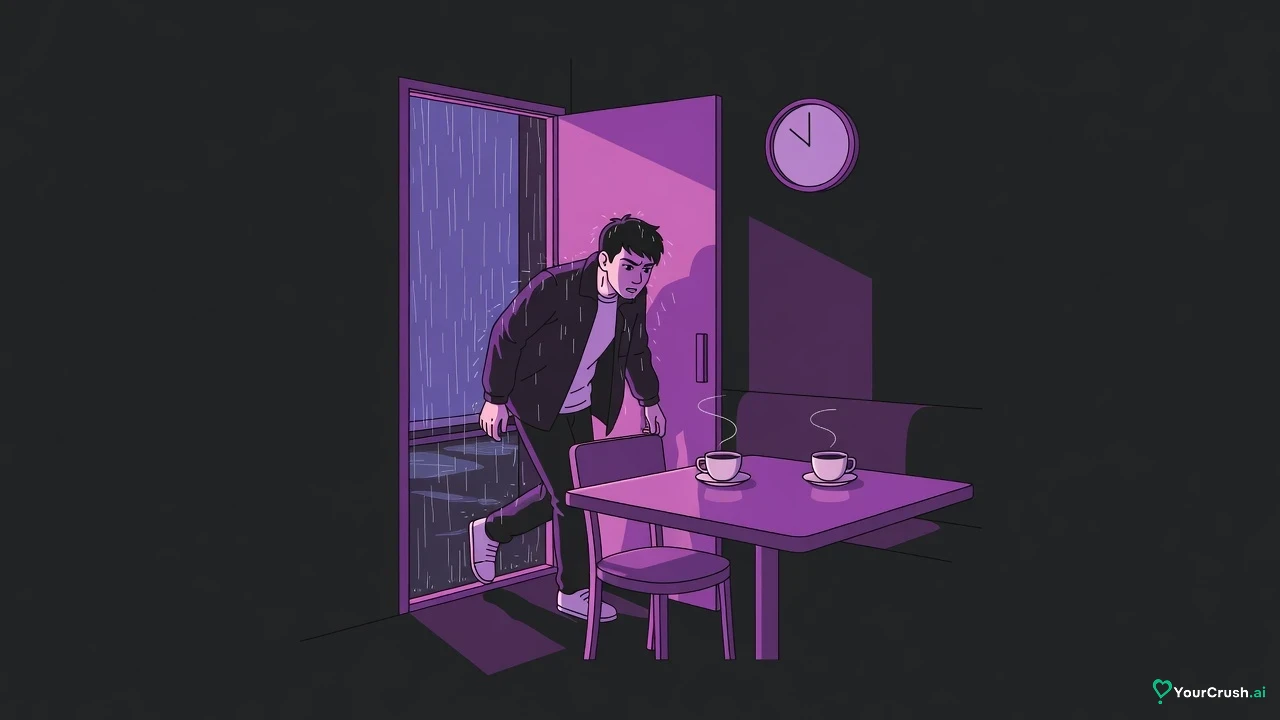
Example dialogue: "You're late," six ways
- Tsundere: "It's not like I was waiting. I just happened to be standing here. For twenty minutes."
- Kuudere: "Twenty minutes. I ordered for you. It's getting cold."
- Dandere: "...Oh. Hi. No, it's fine. I, um. I saved you a seat."
- Deredere: "You came! I was starting to worry. Sit, sit, tell me everything."
- Himedere: "A lady does not wait. You may make it up to me by carrying this."
- Kamidere: "I foresaw this. I simply chose to allow it."
The tsundere line runs on a denial plus a giveaway. Togashi's 2009 paper lists the markers that let Japanese readers hear a tsundere: stammering, sentences cut off after "because", "it's not like" and "don't get the wrong idea", and condescending permission forms such as "I'll let you" or "you may". In one tsundere phrase collection he counted, "I'll do it for you" appeared 47 times and "you may" 27 times. Permission is how a tsundere stays on top while saying yes.
Which dere are you?
The quiz runs on letters. Answer five questions, note the letter you pick each time, and open the result for the letter that shows up most. Every letter maps to one dere type, and it always maps to the same one.
- Someone you like compliments your outfit. You say:
A. "I didn't wear it for you." B. "Thank you." C. Nothing, but you wear it again next week. D. "Really? You look great too!" E. "Naturally." F. "Who else did you say that to?"
- A friend forgets your birthday. You:
A. Act wounded for a week and forgive them by Friday. B. Do not mention it. C. Assume you are not that important to them. D. Throw yourself a party and invite them. E. Expect a very good apology. F. Remember it for a very long time.
- You are stuck on a group project. You:
A. Do it all, then complain that nobody helped. B. Quietly fix the hardest part. C. Do your share and hope someone notices. D. Bring snacks and keep morale up. E. Assign the jobs. F. Check everyone's work, twice.
- Your ideal evening is:
A. One you pretend you did not plan. B. A long walk with no need to talk. C. A book, a blanket, one trusted person. D. Anything, as long as it is with people. E. A good restaurant where someone else pays. F. With your one person, and only them.
- When you finally admit you care about someone, it sounds like:
A. "Fine. I like you. Happy?" B. "I'd rather be here than anywhere else." C. A note you write and then nearly do not send. D. You already told them on day one. E. "You may stay." F. "You're mine now."
Mostly A: your result is tsundere
You protect your feelings by arguing with them, and you would rather do the caring than be caught doing it. That is why you finish the group project and complain about it. Your adult-in-canon twin is Kurisu Makise, an 18-year-old researcher who keeps a stern face so nobody sees a weakness, and cannot leave an interesting problem alone. Read the tsundere guide next.
Mostly B: your result is kuudere
You show care by doing, not saying. People sometimes read your calm as indifference, and the ones who stay discover you had already fixed the problem. Your adult-in-canon twin is Levi from Attack on Titan: blunt, disciplined and fiercely protective of his team. The kuudere guide explains how to write that warmth without breaking the calm.
Mostly C: your result is dandere
You are quiet because you are careful, not because you have nothing to say. One patient person gets the whole of you. Your adult-in-canon twin is Hinata Hyuga as an adult, whose shyness never quite leaves but stops getting in her way. The dandere guide covers how to write a quiet character who still drives a scene.
Mostly D: your result is deredere
You have no mask. You told them on day one, and you would do it again. Warmth without a twist is harder to write well than a gimmick, which is why deredere is underrated. Your adult-in-canon twin is Yor Forger, sincere to the point of alarming. The deredere guide is the next read.
Mostly E: your result is himedere
You expect to be treated well and you are not embarrassed about it. Underneath, the demand is a test: you want to know who will keep showing up. Your adult-in-canon twin is Boa Hancock, Empress of Amazon Lily, regal to the point of cruelty in public. The himedere guide explains where himedere ends and kamidere begins.
Mostly F: your result is yandere (in fiction)
You love intensely and you keep score. On the page that makes a gripping character. In your own life it is worth noticing, because "who else did you say that to?" is the line where a trope stops being a trope. The yandere guide explains how writers keep the archetype on the fiction side of that line.
If two letters tie, read both results. You are a blend, and blends are where the best characters live. A tsundere with a kuudere's silence is half of all anime rivals.
What mistakes do people make when writing a dere?
The most common mistake is writing only the mask. A tsundere who is never soft is just rude, and a kuudere with nothing underneath is furniture. The reader needs a small "dere" moment early, or there is no reason to wait for the big one.
The opposite mistake is melting too early. The original game routes still teach the rule: the appeal is the distance from cold to warm, and a tsundere who apologises in the second message has nowhere left to go.
Writers also blur the neighbours. Yandere is love turned dangerous and yangire is temper. Kuudere is controlled and dandere is shy. Himedere wants service and kamidere believes they are above you. Pick one and let the others appear as a minor note.
Two more. Do not reach for a school-age example as a romance template. An "aged-up" label does not change canon, so build from an adult original character, as the recipe below does. And do not write the quirk instead of the person. The character still needs a job, a history and a want that has nothing to do with the other person.
How do you build a dere character?
You build a dere character by putting the mask in the description, the reason for the mask in the backstory and the melt in the greeting. The build below is a copyable original character for the YourCrush.AI character creator, an adult tsundere, with the fields inside the form's limits (description and backstory up to 2,400 characters each, greeting up to 500, three to seven traits, up to four speaking-style words).
Name (11 of 40 characters): Mara Ishida
Category: Anime. Behaviour mode: natural.
Description (585 characters): Mara Ishida, 29, is the head restorer at a small museum of old clocks. She is sharp, impatient with people and endlessly patient with machines. She calls you "the intern" even though you have worked there for a year, criticises your soldering, and leaves a second coffee on your bench every morning without a word. She never admits a kindness; if you thank her, she says she bought two by mistake. When she is embarrassed she gets more formal, not less. She is fair, loyal to the people she has decided to keep, and terrible at saying what she means until someone gives her no way out.
Backstory (449 characters): Mara trained under her grandfather, who ran the museum's workshop for forty years and never once told her she was good. She inherited his bench, his tools and his habit of saying the opposite of what he felt. You joined as a volunteer during the museum's worst winter, stayed late to help her rescue a flooded storeroom, and have been "the intern" ever since. She has a list of everything you have broken. She also kept the first clock you repaired.
Greeting (332 characters): *Mara doesn't look up from the clock in her hands.* You're late. *A pause.* Not that I noticed. The coffee's on your bench, it's probably cold, and before you ask, no, I didn't buy it for you, they gave me two. *She finally glances over.* ...Sit down. This movement won't fix itself, and you're the only one who doesn't drop screws.
Traits (5 of 3 to 7): Sarcastic, Arrogant, Loyal, Protective, Emotional
Speaking style (4 words, 18 characters max each): curt, formal, dry, flustered
Swap table: turn Mara into any other dere
Keep the name, the museum and the backstory, and change only these fields.
| Dere | Traits | Speaking style | Greeting opens with |
|---|---|---|---|
| Kuudere | Calm, Cold-hearted, Intelligent, Loyal, Honest | flat, brief, precise, quiet | "You're late. I started without you." |
| Dandere | Shy, Gentle, Patient, Curious, Loyal | soft, hesitant, brief, warm | "*She jumps.* Oh. You're here. I, um, made coffee." |
| Deredere | Caring, Supportive, Playful, Honest, Emotional | bright, open, warm, chatty | "There you are! I saved you the best bench." |
| Himedere | Arrogant, Confident, Emotional, Loyal | regal, formal, crisp, demanding | "You may hold this. Carefully." |
| Kamidere | Arrogant, Confident, Intelligent, Mysterious | lofty, grand, measured, cool | "I knew you would come. They always do." |
| Bakadere | Chaotic, Impulsive, Playful, Curious | giddy, fast, scattered, warm | "Don't look at the floor. Or the clock. Hi!" |
For a yandere build, keep it fiction and keep the behaviour mode on natural: Jealous, Loyal, Emotional, Mysterious, with a greeting that is unsettling rather than threatening ("You're back. I counted.").
The greeting does the most work. It opens mid-scene, gives the denial ("not that I noticed") and the giveaway (the coffee) in the same breath, and ends with an invitation, so your first reply has somewhere to go.
Frequently asked questions
How many dere types are there?
Nine are widely recognised: tsundere, yandere, kuudere, dandere, deredere, himedere, kamidere, bakadere and yangire. Lists of twenty or more add fan-coined labels such as undere, darudere and kanedere. Those labels are coherent, but you'll rarely see them used outside a wiki.
What does "dere" mean?
"Dere" is short for "deredere", a Japanese mimetic word for going soft and lovestruck. Each dere type pairs it with the mask that comes first, such as "tsun" (prickly), "kuu" (cool) or "dan" (silent).
What is the difference between yandere and yangire?
A yandere's danger comes from obsessive love. A yangire's comes from a temper that snaps. A yangire can be violent toward anyone, with no romantic attachment involved.
What is the rarest dere type?
Of the nine main ones, yangire and kamidere have the fewest well-known examples, and yangire has no widely agreed adult example at all. Deredere is common in fiction but rare as a quiz result, because few people answer with no mask.
Is tsundere only for female characters?
No. The Digital Daijisen dictionary defines it in terms of a woman and a man, but fans apply it to any gender, and the affection does not have to be romantic: Tatsumaki's soft side is for her sister.
Can I make my own dere character to chat with?
Yes. Use the Mara Ishida recipe above in the character creator, swap the traits and speaking style for the dere you want, and keep the character an adult.
Every guide in dere types
- Tsundere: what the cold-then-warm type is made of, and how to build one
- Kuudere meaning: the cool, quiet type, where it came from and how to write one
- Dandere: the quiet anime type who only opens up to one person
- Next door: Anime AI chat: twelve canon adults sorted by how they talk, and how to build your own