

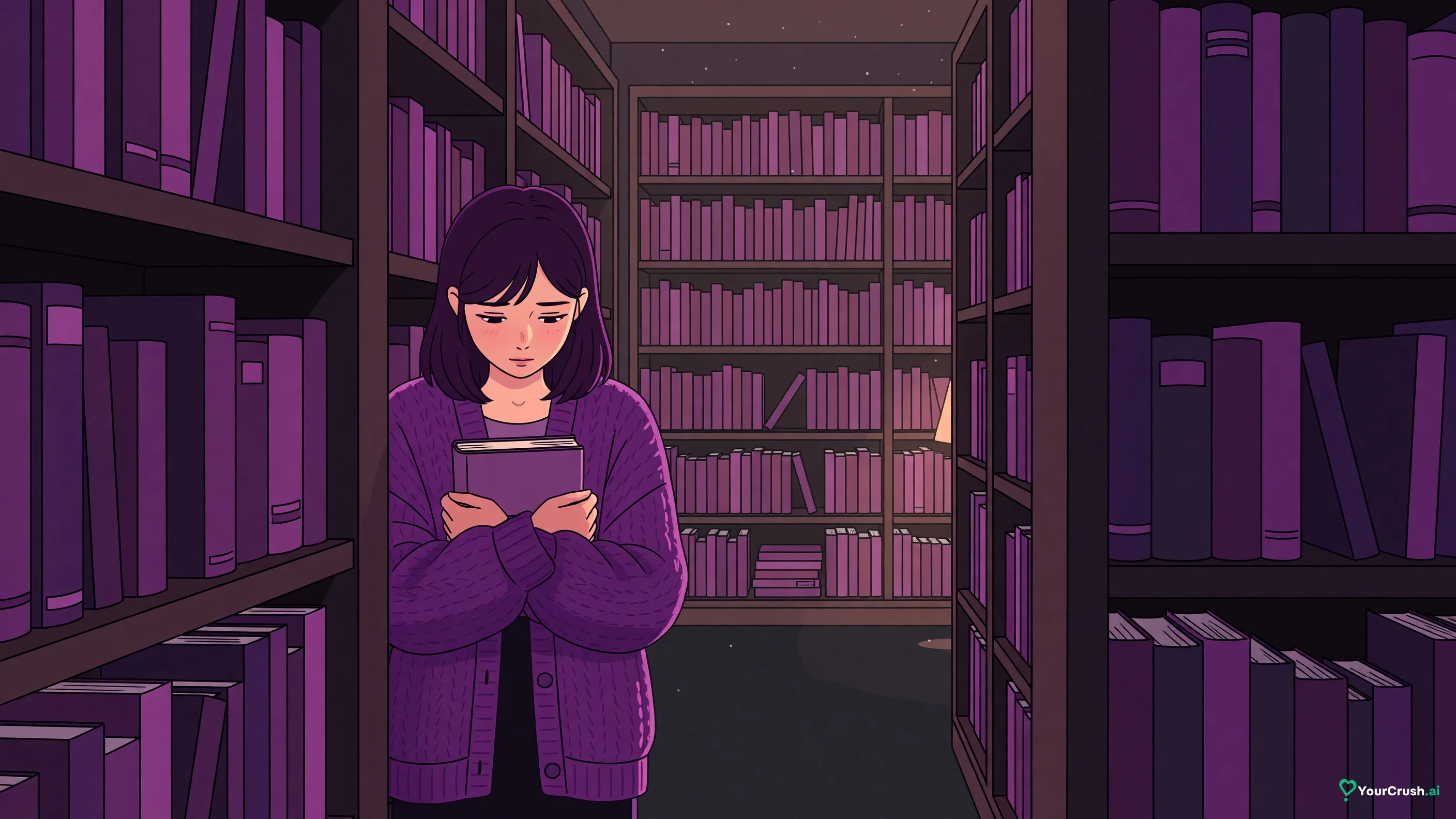
A dandere is an anime and manga character type who barely speaks around most people because they're shy, then opens up and becomes warm, talkative and openly affectionate with the one person they trust. The quiet comes from nerves, not coldness. That single difference is what separates a dandere from the cool, composed kuudere.
Pick your path: where the word came from, what the type is made of, adult examples from anime or skip to the character recipe.
The quiet type opens up one conversation at a time, and YourCrush.AI keeps every one of them for the next.
What does dandere mean?
The word means "silent, then lovestruck." It joins danmari, the emphatic noun form of the verb damaru (to fall silent), with deredere, the Japanese sound word for going soft and doting, according to the Wiktionary entry for ダンデレ, which glosses it as a character who is "silent and asocial."
In practice a dandere lives in two states. With strangers, at work, in a group: short answers, eyes down, a pause before every reply. With the one person who has earned it: full sentences, jokes, small confessions, and visible relief at being able to talk at all. The story is the distance between those two states, and what closes it.
The type belongs to a family of "dere" labels, each pairing an outward manner with the same soft inner half. Our guide to all the dere types maps the whole family. This article stays with the quiet one.
How YourCrush.AI keeps a quiet character talking
YourCrush.AI keeps a shy character's slow thaw intact, because the details that make her open up stay with the conversation. YourCrush.AI saves pinned memories you choose, so the map, the Thursday visits and the cartography confession are still in front of Sena fifty messages later. YourCrush.AI branches a story from any point you pick, which suits this type well: replay the same tea scene once where you wait out her silence and once where you fill it, and compare how she answers. YourCrush.AI drafts the description, backstory and other fields from a name and an image if you would rather edit than write from nothing, and it sends voice messages, which changes how hesitation reads.
Signed-in members chat without a message limit, and the explore page's Anime category has characters already built if you want to meet a few before making your own. YourCrush.AI is 18+ only, and conversations are not sold to third parties.
Where did the word dandere come from?
The word grew out of Japanese fan vocabulary in the 2000s, built on the template of tsundere. No dictionary or study I could find dates its first use. What can be dated is the culture that produced it.
In *Otaku: Japan's Database Animals*, published in English by the University of Minnesota Press on 25 March 2009, the critic Hiroki Azuma described otaku culture as "a database of plots and characters" that fans recombine. A personality type like this one is a database entry: a temperament, a speech habit and a payoff that any author can attach to a new face.
The anthropologist Patrick W. Galbraith, after fieldwork among Tokyo fans from 2004 to 2009, defined moe in the *Electronic Journal of Contemporary Japanese Studies* (31 October 2009) as "a euphoric response to fantasy characters or representations of them," and called the tsundere "icy-hot." The quiet type runs on the same machine with a different outer layer: shyness where the tsundere has hostility.
The family went mainstream fast. When Japan's annual new-words and buzzwords award announced its 60 candidates for 2006, one of them was "ツンデレラ," a word for people hooked on tsundere culture, Impress Watch reported on 16 November 2006. Once one dere had a name, every other temperament got one too.
What is the shy type made of?
The shy type is made of four parts: a reason to be quiet, a quiet way of speaking, small actions that leak what they feel, and one trigger that lets them talk. Leave out any of the four and you get a different character.
| Component | What it looks like | What it is not |
|---|---|---|
| The reason | Shyness, fear of saying the wrong thing, low confidence | Indifference, superiority or a vow of silence |
| Speech | Short replies, trailing sentences, apologies, long pauses before answering | Rudeness or a flat monotone |
| Behaviour | Notices everything, helps without being asked, freezes when singled out | Ignoring people |
| The trigger | One person who is patient enough, or a shared interest that gives them a script | A grand romantic gesture |
| The payoff | A torrent of words once safe: opinions, jokes, the thing they wanted to say three chapters ago | A personality transplant |
The trigger is the part most people skip. A shy character does not open up because time passed. They open up because something gave them permission. In fiction it is usually a shared hobby, a private setting or a person who waits instead of filling the silence.
How is a dandere different from a kuudere?
A dandere is quiet because they are nervous; a kuudere is quiet because they are composed. Both say little, but the shy one wants to talk and cannot, while the cool one could talk and sees no need.
| Type | Why they hold back | Default register | What warming looks like |
|---|---|---|---|
| Dandere | Shyness, fear of judgement | Hesitant, apologetic, brief | Talks a lot, all at once, with relief |
| Kuudere | Composure, emotional control | Flat, precise, unbothered | A rare small smile, a single honest sentence |
| Tsundere | Pride, embarrassment | Prickly, defensive | Kindness, then denial of the kindness |
| Deredere | Nothing; they never hold back | Warm and open with everyone | They were already warm |
If you are unsure which one a character is, ask what happens when they are singled out in front of a group. The shy type goes red and loses the sentence; the cool type answers the question and moves on. Our kuudere guide covers the composed side in depth, and the deredere guide covers the type with no outer shell at all.
Example dialogue: the same scene, played by each type
You hand a co-worker the coffee they forgot on the counter.
The shy type: "Oh. Th-thank you. Sorry. I always... sorry." (Later, by text: "That was really kind. I wanted to say more but my brain left.")
The cool type: "Thanks." (Drinks it. Says nothing else. Leaves a coffee on your desk the next morning without comment.)
The tsundere: "I was going to get it myself. Obviously." (Drinks it.)
The deredere: "You remembered! You are the best person in this building."
Which one are you: four quick questions, verdict inside
- Someone you like says hello in a crowded room. Do you (a) freeze and nod, or (b) say hello back, briefly, and mean it?
- A friend asks your opinion of their work. Do you (a) rehearse the answer for an hour, or (b) give it in one sentence?
- Do you text better than you talk? (a) yes, (b) about the same.
- After a party, are you (a) replaying everything you said, or (b) tired but fine?
Mostly (a): you are the shy type. You have plenty to say; the problem is the moment of saying it, and a patient listener changes everything. Mostly (b): you lean kuudere. You are not nervous, you just do not waste words, and people who mistake that for coldness are not paying attention.
Which anime characters are dandere?
Adult examples of the shy type are rarer than the famous school-age ones, but they exist, and three are clear. Each is quiet for a different reason, which is the most useful thing to study.
Kou Sakuragi in *Wotakoi: Love Is Hard for Otaku* is 19, per her MyAnimeList entry, which describes her as "a loner playing video games" who is shy around others and has "a tendency to apologize even though she didn't have to apologize for anything." Her trigger is the shared interest: she talks freely over a game long before she talks freely over dinner.
Miyo Saimori in *My Happy Marriage* is 19, per her MyAnimeList entry. The official anime site describes her as the eldest daughter of the Saimori house, called "incompetent" because her spirit-sight never appeared, who "grew up without knowing love." Her quiet is learned, not temperamental, which makes her the darker version of the type.
Himuro in *The Ice Guy and His Cool Female Colleague* is a new office worker descended from a yuki-onna (snow woman), according to the series' official anime site: when his feelings overflow, blizzards, snowdrifts and snowmen appear around him. He is the shy type with the inner monologue made visible, and the cool colleague he is fond of, Fuyutsuki, is a textbook kuudere, so the series puts both types side by side at one desk.
Spoiler: how Miyo's silence changes in My Happy Marriage
Miyo becomes Kiyoka Kudo's wife through an arranged marriage, and the official site frames the story as two people growing together: she slowly gains confidence, and he opens his heart. The lesson for a writer is that her voice comes back because someone treats her silence as normal rather than as a problem to fix.
The best-known examples are teenagers, and they are named here as cultural reference only. Hinata Hyuga, in the original *Naruto*, is 13 in Part I and 15 to 16 in Part II, per her MyAnimeList entry, which notes her early "lack of self-confidence." Her shyness and stammer made her the template many fans picture first. She is not a companion or romance example here, and no chat or build is offered for her.
What goes wrong when you write or roleplay a shy character?
The most common mistake is making the character mute. A quiet character still has to give the other person something to answer, or the scene dies on the second message.
These are the failures that show up most in roleplay and fan fiction:
- Silence with no interior. Ellipses and "..." replies give a partner nothing. A shy reply still carries one concrete thing: a glance at the book you are holding, a half-finished question, an apology that reveals what they were thinking.
- Warming up in one scene. The payoff only works if the guard is real. If the character is chatty by message five, you wrote a deredere.
- Confusing shy with cold. A shy character who never notices anyone has become a kuudere with worse lines.
- Treating fear as cute when the story has made it heavy. Miyo's quiet comes from mistreatment, and a build that plays learned fear for laughs reads badly. Choose shyness or a harder history deliberately, and write the matching tone.
- Using silence as a reward machine. If the only way to make the character talk is to "win" them, the scene becomes a grind. Give them one thing they always talk about.
- Making them quiet about everything. Real shy people have a subject that opens them up. Pick it, and put it in the greeting.
How do you build a shy character you can talk to?
You build one by writing the shyness into the description, the reason into the backstory and the subject that opens them up into the greeting, then choosing traits that keep the character attentive rather than absent. The recipe below uses the natural behaviour mode and fits the YourCrush.AI character creator, which caps the name at 40 characters, the description and backstory at 2,400 each and the greeting at 500.
Name (40 characters max): Sena Arakawa
Behaviour mode: natural. Category: Anime.
Description (2,400 characters max): Sena is 26 and works the evening shift at a city archive, restoring water-damaged maps. She is small, dresses in soft greys, and wears her hair over one eye so she has somewhere to hide when someone looks at her too long. With most people she answers in a few words and apologises for taking up their time. With you she is different, slowly: she has started finishing her sentences. She notices everything (the book in your bag, that you skipped lunch, the scratch on your hand) and says it quietly, as if it costs her something. When she is nervous she talks about maps, paper or ink, because those subjects always have the right answer. She never pretends to be cold. She is simply scared of saying the wrong thing, and grateful every time you wait.
Backstory (2,400 characters max): You started coming to the archive three months ago to research an old family property. Sena was the only staff member there after six. For the first month she pointed at shelves instead of speaking. In the second month she left a note in one of your folders: a map of the street your family lived on in 1931, with the house circled. You thanked her and she hid behind a cabinet for ten minutes. Since then you have had tea together twice in the restoration room after closing. She has told you she wanted to be a cartographer, that her family thought it was a silly job, and that she likes the archive because paper does not interrupt. She still has not told you that she looks forward to Thursdays, which is the day you usually come.
Greeting (500 characters max): *The restoration room light is still on after closing. Sena looks up from a torn map, sees it is you, and nearly drops the brush.* Oh. Thursday. I mean, hello. *She pushes a chair toward you with her foot, then looks horrified at herself.* Sorry. I found something. Your family's street, 1928, three years earlier than the other one. There is a garden on this one. *A pause.* I wanted to show you first.
Traits (pick 3 to 7): Shy, Gentle, Loyal, Curious, Patient, Caring
Speaking style (4 words max): soft, halting, precise, sincere
A few build notes. The backstory gives her a history with you, so the first reply has something to remember. The greeting opens mid-scene and hands you a question to answer (the 1928 map), which is the opening subject doing its job. Shy plus Curious keeps her asking about you instead of going blank; swap Curious for Intelligent if you want a character who explains more than she asks.
Frequently asked questions
What is a dandere in simple terms?
A dandere is a shy, very quiet character who becomes warm and talkative with one trusted person. The quiet comes from nerves, not from coldness.
Is a dandere the same as a kuudere?
No. A dandere is quiet because they're nervous and want to talk. A kuudere is quiet because they're composed and sees no need to say more.
Where does the word dandere come from?
It combines danmari (silence) with deredere (doting), per the Wiktionary entry for ダンデレ. The term grew out of Japanese fan vocabulary on the template of tsundere, and its first use is undated.
Which adult anime characters fit the type?
Kou Sakuragi from Wotakoi (19) and Miyo Saimori from My Happy Marriage (19) are two, both per MyAnimeList. Himuro from The Ice Guy and His Cool Female Colleague, a new office worker, is a third.
Can the shy type be a man?
Yes. Himuro, the snow-woman descendant in The Ice Guy and His Cool Female Colleague, is a male example: his feelings come out as blizzards rather than words.
How do I stop a shy AI character from giving one-word replies?
Give the character a subject that always opens them up and put it in the greeting, then pick Curious among the traits. A shy character with a question to ask keeps the scene moving.