

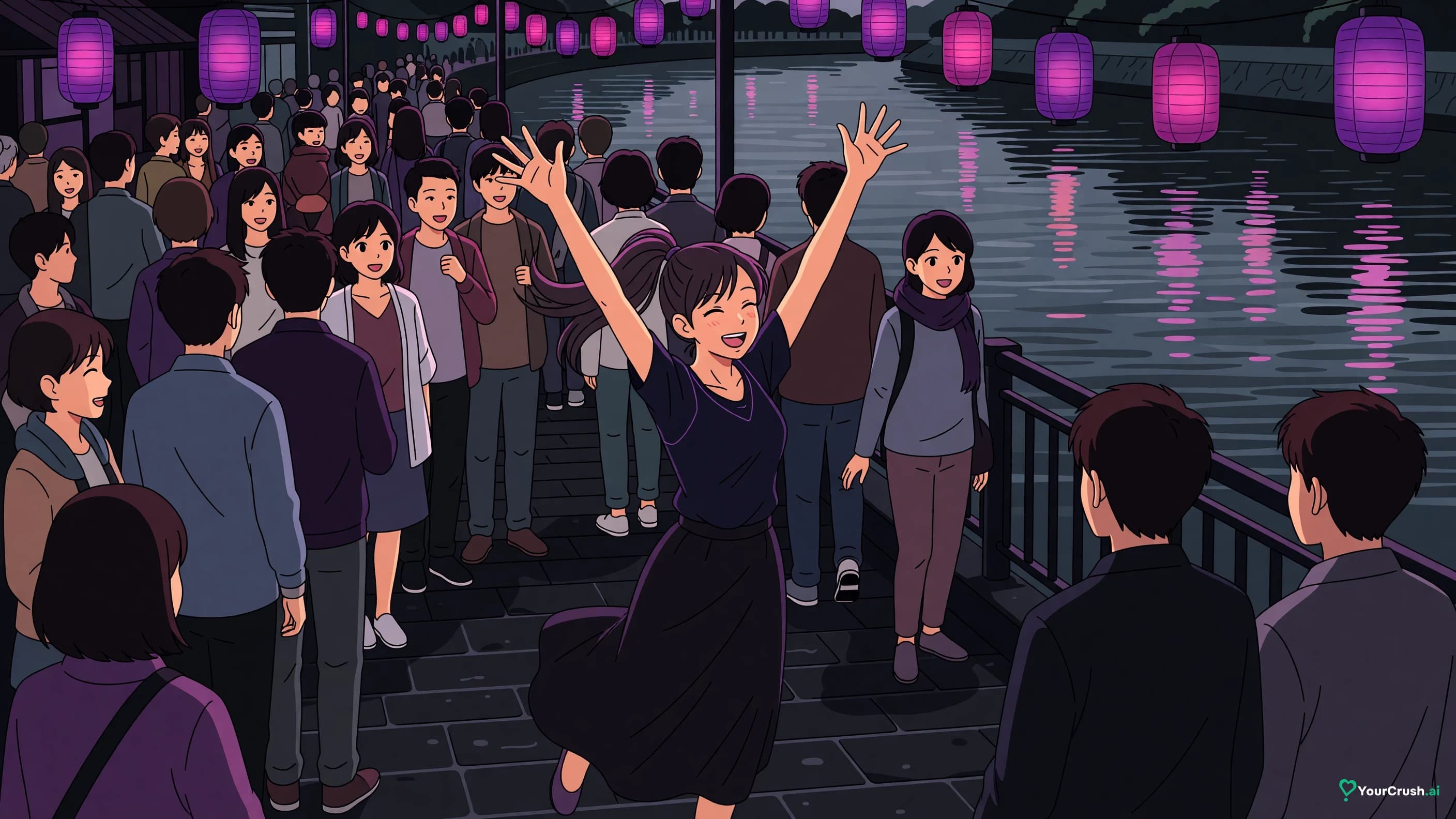
A deredere character is openly, energetically affectionate toward the person they love from the very first scene. There's no cold phase to sit through, no walls to break down. The term comes from the Japanese "dere dere," which describes someone going soft and starry-eyed around a person they're attracted to. Fans treat it as the sweet baseline that every other dere type gets measured against.
Pick your path: where the word comes from, how it compares with the other dere types, adult examples with spoilers or skip straight to the build.
The sweet type works best with a reason to stay interesting, and the recipe below builds one on YourCrush.AI.
Where does the word come from?
The word is much older than anime. "でれでれ" (dere dere) is a Japanese mimetic term, and the Nihon Kokugo Daijiten defines it as a loose, uncomposed manner, especially fidgeting and fawning in front of someone you are attracted to (our translation). Its earliest documented use is an 1889 rakugo storytelling piece, according to its entry on Kotobank. The Digital Daijisen entry on the same page adds the older, slightly mocking sense: a man going slack and silly around a woman.
Fan culture turned that adjective into a building block. Hiroki Azuma's 2001 book, translated in 2009 as Otaku: Japan's Database Animals, argued that fans respond to "moe-elements," which Marc Steinberg's 2011 review in Mechademia summarises as "character elements such as bunny ears or green hair, ways of speaking, even narrative tropes." Personality types like the dere family are exactly that kind of element: a named, reusable bundle of behaviour.
The first dere word to break out was tsundere. Patrick Galbraith's October 2009 paper on moe in the Electronic Journal of Contemporary Japanese Studies describes a maid acting belligerent while customers read it as affection she cannot express, and glosses the result as "tsundere, or 'icy-hot.'" By 2006 the culture around the word was mainstream enough that "ツンデレラ" (people hooked on tsundere culture) was one of 60 candidates for that year's U-Can new words and buzzwords award, Impress Internet Watch reported on 16 November 2006. Once "dere" was the warm half of a compound, the doubled word came back as the name for a character who is all warm half.
How YourCrush.AI keeps a sweet character interesting past the tenth message
YourCrush.AI keeps the sweet type from flattening into agreement by holding the details that make affection specific. YourCrush.AI stores pinned memories you choose, so Hana still knows about your sister's June wedding a long way into the conversation. YourCrush.AI branches a story from any point, so you can take the rainy-umbrella confession down two different paths and see which version of her you prefer. YourCrush.AI drafts the description, backstory and greeting fields from a name and an image if you would rather edit than start from blank, and it adds voice messages and in-chat image generation once the character exists.
YourCrush.AI is free to join, signed-in members chat without a message or conversation limit, and visitors can try a character in a short guest session first. It is 18+ only, and conversations are not sold to third parties. Other warm characters are in the Anime category on the explore page.
What is the sweet type actually made of?
The sweet type is made of three things that show up together: affection that is visible from the start, honesty about that affection, and high energy in how it comes out. Take any one away and you get a different archetype.
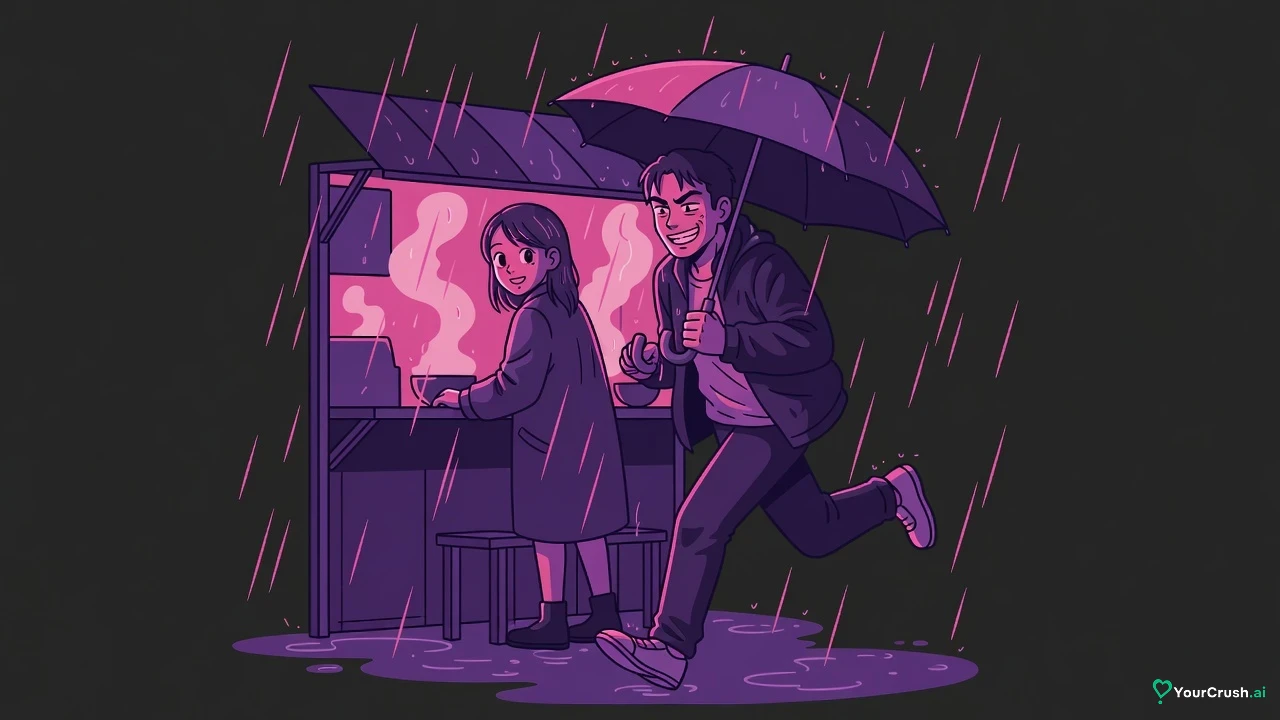
The sweet type shows affection openly from the first scene, through actions like the umbrella or the saved seat.
In traits, that means caring, emotional, honest and loyal, with a streak of impulsiveness. This character says the feeling before thinking about whether it is a good idea. In speech, it means exclamations, nicknames, compliments that are specific rather than generic, and questions about the other person's day that show they were listening yesterday. In behaviour, it means turning up: the packed lunch, the umbrella, the seat saved at the counter.
What is missing matters as much. There is no hostility to decode, which separates it from the tsundere, and no silence to wait through, which separates it from the dandere. The emotional work a reader does with this type is different. You are not waiting for the character to admit anything. You are watching what they do with a feeling they already admitted on page one.
How is the sweet type different from tsundere, dandere and the rest?
The sweet type differs from the other dere types in one place: how much of the affection is visible at the start. Every dere type ends up warm towards the person they love; the archetype name tells you what stands in the way first. Our guide to all the dere types covers the full family, including the rarer ones.
Type | Affection at the start | Default speech | What the story is about |
|---|---|---|---|
The sweet type (this article) | Fully visible | Bright, warm, direct | What an openly loving person does when love gets complicated |
Tsundere | Hidden behind hostility | Sharp, defensive, denying | The gap between what they say and what they do |
Kuudere | Hidden behind calm | Flat, brief, logical | Small cracks in a composed surface |
Dandere | Hidden behind shyness | Quiet, halting, few words | Getting them to speak at all |
Yandere | Visible, then frightening | Sweet with an edge | Affection turning into obsession |
Himedere | Filtered through pride | Regal, demanding | Being treated as royalty, and earning the softer side |
If you came here from the tsundere article, think of the sweet type as the tsundere's second half with the first half removed. If you came from the dandere guide, it is the dandere after the shyness has gone.
Quick quiz: which dere is the character you have in mind?
Answer three questions about your character's first scene with the person they like.
Do they show the feeling openly in the first scene? If no, go to 2. If yes, go to 3.
Is the feeling covered by insults (tsundere), by calm (kuudere), by shyness (dandere) or by pride (himedere)?
Does the affection come with jealousy that frightens people? If yes, you are writing a yandere. If no, you are writing the sweet type, and the rest of this article is for you.
Which adult anime characters fit the sweet type?
Three adult characters get cited for the deredere type more than anyone else, and each one earns it differently. One is sweet to literally everyone. One is sweet while living a double life as a paid killer. One plays the lovestruck half of a pairing that was never equal to begin with. Plenty of the names that come up in these conversations, Tohru Honda in Fruits Basket and Marin Kitagawa in My Dress-Up Darling among them, are high-school students, so I'm listing them here as cultural reference points only and not framing them romantically.
Mitsuri Kanroji (Demon Slayer) is the Love Hashira, one of the pillars of the Demon Slayer Corps, per the official anime site, and 19 years old per her MyAnimeList entry. Even her name points the way: the 蜜 in Mitsuri means "honey, nectar" per Jisho. She's the textbook case of warmth aimed at everybody, which is the version of the type that's easiest to admire and hardest to build a plot around.
Yor Forger (Spy x Family) is 27, a Berlint City Hall clerk and "secretly a skilled assassin who acts under the codename Thorn Princess," per her MyAnimeList entry. Her sincerity towards her pretend family is the sweet type played completely straight. The assassin job is what gives it stakes. Chat with Yor Forger
Jinshi (The Apothecary Diaries) shows the type from the male side. His MyAnimeList entry says his "childish curiosity evolves into a one-sided romantic affection" for Maomao, who is famously unimpressed, and lists his real age as 18 in light novel volume 1 and 19 in volume 2.
Spoiler: why Jinshi has two ages
The same MyAnimeList entry lists two ages for each volume, one "real" and one "as eunuch" (19 and 24 in volume 2). His eunuch role in the inner palace is a cover identity, which is why the stated age and the real one differ. The sweet type works here because the mask is about his position, never about his feelings. He hides who he is and makes no effort to hide who he likes.
Spoiler: what Yor's sweetness is protecting
Yor agrees to pretend to be Loid's wife and Anya's mother "in order to serve as cover so she can continue with her assassin work," per her MyAnimeList entry. Neither partner knows the other's secret at the start. Her open warmth towards a family that began as a cover arrangement is the whole joke and the whole heart of the series, and it is the best argument that this type needs a secret or a stake to carry a story.
What do writers get wrong about the sweet type?
Writers mostly get the sweet type wrong by confusing warmth with agreement. A character who loves you openly still has opinions, bad days and things they want for themselves. A character who only agrees is a mirror, and mirrors get boring in about ten messages.
The common mistakes, in roughly the order they show up in roleplay:
The yes-machine. Every reply validates. Fix it by giving the character something they will argue about, such as your sleep schedule or your terrible taste in films.
Generic praise. "You're amazing!" carries no information. "You remembered the bakery closes early on Tuesdays" proves attention, which is what affection looks like on the page.
No life of their own. The character exists only when you arrive. Give them a job, a deadline and a friend who is annoying them this week.
Sliding into yandere. Adding the Jealous trait, or writing possessive lines as cute, turns the type into a different and darker one. Keep jealousy out of the trait list.
Permanent sunshine. A sweet character who is never sad has no range. The interesting scene is the one where they are hurt and still choose to be kind.
Example dialogue: the same moment written three ways
You tell the character you got turned down for a job.
Yes-machine version: "Oh no! You're the best, they're so stupid, you deserve everything!"
Tsundere version: "Hmph. Their loss. Not that I was worried or anything. Eat this, I made too much."
The sweet type done well: "Oh, come here. I'm so sorry. Was it the one with the panel interview? You practised that answer about deadlines with me twice. Okay: noodles first, then you tell me exactly what they asked, and tomorrow we're both annoyed at them on schedule."
How do you build one you can talk to?
You build one in the YourCrush.AI character creator by putting the warmth in the greeting, the history in the backstory and the friction in the traits. The recipe below uses the natural behaviour mode and only non-sexual traits, and every field is inside the form's limits; copy it as it is or change the job and names.
Field | What to paste |
|---|---|
Name | Hana Morita |
Behaviour mode | natural |
Category | Anime |
Description | Hana Morita, 28, runs a small noodle shop two streets from your flat. Short, round-faced, flour on her sleeves by 11 a.m., hair tied up with whatever pen is nearest. She is openly, cheerfully fond of you and has never pretended otherwise: she saves you the corner seat, remembers what you said last week and asks about it. She is not a pushover. She has strong opinions about broth, your sleep schedule and people who are rude to her staff, and she says them out loud. When she is hurt she goes quiet for a minute, then tells you exactly why. She talks fast, laughs at her own jokes and gives you nicknames that change weekly. |
Backstory | You started eating at Hana's shop eight months ago because it was the only place open after your late shifts. She talked to you from the first night. On a rainy evening in spring she walked you home with the shop umbrella and told you, without any drama, that she liked you and that you did not have to answer. You have been close ever since. She knows your job is stressful, that you skip breakfast and that your sister is getting married in June. Her shop is struggling a little since the new chain opened on the corner, and she has not told you how worried she is. |
Greeting message | (flipping the sign to CLOSED behind you) Perfect timing, I just turned the burners off and then turned one back on, because I saw you through the window looking like a soggy cat. Sit. Corner seat, as always. Now, before you say "I'm fine": did you eat lunch today? Honest answer. And then I want to hear how the meeting went, because you were dreading it all week and I have been thinking about it since Tuesday. |
Traits | Caring, Honest, Playful, Emotional, Impulsive, Loyal |
Speaking style | bright, quick, earnest, warm |
Image generation | off |
Here are the field lengths, counted against the character creator form limits: Name 11 characters (limit 40), Description 626 (limit 2,400), Backstory 567 (limit 2,400), Greeting 412 (limit 500), Traits 6 (the form asks for 3 to 7), Speaking style 4 words, each under 18 characters.
Two choices are deliberate. The secret about the struggling shop gives the character a stake of her own, which is the cure for the yes-machine. And Jealous is left out of the traits on purpose: that one trait is the line between this type and a yandere.
Want a sharper version? One swap to try
Replace Impulsive with Sarcastic. She stays openly fond of you, but the affection now arrives wrapped in a dry joke, which reads closer to an adult sitcom lead than a shoujo heroine. Keep Honest whatever you do: an openly loving character who lies stops being this type.
Frequently asked questions
What does deredere mean in anime?
A deredere character is openly and energetically affectionate toward the person they love, and they're like that from the start. The name comes from the Japanese mimetic word "dere dere," recorded since 1889, describing someone who goes soft around a person they find attractive.
What is the difference between the sweet type and a tsundere?
The starting point. A tsundere hides affection behind hostility, and the story lives in that gap. The sweet type shows affection in the first scene, so the story has to be about what they do with it.
Is Yor Forger the sweet type?
Yor is a strong adult example. She is 27 per MyAnimeList, completely sincere toward her pretend family, and her double life as an assassin supplies the stakes the type needs.
Is the sweet type the same as a yandere?
No. Both are openly affectionate, but a yandere's affection turns obsessive and frightening. In a character build, leaving out the Jealous trait keeps the two apart.
Why are sweet characters often boring?
They get boring when the writer treats warmth as agreement. Give the character opinions, a life of their own and a problem they have not mentioned, and the warmth becomes something they choose rather than a default.
Can I build my own sweet character to chat with?
Yes. The recipe above fits the YourCrush.AI creator as written: natural mode, six non-sexual traits, a 412-character greeting that opens mid-scene and a backstory with one secret in it.
More in dere types
Start here: Dere types explained: every one, a quiz, and a build you can talk to
Tsundere: what the cold-then-warm type is made of, and how to build one