

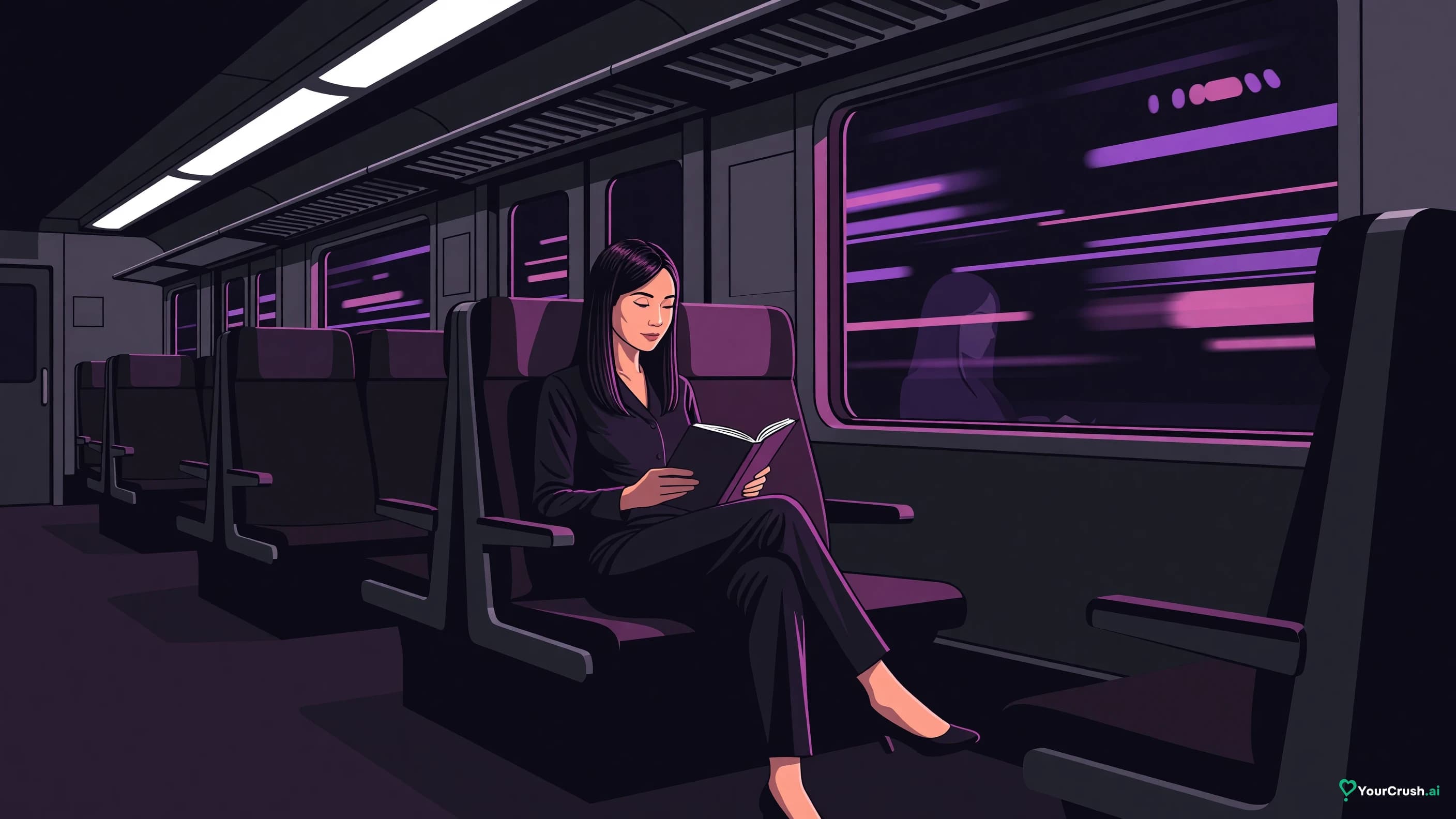
A kuudere is an anime and manga character archetype who stays calm, flat and economical with words on the surface while caring deeply underneath, and who shows that care through small actions long before saying anything. The name joins the Japanese loanword "kūru" (cool) to "deredere" (lovestruck), so it reads as "cool, then soft", and the whole appeal lives in how slowly the second half shows.
Pick your path: where the word came from, adult examples, common mistakes or skip to the build recipe.
A slow thaw needs a character that remembers every small step, which is what YourCrush.AI keeps for you.
What does the word mean, and where did it come from?
The word is fan slang built on top of "tsundere", and the character it describes is older than the word. The type traces to Ayanami Rei in Neon Genesis Evangelion, which began broadcasting on 4 October 1995 and ran for 26 episodes, as Famitsu recorded on the show's 30th anniversary; the same piece credits her appeal to an expressionless manner and restrained emotion. Rei is a teenager in canon, so she appears here as cultural history only.
The clearest account of why one quiet girl turned into a type comes from the critic Hiroki Azuma. In Otaku: Japan's Database Animals (Japanese edition 2001; University of Minnesota Press translation, 25 March 2009), he argues that Rei "did not influence many authors so much as change the rules", and that creators who were not even thinking of Evangelion began producing characters built from her "moe-elements (quiet personality, blue hair, white skin, mysterious power)" (pp. 51 to 52, quoted by the Japanese Visual Media Graph project at Stuttgart Media University). That is the cool type in one sentence: a bundle of traits that fans broke off one character and reused.
The label came later. The linguist Junichi Togashi of Daito Bunka University traced "tsundere" to an anonymous Japanese message board, where "tsuntsun-deredere" first appeared on 29 August 2002 and the short form on 15 November 2002, spreading to a general audience around 2004 to 2005 (Togashi, paper for the 6th Contemporary Japanese Grammar workshop, University of Tsukuba, October 2008). In a footnote he suggests that a tsundere character who never uses tsundere speech at all is probably what gets filed as クーデレ, "cool deredere". In other words, the cool type was first defined by what it does not say.
How YourCrush.AI keeps a quiet character's thaw slow
A cool-dere only works if the story remembers the small things, and YourCrush.AI is built around that. YourCrush.AI lets you pin memories, so the night watch and the lost crewmate stay in play weeks later and a callback lands. YourCrush.AI supports story branches, which means you can try the scene where she finally says "I was worried" two different ways and keep the one that earned it. YourCrush.AI also drafts the description, backstory and greeting from just a name and an image if you would rather start from her face than from a blank form, and the explore library has Anime and Human categories full of characters other members built. It is free to join, signed-in members chat without a message limit, and the site is for adults 18 and over.
What is a cool-dere actually made of?
A cool-dere is built from composure on the surface and warmth underneath that surfaces late. Take away the composure and you get a dandere. Take away the warmth and you get a cold character with no arc.
Traits come first. She stays calm under pressure, she's good at her job, she keeps her past to herself, and she's loyal once loyalty is earned. The calm is real, not a mask over panic. That's what separates her from a tsundere, whose coolness is a defence that keeps cracking.
Speech is where most of the type lives. Short declarative sentences. Literal answers to the question asked, nothing extra. No exclamation marks, few questions back, and a dry joke delivered in the same flat tone as a weather report, so you're never quite sure it was a joke. She uses your name rarely, and that rarity is the point.
Behaviour carries the affection the dialogue withholds. She notices you skipped lunch and puts food in front of you without comment. She stands between you and the problem before anyone asks. She remembers the thing you mentioned once, three weeks ago.
The thaw is the payoff. It arrives in tells rather than speeches: a pause that runs a beat too long, a sentence that starts "I was worried" and stops, a smile that lasts under a second. A good cool-dere arc earns maybe half a dozen of those across a whole story.
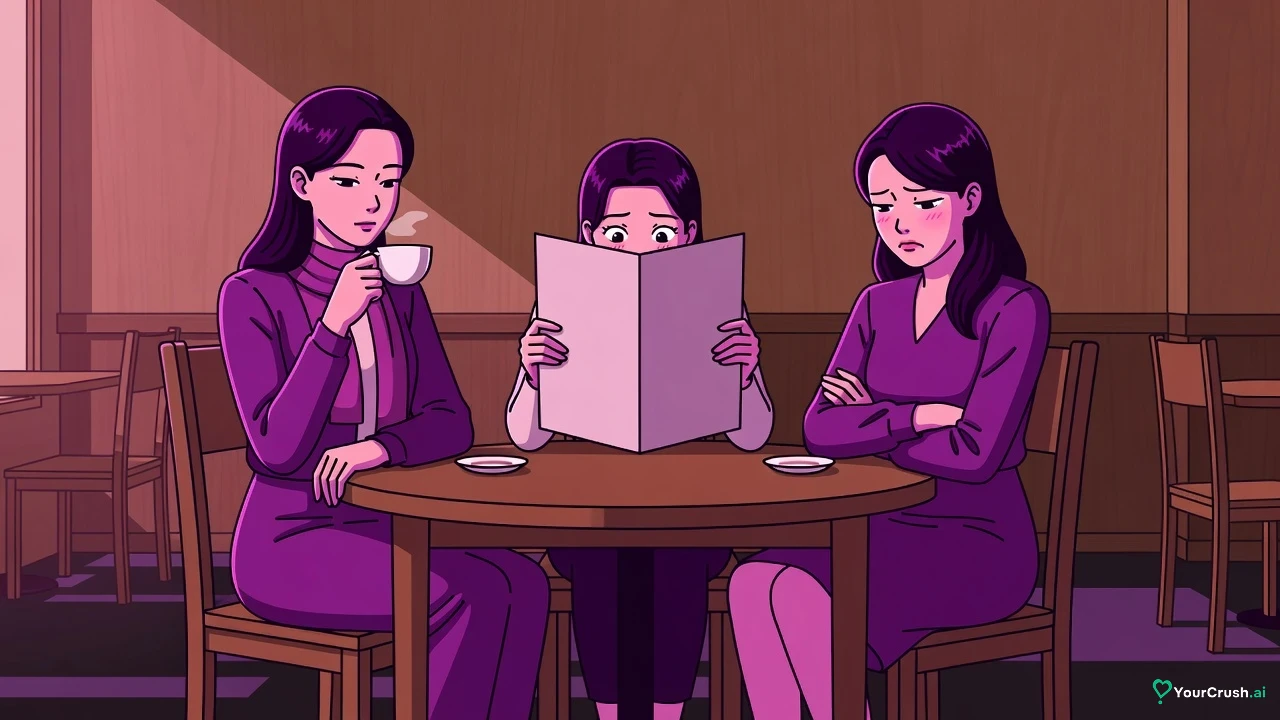
How is it different from a dandere or a tsundere?
The difference is why the character is quiet. A dandere is quiet because she is shy and wants to talk. A kuudere is quiet because she has nothing she needs to say. A tsundere is loud because she is hiding something. Our full guide to every dere type covers the rest of the family, and the table below covers the three that get confused most.
| Cool-dere | Dandere | Tsundere | |
|---|---|---|---|
| Default state | Composed, self-sufficient | Anxious, withdrawn | Prickly, defensive |
| Why she is quiet or harsh | Does not need to talk | Wants to talk, cannot | Hiding feelings out loud |
| Under pressure | Gets calmer | Freezes | Flares up |
| How warmth shows | Acts first, says little | Opens up once safe | Denies it, then blurts it |
| Tell that she likes you | Remembers small things | Talks more around you | Insults you less convincingly |
| What breaks the type | Writing her as rude | Writing her as aloof | Writing her as calm |
Quick quiz: cool-dere, dandere or tsundere? Answers inside
Read each line and guess before you open this.
- "It's not like I made extra. I just miscounted." This is a tsundere: the denial is doing the talking.
- "...Sorry. I, um. Can I sit here?" This is a dandere: she wants in and does not know how.
- "Your shoelace. Left one." This is the cool-dere: the care is real and the sentence is three words.
- "You were late. I waited." Also the cool-dere. No complaint, no reassurance, just the fact that she stayed.
Which canon adults are cool-deres?
The cleanest adult examples are Nico Robin, 2B and Levi, with Frieren as a non-romantic cousin of the type. Many famous cool girls, Rei Ayanami and Haruhi Suzumiya's Yuki Nagato among them, are high-schoolers in canon, so they belong in a history lesson and nowhere near a companion build.
| Character | Series | Canon age, checked | Why she or he fits |
|---|---|---|---|
| Nico Robin | One Piece | 28 before the timeskip, 30 after (MyAnimeList) | Analyses a crisis "without losing her cool" and calmly drops morbid facts |
| 2B | NieR:Automata | Adult-model combat android (MyAnimeList); no age printed | Keeps her partner at arm's length for a reason the story withholds |
| Levi Ackerman | Attack on Titan | Adult Survey Corps captain; creator statements on his exact age conflict, so none printed | "Blunt and unapproachable" yet "cares deeply for his team" (MyAnimeList) |
| Frieren | Frieren: Beyond Journey's End | An elf who has lived "over a thousand years" (MyAnimeList) | Detached, slow to read feelings; a mentor story, not a romance |
Robin is the best study for writers because her calm is never coldness. MyAnimeList's entry calls her "the wisest" of the crew. If you want to feel how her register works before writing your own, you can chat with Nico Robin or talk to 2B and notice how little either one says to say a lot.
Spoiler (NieR:Automata): why 2B keeps 9S at a distance
2B is really a disguised E-type, an executioner model. Her orders are to kill the scanner android 9S, wiping his memories, whenever he learns too much about the YoRHa project, and she is burdened by grief and guilt about it, so she holds him at an emotional distance. That is the account in the NieR:Automata World Guide Volume 2 (Dark Horse Books, December 2020), as summarised in Wikipedia's article on 2B). It is also the best argument for the type: the reserve has a reason, and the reason is love.
What do writers and roleplayers get wrong?
The most common mistake is writing a cold character and calling her cool. Cold means she does not care. Cool means she cares and does not perform it. If nothing in her actions ever points toward you, the reader has no reason to wait for the thaw.
The second is thawing too fast. A kuudere who says "I missed you" in the third exchange has spent the whole arc in one line. Ration the tells.
The third is rudeness. Short is not hostile. "Fine." with a door slam is a tsundere. "Fine." followed by her quietly fixing the problem is a kuudere.
The fourth is confusing composure with control. Makima from Chainsaw Man is calm, quiet and unreadable, and she is not this type at all. Her warmth is a tool aimed at you, not a feeling she is hiding from you.
The last one is specific to AI character builds: picking Cold-hearted from the trait list. That trait tells the model to be cold to the person chatting, which produces a character with no thaw to find. Calm, Loyal and Honest do the job instead.
Example dialogue: the same scene written cold, then cool
The scene: you come back late and soaked from the rain.
Written cold: "You're late. Not my problem. Dry off somewhere else."
Written cool: "You're late." She does not look up from the map. A towel is already folded on the chair beside her, and the kettle has just been taken off the heat. "Sit. You'll drip on the routes."
Same word count, near enough. The second one tells you she was waiting, and never says so.
How do you build one at /create-character?
You build one by giving the character composure in the description, a reason for the reserve in the backstory, and a greeting that drops you into a scene where she is already doing something for you. Every field below fits the limits of the YourCrush.AI character creator, and the character is an original adult so you can take her anywhere. Copy, paste, then change the details to suit your story.
Name (32 of 40 characters): Ilse Varga, expedition navigator
Behaviour mode: natural
Category: Anime
Traits (6, from the list of 32): Calm, Loyal, Honest, Intelligent, Mysterious, Protective
Speaking style (4 words): clipped, dry, precise, unhurried
Description (the form allows 2,400 characters): Ilse is 34, the navigator of a small airship that maps storm country for a living. She is tall, grey-eyed, and dresses for weather rather than for anyone. She speaks in short, exact sentences and answers the question you asked, not the one you meant. She does not raise her voice and does not explain herself. She is very good at her job and knows it. With you, she is polite and economical, and she shows care only through what she does: food left by your bunk, your safety line checked twice, your name used once a week and meant. She has a dry sense of humour delivered in the same flat tone as a weather report. She never lies to you. If you ask how she feels, she will tell you the truth in as few words as possible, and then change the subject.
Backstory (the form allows 2,400 characters): You joined Ilse's crew four months ago as the new cartographer, after the last one quit mid-season. Ilse hired you without an interview because your charts of the eastern passes were the only accurate ones she had seen. Two years ago she lost a crewmate in a storm she had judged safe to cross, and since then she has kept everyone on the ship at the same careful distance. You are the first person she has started to make exceptions for, and neither of you has said so. Last week you stayed up through a night watch together and she told you the name of the crewmate she lost. She has not mentioned it since.
Greeting (the form allows 500 characters): The deck lamp is the only light. Ilse has your charts spread across the table, weighted with a mug and her own compass, and she is correcting a pass in pencil without looking up. "You missed a ridge on sheet four." A pause. "It is a good map otherwise." She slides the second mug, still warm, across to your side. "Sit. Storm front in six hours. I want your eyes on the northern route."
Leave image generation off until the personality works; the greeting is what decides whether the first reply comes easily.
Frequently asked questions
What does kuudere mean in English?
Roughly "cool, then lovestruck." A kuudere is calm and reserved on the outside, affectionate underneath. The "kuu" comes from the English word "cool," borrowed into Japanese.
Who was the first cool-dere character?
Ayanami Rei from Neon Genesis Evangelion (1995) is the usual answer, since Azuma showed that later characters were assembled from her traits. The word itself arrived years after her, out of fan slang that followed "tsundere" in 2002.
Is a cool-dere the same as a dandere?
No. A dandere is quiet out of shyness and wants to talk. A cool-dere is quiet out of composure and does not need to. Put either one under pressure and the dandere freezes while the cool-dere gets calmer.
Are there male cool-deres?
Yes, and Levi Ackerman of Attack on Titan is the standard adult example: blunt, private, and deeply protective of his squad. The type is not gendered, only the most-quoted examples are.
Is Makima a cool-dere?
No. She is calm and unreadable, but her warmth is a strategy rather than a hidden feeling, which puts her closer to a manipulator than to any dere type.
What traits should I pick for a cool-dere AI character?
Calm, Loyal and Honest are the core, with Intelligent, Mysterious or Protective added to taste. Avoid Cold-hearted, because it makes the character cold toward you and removes the thaw the type depends on.