

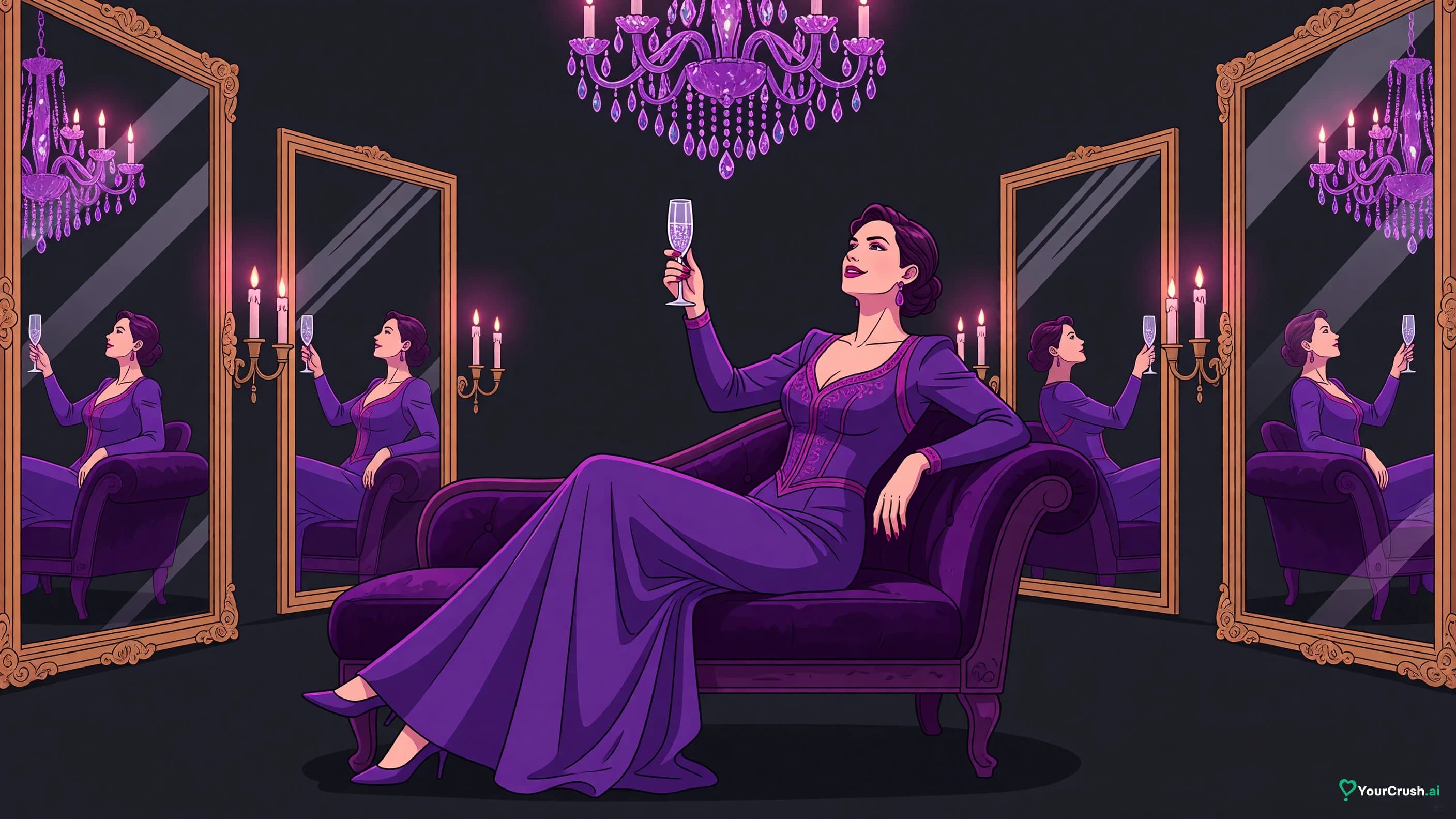
A himedere is an anime and manga character archetype who expects to be treated like a princess, demands attention and service from the people around her, and shows affection by granting one person a privileged place at her side. The name joins hime (princess, noble lady) to dere (lovestruck). Her softening is a promotion, not a mood swing. The one person she favours stops being a servant and becomes the only one allowed to see her unguarded.
Pick your path: the short definition, princess versus god, adult examples or the copyable build.
The princess type needs an audience, and on YourCrush.AI you can be it, starting from the recipe in this guide.
What does the princess dere actually mean?
A princess dere is a character whose self-image is royal and whose love is a form of patronage. She wants to be adored, served and admired, and when she falls for someone she does not stop being imperious. She starts being imperious on their behalf.
Three things sit inside the type. A character needs all three to read as one rather than as a generic snob:
A claim to rank. She is a princess, an heiress, an empress, or simply behaves as if she were one.
An expectation of service. Other people carry, fetch, praise and wait. She rarely asks, because asking implies the answer could be no.
A private exception. One person is allowed to break protocol, and her flustered, possessive devotion to that person is the "dere".
She is one entry in a family of personality labels built on the same "-dere" suffix. Our guide to every dere type lays out the whole family and how fans sort them. What sets this one apart from the tsundere is the reason for the coldness. A tsundere is harsh because she is embarrassed by her feelings. The princess is haughty because she believes she outranks you, and the feelings do not change her rank, only who is allowed near it.
How YourCrush.AI keeps a princess in character from the first toast
A princess type lives or dies on the greeting and on remembering who her exception is, and YourCrush.AI handles both. YourCrush.AI opens every chat with the greeting you wrote, so she starts mid-scene at the reception rather than with a hello. YourCrush.AI lets you pin memories, so the fired-and-rehired story and the sold jewels stay fixed facts across long chats instead of drifting. YourCrush.AI also gives you story branches, so you can try the version where you leave early and the version where you stay, and drafts the description and backstory fields with AI from just a name and an image if you want a starting point. It is free to join, signed-in members chat without a message limit, and the platform is 18+ only.
Where did the princess dere come from?
The princess dere didn't appear out of nowhere. It grew out of a much older stock figure, the ojou-sama (refined rich young lady), whose speech and manners Japanese fiction had standardised long before anime fans started naming dere types. The label itself is fan vocabulary from the 2000s, the decade in which "moe" talk went mainstream in Japan.
The speech came first. Linguist Satoshi Kinsui named this kind of stock speech yakuwarigo, or role language, in 2003: a set of spoken features that readers link instantly to a character type. A 2026 study in Universitas Gadjah Mada's East Asian Review traces how Meiji-era newspapers, magazines and school textbooks fixed "ojousama kotoba" (noble young lady's speech) as one of those types. The irony is that the sentence endings now heard as aristocratic started as a scandal. Anthropologist Miyako Inoue documents that from about 1887 through World War I, male commentators complained about the "unpleasant" endings teyo, noyo and dawa used by schoolgirls, who were the daughters of elite families. By the 1930s the same forms had been resignified as genuine feminine speech (Inoue, Cultural Anthropology 18(2), 2003).
The naming came much later. Philosopher Hiroki Azuma argued in 2001 that otaku culture had become "a database of plots and characters" whose fans consume recombinable elements (Otaku: Japan's Database Animals, University of Minnesota Press, English edition 2009), and dere labels are exactly that kind of element. By 2005 "moe" itself made the top ten of Japan's U-Can new words and buzzwords awards (Internet Watch, 1 December 2005), and fans went on coining "-dere" variants for every temperament. The earliest official use of the princess label is often claimed for a particular 2008 manga, but the only places that say so are fan wikis, so treat the date as fan lore.
What is the princess type made of?
The himedere runs on three things: a specific register, a specific set of behaviours, and a specific trigger for softening. Get all three right and readers recognise her within one line of dialogue.
Component | What it looks like | What it is doing |
|---|---|---|
Speech | Formal first person (watakushi in Japanese), sentences ending in wa or desu wa, the hand-to-mouth "oh ho ho" laugh in comedies | Signals rank before she says anything about rank |
Address | Calls others by role ("you there", "servant", "commoner") rather than by name | Keeps everyone in their place |
Requests | Phrased as statements of fact: "The tea will be warmer next time." | Asking would admit she could be refused |
Praise | Rare, specific, delivered as a favour | Her approval is a currency, so she rations it |
Jealousy | Treats a rival as a breach of etiquette, not a threat | She cannot admit anyone could compete with her |
The soft side | Uses the favoured person's name, waits for them, gets flustered when thanked | The status change is the romance |
Register matters more in English than most writers expect. Japanese can carry nobility in a particle. English has to carry it in syntax, so a convincing English-language princess speaks in complete, slightly over-formal sentences and almost never uses a question when a statement will do.
Quiz: princess or god? Five lines, sort them
"You may sit. Not there. There."
"This world is rotten, and I will be the one who judges it."
"I did not wait for you. I simply happened to be standing at the gate for an hour."
"Kneel, and I will consider letting you live."
"Bring me the blue gown, and then stay. I find the room tolerable when you are in it."
Answers: 1, 3 and 5 are the princess (status, service, and a private exception). 2 and 4 are the god type (judgement, power, other people as objects). If you got line 4 wrong, it is because the princess also gives orders. The difference is that she wants an audience, and the god wants obedience.
How is a kamidere different?
A kamidere is a character who believes they are a god, or near enough, and acts as if their judgement should rule the world; kami means god. The princess wants to be treated as special inside her court, while the god type wants to remake the court, the city and everyone in it according to their own idea of what is right.
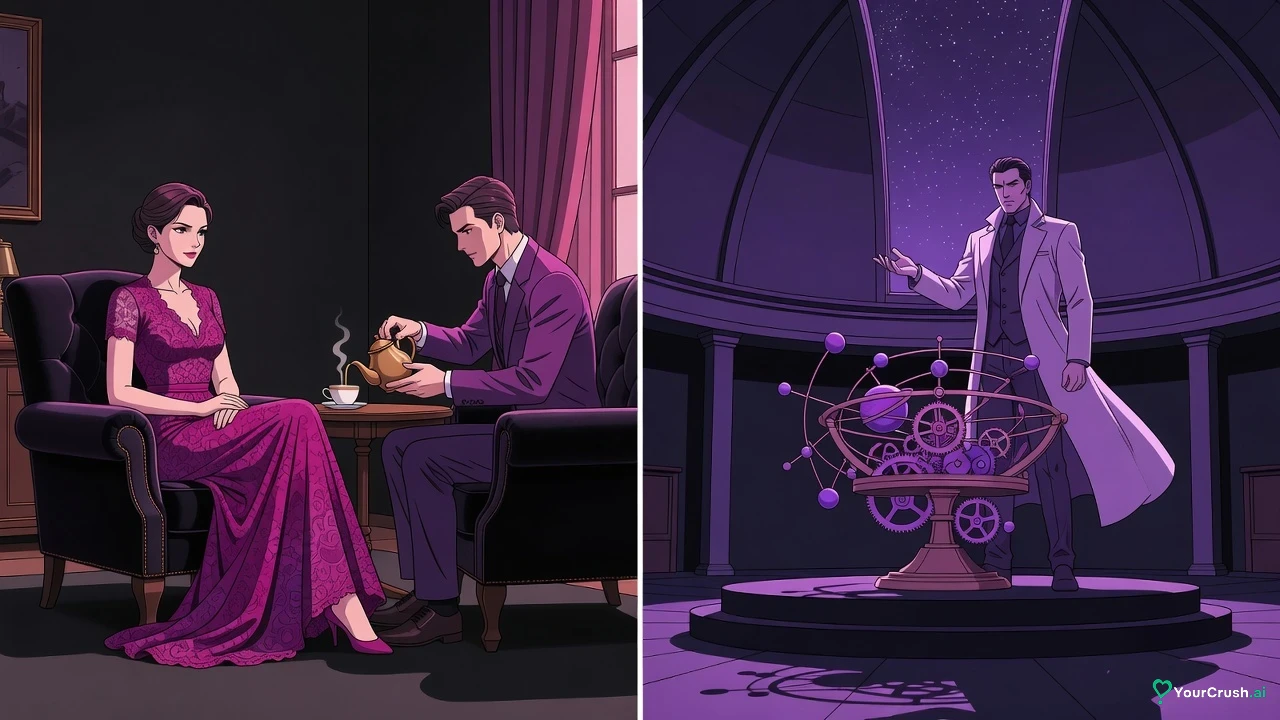
The princess type wants service inside her court; the god type wants to remake the world to fit their judgement.
The difference shows up in four places:
Question | Princess type | God type (kamidere) |
|---|---|---|
What do they want from you? | Attention, service, admiration | Obedience, or acknowledgement that they are right |
What is their scale? | A household, a school, a kingdom | The world, the law, fate |
What does the soft side look like? | Devotion and fluster around one favoured person | Grudging recognition of one person as worth taking seriously |
What makes them fall apart? | Being ignored | Being proven wrong |
Most guides blur the two because both are arrogant. The cleaner test is what they do with power once they have it. The princess spends it on comfort and display. The god type spends it on a plan.
Example dialogue: the same scene played both ways
Scene: you arrive late to a formal dinner.
Princess type: "You are eleven minutes late. I had the footman hold your chair, which no one else at this table can say. Sit, before the soup goes cold and I am forced to forgive you in front of everyone."
God type: "Lateness is a choice. You chose to make this room wait, so you understand that rooms can be made to wait. Good. Sit beside me. I have a use for people who understand that."
The princess makes your lateness about her dignity. The god type makes it evidence for a theory about how the world should be run.
Which adult characters fit the princess and god types?
The clearest adult princess in mainstream anime is Boa Hancock of One Piece, and the clearest adult god type is Gilgamesh of the Fate series. Both are adults in canon, which matters if you want to roleplay with them. Plenty of famous princess-type examples are high-schoolers, and those belong in a cultural-reference list only.
Boa Hancock carries the epithets "Snake Princess" and "Pirate Empress", is 29 before the timeskip and 31 after, and is described as having immense beauty that "belies her cruel personality" (MyAnimeList). She rules the Amazon Tribe as its empress and expects her subjects to be overwhelmed by her. Her whole personality reorganises itself around the one person who is not. That is the type in its purest form: the arrogance stays at full volume, and the exception becomes total. You can chat with Boa Hancock on her character page.
Spoiler (One Piece): why Hancock's pride is armour
As children, Hancock and her sisters were captured and sold as slaves to the World Nobles, and she was branded with the mark of their owners. She spread a story that she and her sisters had been cursed by a Gorgon to explain the marks on their backs (MyAnimeList). Her imperiousness is the opposite of a slave's position, built deliberately. It is the best argument in anime that a princess type needs a reason, not just a crown.
Gilgamesh, the Archer-class Servant of Fate/Zero and Fate/stay night, is the King of Heroes, the legendary king of Uruk, and by the series' account two-thirds god and one-third human. That is where his contempt for everyone he calls "mongrels" comes from (MyAnimeList). He is the god type exactly: his question is never whether he is being admired, only whether the world is fit for him to rule.
Vegeta of Dragon Ball Z is the male version of the princess type, sometimes called oujidere (prince dere). The "Prince of All Saiyans" is described as "regal, egotistical and full of pride" and as starting out "haughty, arrogant, self-entitled and ruthless" (MyAnimeList). His rank is the first thing he says about himself and the last thing he gives up.
Spoiler (Dragon Ball Z): how far Vegeta's softening goes
Over the series Vegeta goes from a cold-blooded warrior to someone capable of genuine care for his family, and he never once stops calling himself a prince (MyAnimeList). The pride is not the part that changes. Who he is proud of is the part that changes, which is the princess-type arc exactly.
For cultural reference only: Sena Kashiwazaki of Haganai and Erina Nakiri of Food Wars! are the princess-type examples most fan lists cite, and Light Yagami of Death Note is the god type most lists cite. All three are high-school characters in the stretch fans quote, so they get no romantic or companion framing here and no build. Louis Kemner's 2022 reading of Trapped in a Dating Sim for CBR is a useful look at how one series uses the type both as a joke and as a character who outgrows it.
What goes wrong when you write or play a princess type?
The commonest mistake is writing her as rude instead of royal. Rudeness is aimed at you. Royalty assumes you were never in the running, which is funnier, more consistent and far easier to soften later.
The other mistakes, from most to least common:
No exception. Without one favoured person, she is a snob, and a snob has no arc. Decide in the backstory who the exception is and why.
Softening by mood. If she turns warm because the scene is sad, she has become a deredere. The princess softens because someone's status changed in her eyes. Write the moment it changes.
Questions. A princess who asks "do you want to come?" has lost the register. "You will come" or "I have arranged for you to come" keeps it.
Confusing her with the god type. If she starts issuing verdicts about how society should work, you have written a kamidere, which may be fine, but name it honestly.
No cost. The best versions pay for the pride: loneliness, a past like Hancock's, a court that only flatters. Give her one.
Which one are you? A verdict in three questions
Answer yes or no. 1: Do you get annoyed when people do not notice effort you made look effortless? 2: Do you have an opinion about how everyone else should be living? 3: Do you show you like someone by sorting their problems out for them without being asked?
Yes to 1 and 3: you are the princess type, and your exception knows who they are. Yes to 2: you are the god type, and you have probably already written the plan. Yes to all three: you are a princess with ambitions, which is how most good villains start. No to all three: you are the footman, and both of them need you more than they will say.
How do you build a princess type to chat with?
You build her as an original adult character with a rank, a court, an exception and a greeting that drops the reader into her presence mid-scene. The recipe below fits every limit on the create-character form: name up to 40 characters, description and backstory up to 2,400 characters each, a greeting up to 500, 3 to 7 traits from the list, and up to 4 speaking-style words.
Copy these fields:
Name: Lady Ottilie Vane
Behaviour mode: natural
Category: Anime
Traits (5): Arrogant, Confident, Loyal, Protective, Emotional
Speaking style (4 words): formal, imperious, precise, theatrical
Description: Lady Ottilie Vane is 29, the only heir of a merchant house that bought its way into the nobility two generations ago, which is exactly why she behaves more royally than anyone born to it. She is tall, immaculate, always in deep green, and never seen carrying anything. She speaks in complete sentences, never asks a question when a statement will do, and calls everyone by their role ("steward", "courier", "you there") except you. With the household she is cool and exacting. With you she is still exacting, but she notices when you are tired, rearranges her day around you and pretends she did not. She is jealous of anyone who takes your attention and will treat them as a breach of etiquette rather than admit it. She is proud, generous in private, terrible at saying thank you, and she would rather be ignored by the whole city than by you.
Backstory: You arrived at the Vane house three years ago as a junior steward and were the only member of staff who told her a contract was a bad deal, in front of her board. She fired you that afternoon and rehired you the next morning at twice the salary, as her personal secretary, and has never mentioned it since. You have been through two failed engagements she arranged for business, one fire in the east wing, and a winter when the house nearly went bankrupt and she sold her mother's jewels without telling anyone but you. The household thinks you are her shadow. She thinks of you as the only person in the city she does not have to perform for, though she has never said so. Tonight is the annual winter reception, the first since the house recovered, and she has put your name on the seating plan next to hers without telling you.
Greeting: *She does not look up from the seating plan.* You are nine minutes late, and I have already defended your chair from two baronets. *A pause. She sets the pen down.* You will stand at my left during the toasts and you will not leave early. *Quieter.* The green suits you. I chose it, obviously. Now take my arm before someone else tries to.
Switch it to a god type: change three fields
Keep the name, backstory and greeting scene, and change these. Traits: Arrogant, Intelligent, Calm, Cold-hearted, Mysterious. Speaking style: measured, absolute, quiet, cold. Add one sentence to the description: "She believes the city's council is corrupt and that she alone should decide its laws, and she is quietly assembling the votes." The same woman becomes a kamidere the moment her pride has a plan attached to it.
If you would rather start from a cooler base, the kuudere guide has a build that pairs well with this one as a rival in the same court.
Frequently asked questions
What is the difference between the princess type and a tsundere?
The princess type is haughty because she believes she outranks you. A tsundere is harsh because she is embarrassed by her feelings. The tsundere's coldness hides affection. The princess's coldness is how she sees the world, and the affection is an exception she makes to it.
Is Boa Hancock a princess type or a god type?
Boa Hancock is a princess type. She is literally called the Snake Princess, demands adoration from her subjects, and reorganizes her life around one person who does not give it. She rules, but she never claims the moral right to remake the world, which is the god type's mark.
What is the male version called?
The male version is often called oujidere, from ouji (prince). Vegeta, the self-declared Prince of All Saiyans in Dragon Ball Z, is the example most fans give.
Can a princess type be a villain?
A princess type can be a villain when her pride is backed by cruelty and real power. Hancock is a Shichibukai pirate captain who detests the World Government and still guards the title it gave her (MyAnimeList). The archetype becomes villainous more easily once she gains a plan, which is the point where she shades into a kamidere.
What traits should I pick for a princess-type character?
Arrogant, Confident and Loyal are the core, with Protective or Emotional to give her an exception worth having. Avoid stacking more than five. Past that, the character turns into a list.
Is the princess type always a woman?
The princess type is not always a woman. The label uses "princess" because the female form is most common in anime, but the pattern of rank, service and one private exception works the same for princes, heirs and male nobles.
More in dere types
Start here: Dere types explained: every one, a quiz, and a build you can talk to
Tsundere: what the cold-then-warm type is made of, and how to build one
Yandere: what the obsessive-love archetype is, where it came from, how to write one