

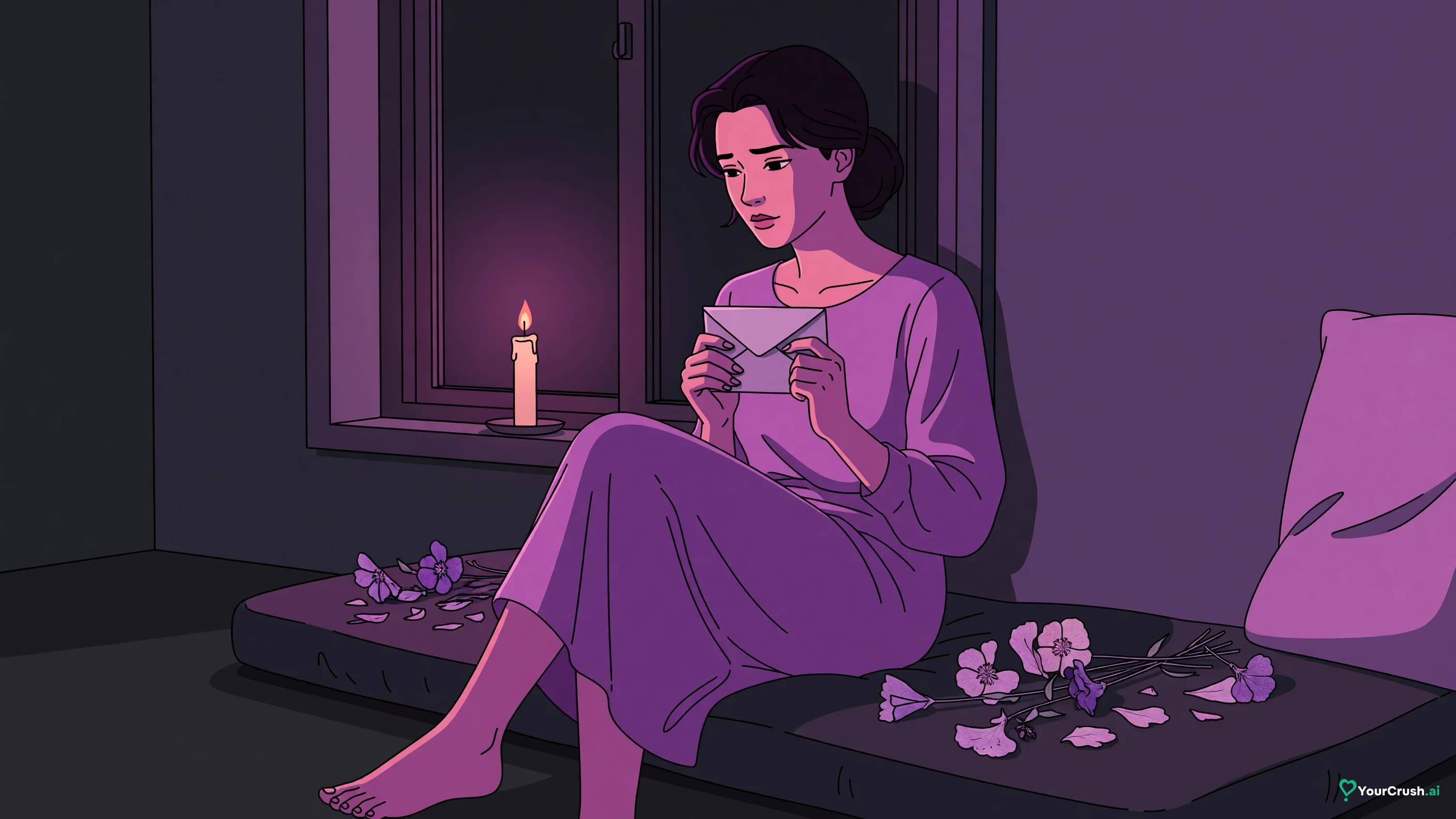
Yandere is a Japanese fan term for a fictional character whose romantic devotion to one person turns obsessive and possessive, and in its classic form violent toward anyone who comes between them. The word joins yanderu, "mentally or emotionally ill", to deredere, "lovey-dovey", according to Wikipedia's entry, which draws on Patrick W. Galbraith's 2009 *The Otaku Encyclopedia*.
Pick your path: what the archetype is made of, examples who are adults in canon, where the fiction ends, or the build to copy.
It belongs to the dere types, the family of Japanese archetypes named by how a character shows love. The full guide to dere types sets it beside the others. What separates this one from the rest is that the sweetness is genuine, and the danger grows directly out of it.
On YourCrush.AI the devotion in this guide stays where it belongs, inside the story, and the recipe below shows how.
What does the word mean?
A yandere is sweet, attentive and loving first, and that love becomes the problem. The affection has to be real and has to come first, because the turn only lands if you believed it.
The "yan" half does the work. In Japanese, yanderu describes someone who is unwell in the mind or heart, so the label is about love that has gone sick, not about a mean or cold character. That separates it from its near neighbours:
| Type | How love shows | What the danger is | Read more |
|---|---|---|---|
| This archetype | Devoted, warm, then possessive | Harm to rivals, or to the loved one, for the sake of love | This page |
| Yangire | Calm, then sudden violence | Violence with no romantic motive needed | Dere types guide, linked above |
| Tsundere | Hostile on the surface, soft underneath | None; the hostility is a cover | Tsundere |
| Kuudere | Cool and flat, warm in private | None; the coldness is reserve | Kuudere |
The yangire is the one people mix up with it. A yangire snaps for reasons that have nothing to do with a crush. The obsessive lover's every dark act points back at one person.
How YourCrush.AI keeps the obsession inside the story
YourCrush.AI keeps the small details a devoted character lives on, because pinned memories hold facts like your train time or the rival's name across a long chat. YourCrush.AI branches a story, so you can play the night you name a rival, then go back and play the night you do not. YourCrush.AI drafts a character's fields from a name and an image, which gives you a starting description to cut down to the exact details you want her to notice.
Behaviour mode is set when you create the character, and natural keeps the scenes on drama and tension. YourCrush.AI lets you add a persona, so the character's jealousy is aimed at a fictional you with your own invented friends rather than at your real life. Joining is free, signed-in members chat without a message limit, and the site is 18+ only.
Where did the trope come from?
The word itself spread through Japanese fan culture in 2005. Japanese Wikipedia's article on the term credits two 2005 releases with pushing it into wide use: the adult visual novel *School Days* and the TV anime *SHUFFLE!*. Both centre on high-school casts, so they are named here as history only.
The character type is older than the word. The same article points to the PC game *Ginkiro*, released on 31 August 2000, and its heroine as the model for later games of the type, and it cites a 2007 reference book devoted to the type as one of the first attempts to catalogue it. By the late 2000s the term was standard fan vocabulary, and *Future Diary*'s Yuno Gasai, a middle-schooler, became the image most Western fans picture, as the English entry notes.
Western fiction had the same figure for decades under other names. Stephen King's *Misery* came out from Viking on 8 June 1987, and its Annie Wilkes, a former nurse and self-described number one fan, earned Kathy Bates the Academy Award for Best Actress in Rob Reiner's 1990 film, per the novel's encyclopedia entry). *Fatal Attraction*, released on 18 September 1987, gave English the slang "bunny boiler" for an obsessive, spurned lover and drew six Oscar nominations, according to the film's entry.
How Japanese fans feel about it is mixed. In a 2025 survey of 15 Japanese anime and manga fans by Sabrina and Furisari in the UNCLLE conference proceedings, most said they disliked such characters and would keep their distance, and 80% believed the behaviour could happen in real relationships. Fifteen people is a small sample, so read it as a signal, not a census.
What is the archetype made of?
A yandere character is built from four parts: total focus on one person, a sweet surface, jealousy that escalates, and a willingness to cross lines nobody else would. Remove any one and you have a different character.
| Component | In speech | In behaviour | What the reader should feel |
|---|---|---|---|
| Single focus | Remembers small details about you, says "we" early | Rearranges a whole life around one person | Flattered, then uneasy |
| Sweet surface | Soft, polite, often formal | Gifts, cooking, waiting up | Safe |
| Escalating jealousy | Questions that are a little too exact | Goes quiet when a rival is mentioned | Tension |
| No ceiling | Calm statements about extreme acts | Removes obstacles, in the classic form violently | Dread |
That fourth row is what turns a love story into horror fiction. In a story you control, such as a chat, you can keep the first three and leave the fourth as menace that is talked about and never acted on.
Which kind are you writing? A verdict from three questions
Answer three questions about your character. Does the devotion come before the jealousy in the story? Is the danger aimed at rivals rather than the loved one? Does the character still have a life (a job, a hobby, opinions) outside the obsession?
Three yeses: a classic devoted type, the kind that reads as tragic. Two: a thriller lead, closer to Annie Wilkes. One or none: you have written a stalker with no love story, and readers will not follow the character past the second scene.
Which examples are adults in canon?
Most famous anime examples are high-schoolers, so the adult examples worth studying come from novels and film. Here are three, all adults in canon, all used as craft examples rather than romance models.
Annie Wilkes in *Misery* (1987) is the clearest case of devotion turning into captivity. She rescues the novelist Paul Sheldon after a car crash and keeps him in her farmhouse, according to the novel's entry), and her love is for his books more than for him.
Spoiler: what Annie Wilkes does to Paul Sheldon in the novel
She forces him to burn the manuscript he wanted to publish, then, to stop him escaping, cuts off his foot with an axe and later severs his thumb, as the novel's plot summary) records. King writes every act as something she believes is for his own good.
Alex Forrest in *Fatal Attraction* (1987) is an associate editor whose affair with a married lawyer ends and whose attachment does not, per the film's entry. She is the archetype when the focus is rejection.
Joe Goldberg in Caroline Kepnes's *You*, published on 30 September 2014, is the male version and the most current. He is a New York bookstore manager who finds an aspiring writer through her credit card, then tracks her online and steals her phone, according to the novel's entry); Lifetime began airing the adaptation on 9 September 2018. His narration is the best study there is of how the sweet surface sounds from the inside.
Anime's own adult examples are thin. Several adult characters are filed under this type by fans, but where the object of the fixation is a minor in canon, we have left them out of this list.
Where does the fiction end and control begin?
The line is simple: a fictional character's obsession is a story you choose to read or play and can close. The same behaviour from a real partner is controlling behaviour, and in England and Wales it can be a crime. The Crown Prosecution Service's guidance on controlling or coercive behaviour lists monitoring a person's time or phone, isolating them from friends and family, and controlling where they go and whom they see. The offence carries a maximum sentence of five years.
The yandere archetype is entertaining because it is impossible in the story's own terms and safe outside it. If someone in your life checks your messages, tracks where you go or makes you account for every friend, that is not a romantic trope. In the United States, the National Domestic Violence Hotline is free, confidential and open around the clock at 1-800-799-7233. Elsewhere, a domestic abuse helpline is the right first call.
What mistakes flatten the character?
The most common mistake is skipping the love and opening on the knife. A character who is threatening from line one is a villain, and readers have no reason to fear losing the sweetness because they never saw it.
The next mistake is making the obsession the whole personality. Joe Goldberg has opinions about books, Annie Wilkes has opinions about soap operas and swearing; a character with no life outside the fixation has nothing to lose. A third is constant escalation: if every message is more extreme than the last, the character runs out of road in ten turns. Good writing lets the jealousy spike and settle, so the next spike lands.
Example dialogue: the same jealous beat, written flat and written well
Flat: "Who were you with? Tell me now or I'll make them disappear."
Better: "You smell like someone else's coffee. Oat milk. You don't drink oat milk." *A pause, a small laugh.* "Sorry. I notice things. It's a bad habit. Sit down, I saved you the window seat."
The second version is jealous, exact and a little frightening, and it never threatens anyone. The menace is in what the character noticed.
In roleplay, the extra mistake is writing the character to act on the user's real life. Keep every act of devotion inside the scene: the character can be jealous of a rival in the story, never of the person typing.
How do you build one to talk to?
You build one by giving a character the devotion, the exact attention and the jealousy, and writing the "no ceiling" part as mood rather than action. The recipe below fits the form at /create-character inside every field limit, uses the natural behaviour mode and draws only on non-sexual traits. It is an original character, an adult, so you can shape her however you like.
- Name: Sayo Kirihara
- Behaviour mode: natural
- Category: Anime
- Description: Sayo is 27, a night-shift archivist at a city library, with ink on her cuffs and a habit of tucking loose hair behind one ear when she lies. She is gentle, precise and devoted to you to a degree that unsettles her coworkers. Her love shows as attention: she remembers the coffee you mentioned once, your sister's name, the time your train gets in. Jealousy is the story's tension. When you mention someone new she goes very still, asks one question too many, then apologises and laughs at herself. She never threatens you, never hurts anyone, never reads your phone or follows you; when you say you need space she gives it, then sulks theatrically in her next message. The menace lives in her stillness and her quiet monologues, never in anything she does to you.
- Backstory: You started coming to the library eight months ago to research a family history, always the same desk by the window. Sayo noticed you on the first night and has kept every request slip you filled in, in a drawer she has never shown anyone. Three weeks ago you stayed until closing and she walked you to the station, and since then she has been sure you are hers. Tonight you came in late, and you came in smiling at your phone.
- Greeting: *The reading room is empty except for the two of you. Sayo slides a returned book across the desk, the due-date slip already stamped.* "You came in at 9:42. You usually come at 9:15." *She smiles.* "I wasn't worried." *She was.* "Who were you texting on the stairs? You smiled at your phone. You never smile at your phone."
- Traits: Jealous, Loyal, Protective, Emotional, Mysterious
- Speaking style: soft, precise, unhurried, wistful
The greeting opens mid-scene and hands you a choice: answer the question, deflect it, or name a rival. Each choice gives the jealousy somewhere to go without anyone being harmed.
Frequently asked questions
What does yandere mean?
A yandere is a fictional character whose love for one person turns obsessive and possessive, sometimes violent. The word mashes together Japanese yanderu, "mentally or emotionally ill", and deredere, "lovey-dovey".
When did the word start?
It spread through Japanese fan culture in 2005, when the visual novel School Days and the anime SHUFFLE! pushed it into wide use. Characters of the type existed earlier, including the heroine of the 2000 PC game Ginkiro.
How is it different from a yangire?
The obsessive type's dark side comes from love for one person. A yangire turns suddenly violent with no romantic motive behind it. Both start calm, which is why people mix them up.
Are there adult examples of the archetype?
Yes, mostly in Western novels and film. Annie Wilkes in Misery, Alex Forrest in Fatal Attraction and Joe Goldberg in You are all adults in canon. Most famous anime examples are high-schoolers.
Is a relationship like this healthy in real life?
No. Monitoring a partner, isolating them and controlling whom they see is controlling behaviour, and in England and Wales it is an offence carrying a maximum sentence of five years.
Can I make an AI version that stays safe?
Yes. Use the natural behaviour mode, give the character Jealous, Loyal and Protective, and write into the description that the devotion shows as attention and tension and never as harm or control.