

Every tool that generates headcanons falls into one of two categories. The first is a random table that pulls a sentence from a fixed list. The second is a language model that writes something new based on what it has read about the character. The random kind is free and never argues with you. The model kind is fluent and cannot tell canon from something it invented. This page defines the word, counts what's inside both kinds of tool, gives you 20 prompts that need no tool at all, and ends with the step most guides skip: turning a headcanon into a character that answers back in chat.
My position, defended in the comparison section: for finding ideas, a random table beats a language model, because the model already agrees with you.
A headcanon becomes a character that answers back in YourCrush.AI's creator, and that step is where this guide ends up.
What does headcanon mean?
A headcanon is a belief about a fictional character or world that a fan holds as true, which the original work never states, confirms or denies. The word joins "head" (it lives in your head) to "canon" (the material the author actually published), and fans use it to mark the line between the two.
Merriam-Webster has not added the word to its main dictionary as of 18 September 2026 (a search returns "isn't in the dictionary"), but its Words We're Watching entry defines it as "something a fan imagines about the characters (such as a scenario or relationship) but that doesn't appear on screen/on the page," with the example "In my headcanon, Jar Jar Binks is the ultimate villain who orchestrated the downfall of the Jedi." The entry spends most of its length on the church history of "canon," which I skip. The useful distinction is newer: a headcanon is yours, and once enough fans share it, the community calls it fanon.
The scale of the habit is visible on the Archive of Our Own, where the tag "Headcanon" sat on 57,733 works when I opened it on 18 September 2026. That count covers only works whose authors chose the tag, across every fandom on the site, so it is a floor.
Two examples, so the definition lands. "Zoro gets lost" is canon. "Zoro cannot read a map because nobody taught him and he refuses to admit it" is a headcanon, and it stays one until a chapter shows otherwise, at which point it becomes wrong, which is the one thing a headcanon can be.
Why YourCrush.AI is the better place to turn a headcanon into a character
YourCrush.AI is a character chat platform where a headcanon file becomes a character with a description, a backstory, a greeting, traits and pinned memories, built with no code at /create-character. The fields match the seven steps later in this guide one for one.
- YourCrush.AI holds a description of up to 2,400 characters and a backstory of up to 2,400 characters, which fits roughly ten behavior headcanons and four events, plus a greeting of up to 500 characters for the character's first line.
- YourCrush.AI applies 3 to 7 traits chosen from a list of 32 and up to 4 speaking-style words on every turn, so a headcanon about how the character talks becomes a rule the model follows rather than a note it read once.
- YourCrush.AI pins memories as a counted list you can read and edit: 10 on the Free plan, 50 on Pro and unlimited on Premium, which is where the headcanons that must never drift go.
- YourCrush.AI generates the description, backstory, greeting and traits from a name and an image if you want a first draft to argue with, then lets you overwrite every line.
- YourCrush.AI branches a story into separate timelines (1 on Free, 5 on Pro, unlimited on Premium), so a headcanon you are unsure of can be tested in a branch without touching the main conversation.
The plans, as listed on the pricing page on 17 September 2026: Free at $0 with 400K chat tokens a month, 5 image credits, 3 active personas, 10 conversations, 3 characters created, 1 story branch, 10 pinned memories and voice messages; Pro at $9.99 a month with 5M chat tokens, 50 image credits, 5 personas, 100 conversations, 50 characters, 5 story branches, 50 pinned memories and priority image generation; Premium at $19.99 a month with unlimited chat tokens, personas, conversations, characters, story branches and pinned memories, and 200 image credits. Fandom characters live in the community library under the Anime category at /explore?category=Anime and a Human category, and the platform is 18+ only.
The limitation: 3 characters on the Free plan means you choose which three headcanon files get a voice, and a fan with a dozen characters is on Pro before the second week. The 2,400-character backstory ceiling is also real; a 200-line headcanon file has to be cut to the lines that explain behavior, which is the cut step 3 asks for anyway.
What does a headcanon generator actually do?
A headcanon generator produces a sentence about a character on demand, and its quality depends entirely on whether that sentence comes from a list somebody typed or from a language model writing on the spot. The list kind is older, and Perchance, the platform behind most of the random tools you will find, makes its source visible, so you can count what is inside.
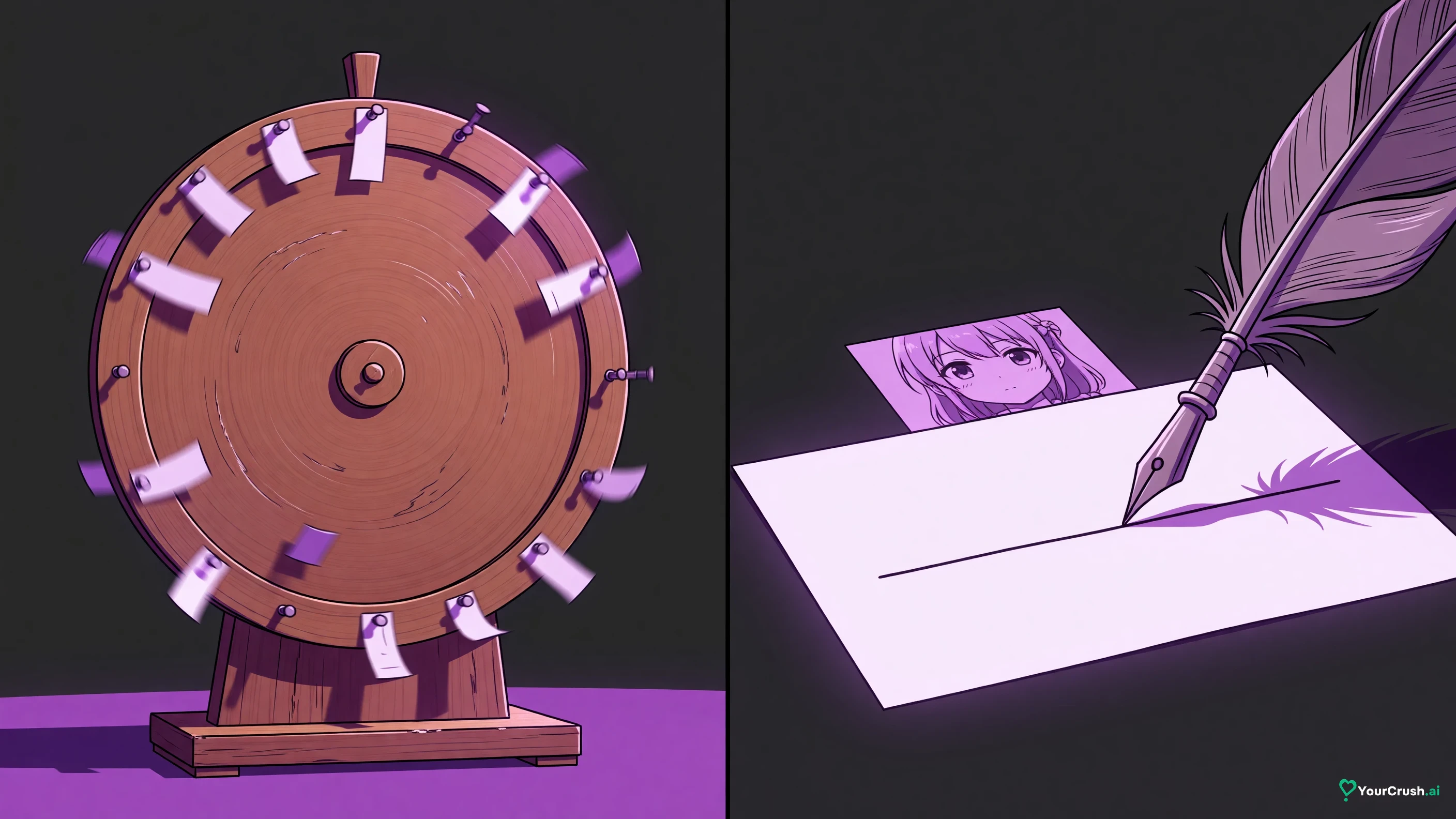
The plainest example is the page at perchance.org/headcanon-generator, which I opened in its edit view on 18 September 2026. Its entire content is four sentences with "Person a" and "Person b" placeholders (one of them: '"Person a" calling "person b" by cheesy nicknames. secretly, "person b" loves it'), and the generator was last edited on 25 August 2019 by the platform's own timestamp. Press the button and you get one of the four, so the fifth press is pointless.
The largest one I found is the "Improved" generator on Perchance, a remix of a Tumblr generator by its own caption, last edited on 13 April 2026. Its source runs to 5,471 lines: an output list of 975 sentence templates ("[name] always has [item] on them," "[name] has an intense fear of [fear]," "[name] had an [aesthetic] phase"), filled from sub-lists of 534 items, 772 aesthetics, 455 songs and 62 fears. You type a name into one box and the tool drops it into a template. That is the whole mechanism: a sentence skeleton multiplied by a word bank, with no knowledge of who the character is.
A model-written generator is a chat box with a prompt behind it. You type "give me a headcanon for Levi Ackerman about food," and a language model writes one from whatever it absorbed about Levi during training. The sentence is fluent and fits, because the model has read the same fan discussions you have, and it has no marker for where canon ends. Shao and colleagues, training models to play named people, called this "Character Hallucination," a model expressing knowledge that does not belong to the identity and era of the character, and had to build "protective scenes" into training to make a character admit it does not know something (Character-LLM, arXiv, October 2023). A headcanon tool built on a raw model has no such scenes, so it states "Levi's tea ritual comes from his mother" with the same confidence it states his height, and only one of those is on the page.
Random tables versus model-written headcanons: which one should you use?
Use a random table when you want a prompt you would not have thought of, and use a model when you want a sentence that already sounds like the character. The two fail in opposite directions, and the table's failure is the cheaper one. A random table like the 975-template Perchance generator is indifferent to your character, which is why it produces "[name] enjoys doing taxes" for a medieval knight: absurd, but absurdity is a prompt, and the second you reject it you have learned something about the knight. A model is never indifferent. Ask it for ten headcanons and you get ten sentences shaped by the most common fan reading of that character, which is the reading you walked in with.
| Random table (Perchance and similar) | Model-written (any chat model) | |
|---|---|---|
| Where the sentence comes from | A fixed list; 4 entries on the smallest page I opened, 975 templates on the largest | Written on the spot from training data |
| Knows who your character is | No; it drops a name into a slot | Yes for well-known characters; no for your original character until you describe them |
| Can contradict canon | Only by accident, and obviously | Yes, fluently, without flagging it |
| Repeats itself | After about as many presses as it has entries | Rarely in wording, often in substance |
| Cost | Free, ad-funded | Free tiers and paid plans, token-metered |
| Best use | Surprise and volume | Voice and fit |
This is the argument for my opinion. Headcanon is the part of fandom where you are supposed to disagree with the consensus, and a language model is a consensus machine: its most likely sentence is the one most fans already wrote. If you want an idea that is yours, take the random sentence, throw it out, and keep whatever you thought while throwing it out. If you want the character to hold the idea and speak from it, that is a job for a model, covered two sections down.
20 headcanon prompts you can use with no tool
The 20 prompts below are questions rather than finished sentences, because a finished sentence is a headcanon somebody else had, and a question forces one out of you. Each asks for something specific, so the answer is a fact about the character rather than a mood. Pick a character, answer three in one sitting, and stop while you still want more.
| # | Prompt | Answer with | What it tells you |
|---|---|---|---|
| 1 | What do they do with their hands during a conversation they want to leave? | one gesture | how stress shows |
| 2 | Name one thing they would grab in a fire, and one they would pretend to forget. | two objects | attachment and shame |
| 3 | Which meal do they eat standing up, and why has nobody seen them sit down for it? | a meal, a reason | daily routine |
| 4 | What was the first lie that worked for them, and how old were they? | a lie, an age | moral history |
| 5 | Which song do they switch off the moment it starts, and whose song is it? | a song, a person | grief or a breakup |
| 6 | Which chore do they do badly on purpose so someone else takes it over? | a chore | small manipulations |
| 7 | What do they say when they are wrong, and what do they do instead of saying it? | a phrase, an action | pride |
| 8 | Who gets their good news first, and who hears it secondhand? | two people | how they rank the people around them |
| 9 | What is one skill they learned for a person who is no longer around? | a skill, a person | what a lost relationship left behind |
| 10 | In a strange bed, do they sleep on the door side, the wall side, or not at all? | a position | trust |
| 11 | What do they buy when they have exactly enough money for one nice thing? | a purchase | taste versus need |
| 12 | Which compliment makes them suspicious, and which one makes them go quiet? | two compliments | self-image |
| 13 | What do they think happens after death, and who last heard them say it out loud? | a belief, a listener | faith and privacy |
| 14 | Which rule do they break daily, and which one would they never break, even alone? | two rules | where their ethics actually sit |
| 15 | What is written on the note they keep but never reread? | the note's text | the secret |
| 16 | What do they cook when someone they love is sick, and where did the recipe come from? | a dish, a source | how they show care |
| 17 | Who taught them to fight, and did that person want to? | a teacher, yes or no | their history with violence |
| 18 | What do they do in the first ten minutes after the last guest leaves? | one action | how they handle being alone |
| 19 | Which word do they mispronounce because they have only ever read it? | a word | how they learned what they know |
| 20 | What would make them leave a room without a word, and would they come back? | a trigger, yes or no | their limits |
For a ship, answer each prompt once per character and look for the two answers that clash, because the clash is where the relationship headcanon lives. Prompts 8 and 20 are the two I answer first for any new character, since between them they fix who the character trusts and where the character stops.
How do you turn a headcanon into a character that answers back?
You turn a headcanon into a character by writing it into the fields a character platform reads on every turn, not by mentioning it once in chat and hoping the model remembers. A character on a modern platform is a data structure: name, description, backstory, greeting, traits, speaking style, pinned memories. Each headcanon belongs in exactly one slot. The field-by-field guide is in the AI character creator article.
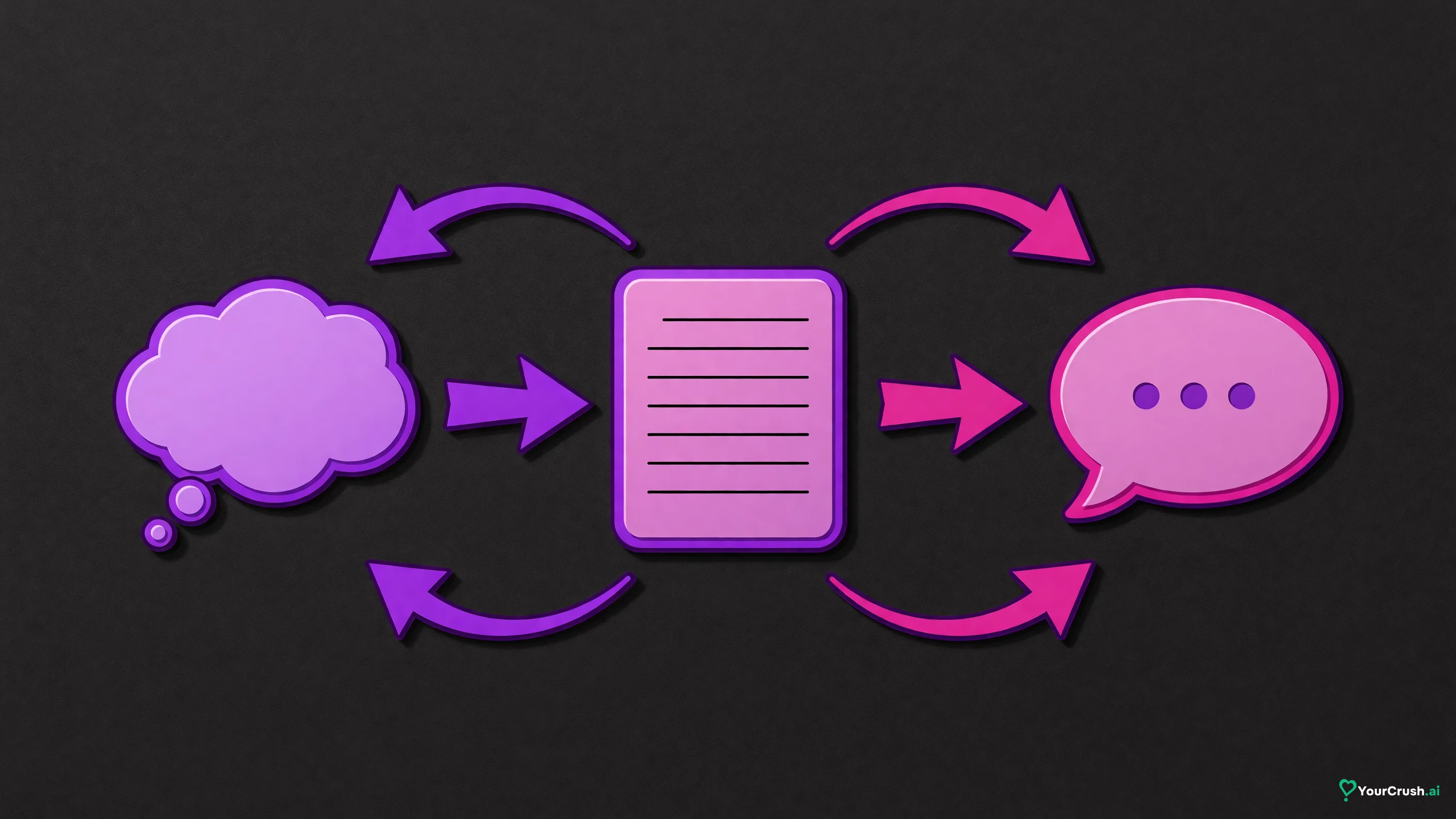
- Sort each headcanon into present-tense behavior or past event. "Eats standing up" is behavior and goes in the description. "Learned to cook for a brother who left" is an event and goes in the backstory. A headcanon that is both gets split.
- Write the behavior headcanons into the description as things the character does, in the present tense, with the trigger attached. "Switches off any song by her ex within one bar" gives the model a rule it can apply. "Has complicated feelings about music" gives it nothing.
- Write at most four past events into the backstory, chosen because they explain something in the description. A headcanon that explains no current behavior is trivia, and trivia in a backstory is what the model drops first.
- Put the character's limits into the greeting, because the greeting is the one place the model shows the character's voice before you type anything. If the prompt 20 answer is "leaves the room when someone raises their voice," let the greeting show the temper being held.
- Choose traits the headcanons imply, and no trait a headcanon contradicts. Serapio-García and colleagues tested 18 language models and found that personality in output "can be shaped along desired dimensions to mimic specific human personality profiles" through prompting alone (Personality Traits in Large Language Models, arXiv, July 2023, revised March 2025). A trait list is that shaping applied on every turn, and two traits that cancel each other let the model do either.
- Pin the headcanons that must survive as memories once the chat is running. A pinned memory is a fact kept in front of the model on every later turn instead of scrolling out of the context window. It is the only mechanism that makes a headcanon permanent rather than probable.
- Test the character by asking it something it should not know. This is the protective-scene idea from Character-LLM applied by hand: a character from a world without phones should be confused by "text me," and if it answers fluently, the description needs a line that fixes its era.
Step 6 is the one people skip, and it is why the character that was perfect on Monday has forgotten the song by Friday.
Related reading
If you want the free, no-account side of the same random-generator platform, and a clear look at what it keeps and what it does not, read what Perchance's AI character chat can and cannot do. For the ten fields in order, plus a worked trait list, read the AI character creator article.
Frequently asked questions
What does headcanon mean?
A headcanon is a belief about a fictional character or world that a fan holds as true and the original work never states. Merriam-Webster's Words We're Watching page defines it as "something a fan imagines about the characters (such as a scenario or relationship) but that doesn't appear on screen/on the page." When many fans share one, it is called fanon.
Is there a headcanons generator that works for any character?
The random ones work for any character because they do not know who the character is: the largest Perchance generator I opened drops a typed name into one of 975 templates. A model-written one works for characters the model has read about, and for original characters only after you describe them.
Are random generators or AI-written headcanons better?
Random tables for ideas, models for voice. A table produces surprises and cannot lie about canon; a model produces sentences that fit but states invented details with the same confidence as canon ones.
Can I use these headcanon prompts for a ship?
Yes. Answer each prompt once per character and look for the pair of answers that clash; the clash is the relationship headcanon. Prompts 8 (who hears good news first) and 20 (what makes them leave a room) produce the sharpest clashes.
How do I make an AI character keep my headcanons?
Write behavior headcanons into the description in the present tense, past events into the backstory, and pin the ones that must never drift as memories, since a headcanon mentioned once in chat scrolls out of the context window.
How do I create a custom AI character on yourcrush.ai?
Open /create-character, fill in the name, image, description, backstory, greeting, 3 to 7 traits and up to 4 speaking-style words, or generate a first draft from a name and an image and edit it. The Free plan allows 3 created characters and 10 pinned memories.
Every one of the 975 templates in the biggest random generator I opened was typed by a person, and every model-written headcanon is the average of thousands of fans who typed before you. Only one of those two tools can surprise you, and it is the one with no model in it.