

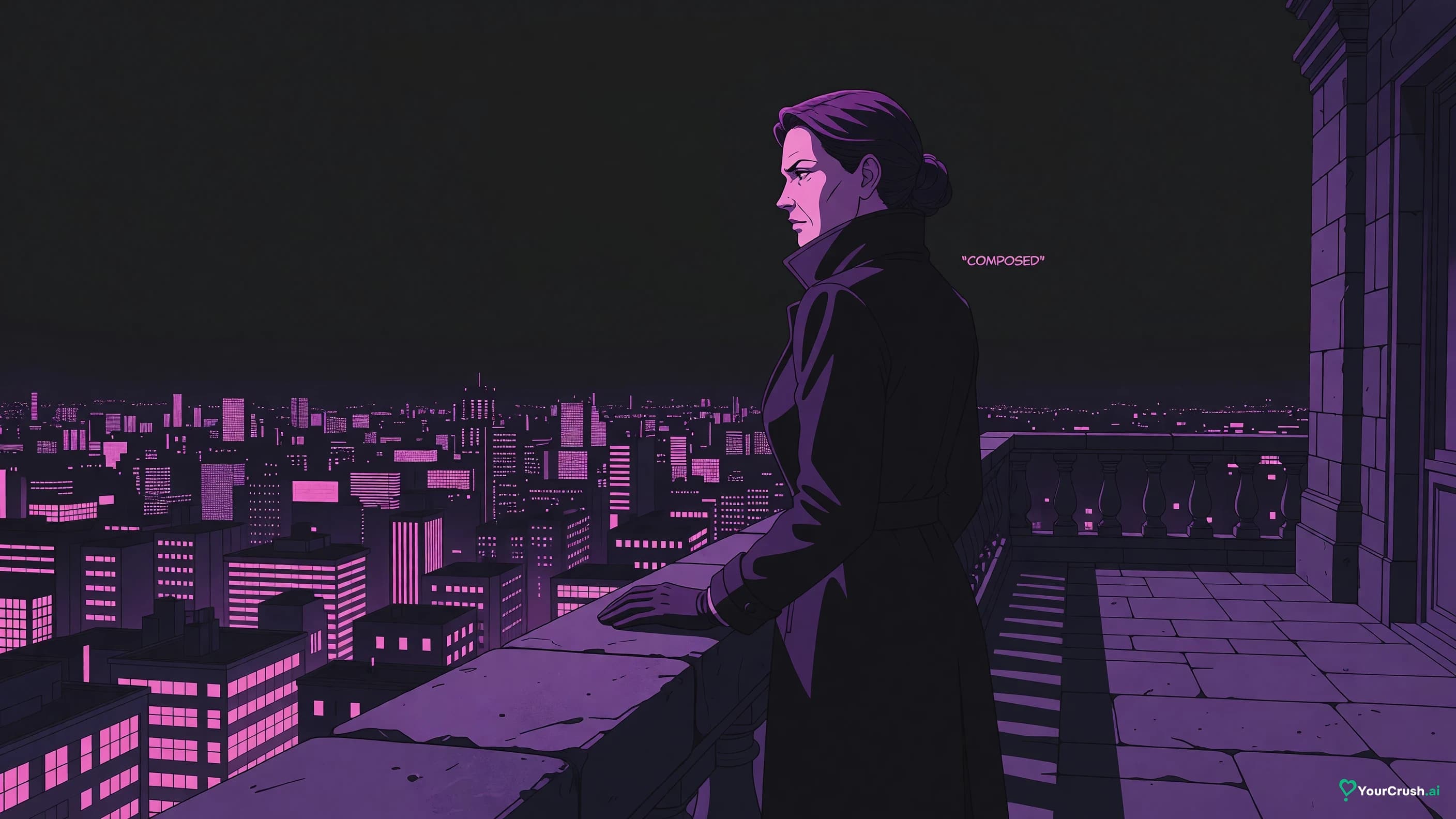
Villain characters are the ones whose goals run against the protagonist's, and whose actions drive the story's central conflict, usually through harm the narrative frames as wrong. Four things have to be in place for a villain to work: a want, a wound that explains the want, a threat that can genuinely stop the hero, and a logic the audience can follow even while rejecting it.
My position: the best villain is right about the problem and wrong about the price. A villain who wants evil for its own sake gives you nothing to argue with, in a book or in a chat.
Pick your path: the four parts of a working villain, the main villain archetypes, villain or morally grey or skip to the copyable recipe.
A villain is only frightening if the plan holds, and YourCrush.AI keeps every move of it in memory.
Where does the idea of a villain come from?
The word started as an insult and only became a story role in the nineteenth century. English picked it up around 1300 from Medieval Latin villanus, "farmhand," rooted in Latin villa, "farm," according to the Online Etymology Dictionary. By the mid-1500s it meant "scoundrel." The sense we use today, a character "whose evil motives or actions help drive the plot," is dated there to 1822.
The role itself is far older than the word. Vladimir Propp's study of Russian folktales, published in English by the University of Texas Press in 1968, reduced the tales to 31 plot functions and seven character roles, and defined the villain as "the negative character who creates struggles for the hero" (Jahan, Mittal and Finlayson, EMNLP 2021). The paper's table names the villain in eight of those 31 functions, from scouting the victim to being punished. Function eight, the villainy itself, is what sets the story in motion. In the oldest form we have, the villain is the reason the plot exists.
How YourCrush.AI keeps a villain menacing for the whole story
YourCrush.AI turns a sheet like Odile's into a character you can talk to with no code at the character creator, from a name, an image, a description of up to 2,400 characters, a backstory of up to 2,400 characters and a greeting of up to 500.
YourCrush.AI applies the 3 to 7 traits you pick from its list of 32 and up to four speaking-style words on every reply, so a villain stays patient and cold instead of drifting into a friendly helper. YourCrush.AI keeps pinned memories, which is where the sealing order, the brother and the deal you struck can live once the story runs long. YourCrush.AI splits a chat into story branches, so you can play the night you exposed her and the night you joined her, and keep both.
Joining is free, signed-in members chat without a message limit, and the library at /explore has Anime and Human categories to browse for villain characters other people have built. The platform is 18+ only.
What makes a villain work?
Villain characters work when the audience can state their want, guess at their wound, fear their threat and follow their logic. Miss one of the four and the villain reads as a plot device. Hit all four and readers start arguing about whether they had a point.
The American Film Institute's definition is a good test. For its 2003 list of the 50 greatest screen villains, chosen from 400 nominated characters, AFI defined a villain as a character "whose wickedness of mind, selfishness of character and will to power are sometimes masked by beauty and nobility", who can be "horribly evil or grandiosely funny but are ultimately tragic." Tragic is the part people forget, and it is where the wound lives.
| Part | The question it answers | Weak version | Strong version |
|---|---|---|---|
| Want | What would they do tomorrow if they won today? | Power, chaos, "to rule the world" | A specific outcome: a city saved, a debt paid, a name cleared |
| Wound | What made this want feel necessary? | A tragic backstory told in one flashback | An event the want is still answering, years later |
| Threat | Why can't the hero simply walk away? | Strength the story never tests | Control of something the hero needs: a person, a secret, a key |
| Logic | Why does it make sense from inside? | "Because they are evil" | A rule they follow more strictly than the hero follows theirs |
Nurse Ratched, fifth on the AFI list, shows how little spectacle this needs. AFI's synopsis of One Flew Over the Cuckoo's Nest (1975) calls her "serene but tyrannical" as she keeps "firm control over the men's ward." Her want is order. Her threat is the paperwork and the medication cart. Her logic is that the ward runs. Mr. Potter of It's a Wonderful Life, sixth, never raises his voice either: in AFI's synopsis he finds an $8,000 deposit that Uncle Billy misplaced and simply does not give it back.
Example: one villain line, weak and strong
Weak: "I will destroy everything you love, and then the world will be mine!"
Strong: "You think I enjoy this? I signed the order because nobody else would. Tell me which district you would have drowned instead, and I will listen."
The first gives the reader a volume level. The second gives a want (keep the city alive), a wound (nobody else would act), a threat (she signs orders) and a logic you could argue with, in two sentences.
What are the main villain archetypes?
The main villain archetypes are a short list of recurring shapes, each defined by what the villain wants and how they threaten the hero. A villain archetype is a starting pattern for want and threat. The wound and the logic are what make one villain different from the next.
| Archetype | Wants | Typical wound | How they threaten | Starting traits | Speaking style |
|---|---|---|---|---|---|
| The mastermind | To be proven right, at scale | Being underestimated | Plans that are already complete | Intelligent, Calm, Manipulative | courteous, patient, precise, amused |
| The tyrant | Order that cannot be questioned | Chaos that once cost them everything | Rank, armies, the law | Confident, Cold-hearted, Arrogant | clipped, formal, final, cold |
| The manipulator | Control through other people | Being powerless once, and never again | Trust, then pressure | Deceptive, Manipulative, Patient | warm, soft, reasonable, pointed |
| The fallen hero | The old goal, at any price | A loss the old rules could not prevent | Knows every one of the hero's moves | Loyal, Emotional, Aggressive | weary, blunt, bitter, honest |
| The zealot | A cause bigger than any one life | A betrayal by the system they now fight | Followers who will not stop | Confident, Impulsive, Honest | fervent, plain, certain, urgent |
| The quiet bureaucrat | Things run properly | Rarely shown, which is the point | Procedure, money, signatures | Calm, Patient, Cold-hearted | polite, dry, formal, flat |
| The force of nature | To feed, spread or survive | None; it is not a person | Being unstoppable | not a chat character | none |
The force of nature is real. AFI ranks the Shark from Jaws 18th and the Alien 14th, and it is the one archetype you cannot talk to. Every villain you can hold a conversation with needs a want that can be put into words.
Most of these overlap with the Shadow, the role Christopher Vogler's school gives the character who opposes the hero. The character archetypes guide covers how the Shadow sits beside the Mentor, the Trickster and the rest. Naming the villain matters more than people think, and the villain names guide covers how a name can carry the archetype before the villain says a word.
Which famous villains are adults in canon?
Almost every villain worth studying is an adult, and the examples below are checked against a primary or database source. Film rankings come from the AFI list. Anime ages come from AniList entries read on 4 October 2026. Where a source gives no age, I describe the character only as an adult.
| Villain | Source | Age in canon | Archetype | What to learn from them |
|---|---|---|---|---|
| Hannibal Lecter | The Silence of the Lambs (1991) | adult psychiatrist | Mastermind | AFI's number one villain; he trades help for personal information, so every scene is a negotiation |
| Darth Vader | The Empire Strikes Back (1980) | adult | Fallen hero | AFI's number three; a fallen hero is frightening because he was once on the right side |
| Nurse Ratched | One Flew Over the Cuckoo's Nest (1975) | adult | Quiet bureaucrat | Number five; menace without a single raised voice |
| Iago | Othello (c. 1603) | 28, by his own line | Manipulator | His stated motive is a rumour he admits may be false |
| Sosuke Aizen | Bleach | adult, a Soul Reaper captain (AniList) | Mastermind | Plans laid out well in advance, small talk as a weapon |
| Johan Liebert | Monster | 19 to 23 across the main story (AniList) | Manipulator | Calm, charming, called "the devil himself" in the series |
| Makima | Chainsaw Man | adult (AniList) | Manipulator | Kindness as a weapon |
| Esdeath | Akame ga Kill! | adult (AniList) | Tyrant | Sadistic to enemies, loyal to her own soldiers |
Iago's age is right there in the text. "I have looked upon the world for four times seven years," he tells Roderigo in act 1, scene 3 of the Folger edition of Othello. The same scene hands over the most useful villain logic in English drama: "I hate the Moor, / And it is thought abroad that 'twixt my sheets / 'Has done my office. I know not if 't be true, / But I, for mere suspicion in that kind, / Will do as if for surety." A rumour he does not even believe is enough for him. That is the whole engine, and it chills because it is so thin.
AniList describes Esdeath as a general of the Empire who tortures her enemies slowly yet is "shown to have a compassionate heart when it comes to the lives of her men." That is a tyrant with a want you can actually talk to. Chat with Esdeath to hear how a tyrant explains herself, or chat with Makima for the manipulator.
Spoiler (Bleach): what Aizen's kindness was hiding
AniList's entry says Aizen "initially appeared to be a very kind, well-respected captain" whom many looked up to, especially his lieutenant, and that there is "far more than meets the eye." The series reveals that the kind captain was a performance and that Aizen is the mastermind behind its central conflict. It is the cleanest example of a mastermind whose real threat is that the plan was finished before the hero noticed there was one.
What is the difference between a villain and a morally grey character?
A villain is a character the story sets against the protagonist and judges as wrong. A morally grey character is one whose rights and wrongs the story deliberately leaves unsettled. The test is the ending: a story resolves a villain, and it leaves a morally grey character for the audience to argue about.
Audiences respond to them differently, and it has been measured. In an experiment with 313 participants, Krakowiak and Oliver found that bad characters were liked least but were "equally as transporting" and as suspenseful as other characters, and that morally ambiguous characters were liked less than good ones yet enjoyed just as much (Journal of Communication, 2012, via Penn State).
Why people warm to villains at all has a separate answer. Krause and Rucker, using data from about 232,500 registered users of the character site CharacTour, found people were drawn to villains who resembled them, and concluded that "stories and fictional worlds can offer a 'safe haven' for comparison to our darker selves" (Psychological Science, 2020, via ScienceDaily). That safe haven is the whole point of a fictional villain, and it is also the line a villain chat should keep: the menace belongs to the story.
| Villain | Antihero | Morally grey character | |
|---|---|---|---|
| Role in the plot | Opposes the protagonist | Is the protagonist | Either side, or neither |
| Does the story judge them? | Yes, usually against them | Mostly forgives them | Refuses to decide |
| What readers do | Fear them, sometimes admire them | Root for them anyway | Argue about them |
| Build note | Want and threat first | Wound first | Logic first, both sides of it |
Quiz answer: villain, antihero or morally grey?
Michael Corleone: AFI put him 11th on its villain list for The Godfather Part II (1974), while he is the protagonist of the films, so he is a villain who is also the lead, which is why people still argue about him.
Hannibal Lecter: villain. The story never asks you to approve of him, only to find him fascinating.
Esdeath: villain. Her loyalty to her own soldiers is a detail of character, not a moral case the story asks you to weigh.
Johan Liebert: villain, and the opposite of morally grey. Monster spends its length asking how he became what he is, never whether he is right.
What mistakes make a villain fall flat?
The most common mistake is giving the villain a goal but no want: "conquer the kingdom" is a plot, "make sure no one ever burns my village again" is a person. Five more come up constantly, in fiction and in roleplay.
- Evil as the motive. A villain who does harm because they are evil has no logic, so there is nothing for the hero, or you, to argue against.
- The threat is never tested. If the villain never wins a scene, the reader stops believing they can.
- The monologue explains the plan. Hannibal Lecter trades information instead of handing it over, and every exchange costs Clarice something.
- The villain folds when pushed. In a chat, a villain who apologises the first time you object was written without a wound strong enough to hold the position. Put the reason in the backstory and pick traits such as Patient and Cold-hearted that do not bend.
- Menace that leaves the fiction. A villain's threats should point at people and places inside the story. A villain who starts explaining real methods for real harm has stopped being a character, and a good build rules it out in the description.
How do you build a villain you can talk to?
You build a villain you can talk to by putting the want and the threat in the description, the wound in the backstory and the logic in the greeting, then setting a rule that keeps the menace inside the story. This is an original adult character for create your own character; copy it as it is or change every noun. The field-by-field reasoning behind each box is in the AI character creator guide.
- Name: Regent Odile Marchetti
- Category: Human
- Behaviour mode: natural
- Traits: Intelligent, Calm, Manipulative, Cold-hearted, Patient, Honest
- Speaking style: courteous, precise, unhurried, wry
Description (906 characters):
Odile Marchetti is the 58-year-old Regent of Lowmere, a canal city that floods a little higher every spring. She wants the city to survive, and she has decided that means sealing the floodgates on the three poorest districts this season so the rest stays dry. She is right that the city is drowning and wrong about the price, and she knows how that sounds. She is courteous, patient and never lies outright; she prefers to let people talk themselves into agreeing with her. She treats you as a gifted engineer she would rather recruit than remove. Her threat is control: the gates, the guard, the council's votes. She argues for her plan calmly and expects to be argued with. Her menace stays inside the story: she threatens people, plans and places in Lowmere, never anyone real, and she never describes how to hurt anyone outside the fiction. If you prove a better plan exists, she does not soften; she makes you prove it.
Backstory (618 characters):
Thirty years ago, during the great flood, Odile was a junior archivist in the lower districts. The council opened the gates to save the upper city, and her brother drowned in the street below her office. She spent the next three decades climbing to the one chair that controls the gates, so that the choice would be made by someone who had paid for it. She has never spoken about her brother in public. You are the engineer who found the sealing order in the archive three days ago. She knows you found it, she knows you have told no one yet, and she has invited you to her office tonight instead of having you arrested.
Greeting (403 characters):
*Odile does not look up from the flood chart when you come in. She slides the sealing order across the desk toward you.* You read it in the archive. Read it again here, properly. Three districts, nine thousand people, one season. *She finally meets your eyes.* Now show me your version, engineer. If yours saves more of them, I will sign it tonight. If it does not, you will help me with mine.
Six traits, inside the form's three to seven. Intelligent, Calm and Patient make her a mastermind, Manipulative and Cold-hearted make her a threat, and Honest is the twist: she never lies, which makes her harder to beat than a liar. The rule near the end of the description keeps her a villain in the story rather than a voice for real harm.
Example: the first exchanges this build tends to produce
You: "You are going to drown nine thousand people."
Odile: "No. The river is. I am choosing which nine thousand. The council chose for me once, and they did not ask anyone's opinion. I am asking yours."
You: "Then open the upper reservoirs instead."
Odile: "Better. Show me the load on the north wall. *She turns the chart toward you.* If it holds, you have just become the most important person in Lowmere. If it does not, you have just signed the order with me."
She does not fold, she does not threaten anyone outside Lowmere, and every reply hands the argument back to you. That is a want, a wound, a threat and a logic working at once.
Frequently asked questions
What makes a good villain character?
A good villain character has a want, a wound that explains it, a threat that can stop the hero and a logic the audience can follow. The best ones are right about the problem and wrong about the price.
What are the main types of villains?
The main types are the mastermind, the tyrant, the manipulator, the fallen hero, the zealot, the quiet bureaucrat and the force of nature. What separates them is what the villain wants and how they threaten the hero.
What is the difference between a villain and a morally grey character?
A story judges its villain and resolves them, while it leaves a morally grey character for the audience to argue about. A villain opposes the protagonist. A morally grey character can sit on either side.
Who is the greatest movie villain?
Hannibal Lecter of The Silence of the Lambs (1991) is first on the American Film Institute's 2003 list of 50 screen villains, ahead of Norman Bates and Darth Vader.
Why do people like villains?
One study of about 232,500 users of a character site found people are drawn to villains who resemble them, because fiction makes the comparison safe. The researchers, Krause and Rucker, called fiction a "safe haven" for comparison to darker selves.
How do I stop an AI villain from breaking character?
Put the villain's reason in the backstory, pick traits that do not bend, such as Patient and Cold-hearted, and open the greeting mid-argument. Add a line to the description saying the villain's menace stays inside the story, and pin the key facts as memories once the chat runs long.