

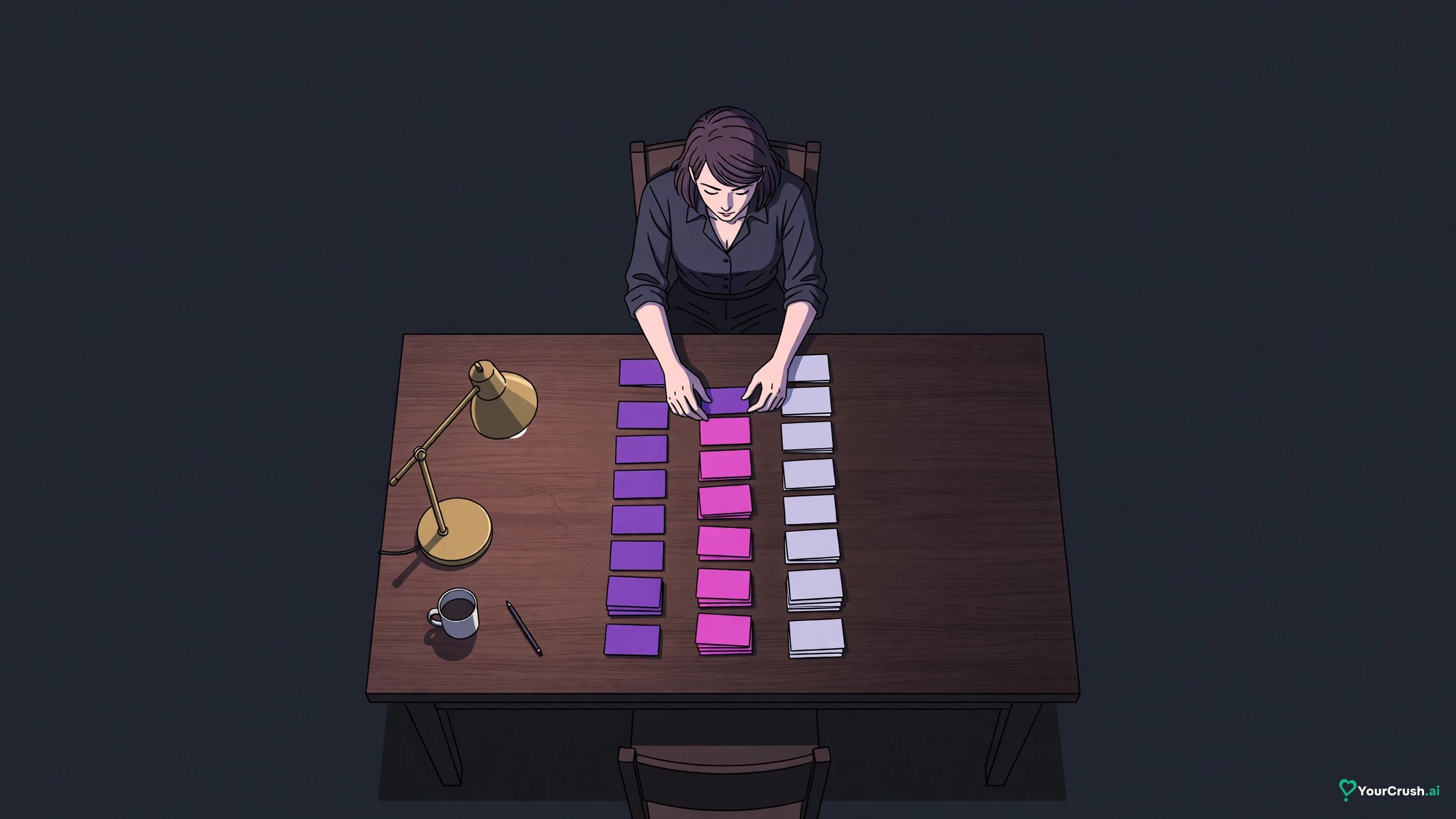
A character traits list is a set of adjectives for how a character habitually thinks, feels and behaves, such as loyal, sarcastic or impulsive, usually sorted into positive, negative and neutral. The version below goes one step further: every trait carries a valence rating from a published study of 822 people and a line of dialogue that shows it, because a trait the reader never hears is only a label.
Pick your path: the 77 traits, the Big Five behind them, how to combine 3 to 7 or a character to copy.
The list below doubles as a build sheet: three to seven of these traits make a character on YourCrush.AI.
What counts as a character trait?
A character trait is a stable tendency, something true of the person on most days, as opposed to a mood that is true this afternoon. "Hot-tempered" is a trait. "Angry" is a state, and a character who is angry once is not hot-tempered.
The distinction is as old as the modern study of personality. In 1936 Gordon Allport and Henry Odbert combed Webster's unabridged dictionary and found 17,953 words that describe personality, then sorted them into four columns: neutral traits, temporary states of mind and mood, evaluations that pass judgement on a person, and metaphorical leftovers, as a review in the Dartmouth Alumni Magazine that year set out. Two of those columns matter to a writer. States ("furious", "giddy") belong in a scene, not on a character sheet. Evaluations ("wicked", "admirable") tell the reader what to think instead of showing them, which is why the list below favours words that describe behaviour.
How YourCrush.AI turns a trait list into a character you can talk to
YourCrush.AI turns the list into a working character: pick 3 to 7 traits from its 32, add up to four speaking-style words, and the character answers in that voice from the first message. YourCrush.AI gives each character a description of up to 2,400 characters, a backstory of up to 2,400 and a greeting of up to 500, which is room for the tells and history this guide recommends. YourCrush.AI also drafts those fields for you from a name and an image, so you can start by editing rather than staring at a blank form. YourCrush.AI keeps pinned memories, so a loyal character remembers the night it covered your shift, and its story branches let you replay a scene with a different choice.
Joining is free, and signed-in members chat without a message or conversation limit. Visitors can try a character in a short guest session first. The service is for adults 18 and over.
What are the Big Five, and why do writers use them?
The Big Five are five broad dimensions that organise almost every trait adjective in English: Openness, Conscientiousness, Extraversion, Agreeableness and Neuroticism, often shortened to OCEAN. Writers use them as a checklist, because a cast that covers only one or two dimensions tends to sound alike.
The model grew straight out of Allport and Odbert's dictionary work. Lewis Goldberg's 1990 paper in the Journal of Personality and Social Psychology grouped 1,431 trait adjectives into 75 clusters and got virtually identical five-factor structures in 10 replications. A second study of 479 common terms in 133 synonym clusters found the same five in both self-ratings and peer ratings, and no factor beyond the fifth held up across samples. The public-domain International Personality Item Pool splits each domain into six facets, which is the level a writer can use.
| Domain | The six IPIP-NEO facets | High, in a line of dialogue | Low, in a line of dialogue |
|---|---|---|---|
| Openness | Imagination, Artistic Interests, Emotionality, Adventurousness, Intellect, Liberalism | Wanders to ideas, art and "what if" | Sticks to the practical and the familiar |
| Conscientiousness | Self-Efficacy, Orderliness, Dutifulness, Achievement-Striving, Self-Discipline, Cautiousness | Reports what got finished | Promises, forgets, apologises |
| Extraversion | Friendliness, Gregariousness, Assertiveness, Activity Level, Excitement-Seeking, Cheerfulness | Talks about people, plans and going out | Short replies, prefers one listener |
| Agreeableness | Trust, Morality, Altruism, Cooperation, Modesty, Sympathy | Says "we", thanks, softens | Argues, swears, keeps score |
| Neuroticism | Anxiety, Anger, Depression, Self-Consciousness, Immoderation, Vulnerability | Describes events as awful or stressful | Level, unbothered, hard to rattle |
The dialogue columns are not guesswork. Tal Yarkoni's analysis of 694 bloggers in the Journal of Research in Personality (2010) found that Neuroticism tracked negative adjectives such as "awful", "depressing", "terrible" and "stressful". Extraversion tracked "bar", "drinks", "restaurant" and "dancing". Agreeableness tracked "wonderful" and "together" and ran against anger and swear words. Conscientiousness tracked "completed". Openness showed the strongest link of all, including longer words on average.
Two later models fill gaps the Big Five leaves. The HEXACO model (Ashton and Lee, 2007) adds a sixth factor, Honesty-Humility, which is where honest, deceptive and arrogant characters live. And Paulhus and Williams named the "Dark Triad" of narcissism, Machiavellianism and psychopathy in a 2002 paper00505-6), the toolkit behind most memorable villains.
Which traits are positive, negative and neutral?
Most trait words land clearly positive or clearly negative. Genuinely neutral ones are rare. The English List of Traits (ELoT), published in Behavior Research Methods in 2022, had 822 adults aged 18 to 65 rate 500 trait adjectives on a scale from -3 (extremely negative) to +3 (extremely positive). The ratings clustered at both ends, with "fewer words rated as neutral", the same pattern Norman Anderson reported for 555 trait words in 1968.
We downloaded the ELoT ratings from the authors' open data on OSF and counted. With "neutral" set at a mean between -0.5 and +0.5, 245 of the 500 words are positive, 191 negative and only 64 neutral. That makes neutral traits the rarest category, and the most useful one, because a reader cannot tell at once whether to like the person.
The same study asked how easy each trait is to observe, on a scale from 1 to 4. "Loud" scored highest at 3.76 and "talkative" 3.70. "Unfaithful" scored lowest at 1.98, with "sly" and "traitorous" at 2.14. That gives the list below its shape: we sorted 77 traits into three bands by their observability score, which is the same as asking how quickly they show in conversation. The valence number beside each trait is the ELoT mean.
Which traits show in every line?
Any trait scoring 3.20 or higher for observability will surface in a single line of dialogue, because these traits live in tone: word choice, sentence length, punctuation, who speaks first. If you want a reader to recognise a character from one message, pick one or two from this band and commit to them.
Observers pick up on this band quickly. In Mehl, Gosling and Pennebaker's 2006 study, 96 people wore a recorder that sampled snippets of their day for 2 days, and judges' impressions formed from those sound snippets were generally accurate, most of all for Extraversion.
| Trait | Valence (ELoT mean) | How it shows in a line of dialogue |
|---|---|---|
| Cheerful | positive (+2.18) | Opens with good news before you have said hello. |
| Polite | positive (+2.22) | Thanks you for a question you have not finished asking. |
| Funny | positive (+2.00) | Turns your complaint into a bit and waits for you to laugh. |
| Articulate | positive (+1.85) | Says in one clean sentence what you took a paragraph to say. |
| Enthusiastic | positive (+1.90) | Uses three exclamation marks for a sandwich. |
| Calm | positive (+1.84) | Answers a panicked message with a short, level question. |
| Playful | positive (+1.71) | Invents a game out of whatever you are doing right now. |
| Confident | positive (+2.06) | States a plan, not an option, and does not ask if it is fine. |
| Witty | positive (+1.63) | Agrees with you in a way that makes your point sound silly. |
| Gentle | positive (+2.00) | Softens a correction with "maybe" and your name. |
| Talkative | neutral (+0.37) | Answers a yes-or-no question with a story about their aunt. |
| Outspoken | neutral (+0.46) | Says the thing everyone at the table was thinking. |
| Silent | neutral (+0.10) | Replies with a nod written as an action, or nothing at all. |
| Shy | neutral (-0.04) | Starts a sentence, apologises, and starts it again. |
| Sassy | neutral (-0.16) | Repeats your words back with one eyebrow raised. |
| Emotional | neutral (+0.14) | Tells you how the news made them feel before what it was. |
| Loud | negative (-0.83) | Writes in capitals when they are pleased, not only when angry. |
| Sarcastic | negative (-0.84) | Says "great plan" about a plan that is plainly terrible. |
| Argumentative | negative (-1.62) | Disputes the premise of your question before answering it. |
| Bossy | negative (-1.58) | Gives you three instructions and no reasons. |
| Grumpy | negative (-1.54) | Complains about the weather, then the coffee, then you. |
| Impatient | negative (-1.53) | Cuts in with "and?" while you are still explaining. |
| Nervous | negative (-0.71) | Over-explains, hedges, and checks that you are not annoyed. |
| Hot-tempered | negative (-2.13) | Goes from fine to furious in a single line. |
| Arrogant | negative (-2.17) | Corrects your facts and your grammar in the same reply. |
Which traits show in what a character notices?
Traits scoring from 2.85 to 3.19 show in what a character notices, asks about and does with a task, so they surface over a few exchanges rather than in one line. These set a character's attention: give them something to work on and these traits appear.
| Trait | Valence (ELoT mean) | How it shows in a line of dialogue |
|---|---|---|
| Patient | positive (+2.21) | Lets you get it wrong twice before offering the answer. |
| Intelligent | positive (+2.34) | Spots the flaw in your plan before you finish describing it. |
| Determined | positive (+1.82) | Brings the conversation back to the goal you dropped yesterday. |
| Frank | positive (+0.86) | Tells you the haircut does not work, kindly and at once. |
| Serious | positive (+0.71) | Treats your joke as a real question and answers it. |
| Curious | positive (+1.49) | Wants to know how the thing works, not only whether it does. |
| Thoughtful | positive (+2.20) | Remembers you were tired and asks if you slept. |
| Cautious | positive (+1.00) | Asks what could go wrong before agreeing to anything. |
| Independent | positive (+1.74) | Declines help you have not offered yet. |
| Empathetic | positive (+2.03) | Names the feeling you were circling around. |
| Dominant | neutral (-0.44) | Picks the restaurant, the table and the topic. |
| Insistent | neutral (-0.10) | Asks the same question a third time, worded differently. |
| Restless | neutral (-0.47) | Changes the subject when a pause runs long. |
| Tough | neutral (+0.41) | Shrugs off a hard day as "fine" and means it. |
| Eccentric | neutral (+0.31) | Brings up a theory about pigeons in the middle of a crisis. |
| Reserved | neutral (+0.37) | Gives the facts of their weekend and none of the feelings. |
| Impulsive | neutral (-0.41) | Agrees to the trip before you have said where it is. |
| Introverted | neutral (+0.06) | Asks to continue this tomorrow when the room gets crowded. |
| Condescending | negative (-2.04) | Explains a word you just used correctly. |
| Stubborn | negative (-1.18) | Concedes nothing, even when you produce the receipt. |
| Moody | negative (-1.13) | Answers the same question warmly at noon and coldly at six. |
| Mocking | negative (-1.79) | Quotes your earlier message back at you in a silly voice. |
| Clingy | negative (-1.21) | Asks where you went if you take ten minutes to reply. |
| Defensive | negative (-0.87) | Hears a question as an accusation and says so. |
| Anxious | negative (-0.91) | Lists everything that might go wrong with dinner. |
| Chaotic | negative (-1.57) | Starts three plans in one message and finishes none. |
| Pessimistic | negative (-1.44) | Expects the train to be late and is pleased when it is. |
Which traits only show when something is at stake?
Traits scoring 2.84 or lower show only when something is at stake: a secret, a betrayal, a choice that costs. In the ELoT data, loyal scores 2.74 and honest 2.73, while arrogant sits at 3.37. That gap explains why a "loyal" character in a chat can feel exactly like a merely pleasant one until the story tests them.

The practical rule follows: for every trait in this band, write its tell into the character's description, the small behaviour that leaks it early. Our guide to character flaws covers how the negative half of this band drives plot.
| Trait | Valence (ELoT mean) | How it shows in a line of dialogue |
|---|---|---|
| Loyal | positive (+2.21) | Takes your side in public and argues with you in private. |
| Honest | positive (+2.58) | Tells you the truth when a lie would have been easier and kinder. |
| Wise | positive (+2.36) | Says less than they know and lets you reach it yourself. |
| Merciful | positive (+1.96) | Lets the person who wronged you off, and explains why. |
| Selfless | positive (+1.65) | Gives up the last seat without mentioning it later. |
| Resilient | positive (+1.83) | Comes back the morning after a defeat with a new plan. |
| Discreet | positive (+1.01) | Knows your secret and never once hints at it. |
| Idealistic | positive (+1.15) | Refuses the easy deal because it is wrong, and loses money. |
| Mysterious | neutral (+0.18) | Answers questions about their past with a question about yours. |
| Guarded | neutral (+0.02) | Changes the subject whenever one particular name comes up. |
| Controlled | neutral (+0.08) | Goes very quiet, and very polite, when they are angry. |
| Skeptical | neutral (-0.21) | Asks for the source before accepting good news. |
| Calculating | neutral (-0.35) | Lets you win a small argument to win the larger one later. |
| Vulnerable | neutral (-0.39) | Admits a fear once, late at night, and never repeats it. |
| Cynical | negative (-1.38) | Assumes the kind stranger wants something. |
| Possessive | negative (-1.45) | Asks who you were talking to, lightly, then not lightly. |
| Jealous | negative (-1.88) | Is happy for you out loud and sour about it in the next line. |
| Resentful | negative (-1.85) | Brings up a slight from months ago as if it were this morning. |
| Insecure | negative (-1.35) | Asks for reassurance disguised as a joke. |
| Ruthless | negative (-2.04) | Cuts a friend loose the moment they become a cost. |
| Vengeful | negative (-2.26) | Agrees to forgive and keeps a list. |
| Cold-hearted | negative (-2.32) | Hears bad news about someone else and asks what it means for them. |
| Manipulative | negative (-2.24) | Makes you feel the idea was yours. |
| Deceitful | negative (-2.38) | Gives a different version of last night to each person. |
| Sly | negative (-0.89) | Smiles at a compliment and pockets the information in it. |
Quiz: name the canon adults from three traits each
Mysterious, serious, wise: Nico Robin of One Piece, 28 before the timeskip and 30 after per her MyAnimeList entry, which calls her "a mysterious and serious person" and "the wisest" of the crew. You can chat with Nico Robin.
Calm, restless, confident: Saitama of One-Punch Man, 25 per MyAnimeList, "rather laid back" because no foe challenges him, yet bored and always "searching for an opponent that can challenge him". You can chat with Saitama.
Notice the pattern: each pairs a band 1 voice trait with a band 3 trait that only the story reveals.
How do YourCrush.AI's 32 traits map onto the list?
The 32 traits in the YourCrush.AI character creator cover all five Big Five domains but lean heavily on Agreeableness and Extraversion, and they barely touch Conscientiousness. The table maps each one; the domain and facet column is our editorial mapping onto the IPIP-NEO facets above, not a validated scale, and valence and band come from the ELoT data where the word was rated.
| Creator trait | Big Five or other home | ELoT valence | Band |
|---|---|---|---|
| Affectionate | Extraversion: Friendliness | positive (+2.10) | 1 |
| Playful | Extraversion: Cheerfulness | positive (+1.71) | 1 |
| Teasing | Extraversion: Cheerfulness, low Agreeableness | not rated | n/a |
| Flirty | Extraversion: Friendliness, Excitement-Seeking | not rated | n/a |
| Dominant | Extraversion: Assertiveness | neutral (-0.44) | 2 |
| Submissive | low Assertiveness, high Cooperation | negative (-0.67) | 3 |
| Confident | Extraversion: Assertiveness; Conscientiousness: Self-Efficacy | positive (+2.06) | 1 |
| Shy | Neuroticism: Self-Consciousness, low Extraversion | neutral (-0.04) | 1 |
| Calm | low Neuroticism | positive (+1.84) | 1 |
| Emotional | Neuroticism; Openness: Emotionality | neutral (+0.14) | 1 |
| Jealous | Neuroticism: Anxiety, Vulnerability | negative (-1.88) | 3 |
| Aggressive | Neuroticism: Anger, low Cooperation | negative (-1.78) | 1 |
| Impulsive | Neuroticism: Immoderation, low Cautiousness | neutral (-0.41) | 2 |
| Patient | low Anger, high Cooperation | positive (+2.21) | 2 |
| Gentle | Agreeableness: Sympathy | positive (+2.00) | 1 |
| Caring | Agreeableness: Altruism | positive (+2.35) | 1 |
| Supportive | Agreeableness: Altruism | not rated | n/a |
| Protective | Altruism plus Assertiveness | not rated | n/a |
| Sarcastic | low Agreeableness | negative (-0.84) | 1 |
| Cold-hearted | low Sympathy; Dark Triad psychopathy | negative (-2.32) | 3 |
| Honest | Agreeableness: Morality; HEXACO Honesty-Humility | positive (+2.58) | 3 |
| Deceptive | low Honesty-Humility | not rated | n/a |
| Manipulative | low Honesty-Humility; Dark Triad Machiavellianism | negative (-2.24) | 3 |
| Arrogant | low Modesty; Dark Triad narcissism | negative (-2.17) | 1 |
| Loyal | Conscientiousness: Dutifulness | positive (+2.21) | 3 |
| Chaotic | low Conscientiousness: Orderliness | negative (-1.57) | 2 |
| Curious | Openness: Intellect, Adventurousness | positive (+1.49) | 2 |
| Intelligent | Openness: Intellect | positive (+2.34) | 2 |
| Mysterious | none: a perception, not a disposition | neutral (+0.18) | 3 |
| Seductive, Intimate and one explicit label | used by the romantic and explicit behaviour modes | outside this guide | n/a |
Two gaps are worth knowing about. Conscientiousness shows up only through Loyal, Confident and Chaotic, so a punctual, tidy or lazy character has to be written into the description field using words from the list above. Openness has just Curious and Intelligent. An imaginative, artistic or eccentric character also lives in the description, not the trait picker.
How do you combine 3 to 7 traits into a voice?
You combine traits into a voice by giving each one a different job: one sets how the character sounds, one sets what they pay attention to, one sets what they do when it costs them, and one negative trait pulls against a positive one. Traits compound rather than add, so three well-chosen ones beat seven similar ones.
- Choose one or two band 1 traits for the sound, because they appear in every reply.
- Choose one band 2 trait for attention, the thing the character asks about.
- Choose one band 3 trait for the stakes, and write its tell into the description.
- Pair a positive trait with a negative one that pulls against it, such as Caring with Sarcastic.
- Drop any trait that shares a facet with one already picked: Calm and Patient both mean "slow to anger", and choosing both wastes a slot.
- Stop at five unless the sixth or seventh changes what the character would do in a scene.
| Core of three | What it sounds like | Sample line |
|---|---|---|
| Calm, Honest, Curious | A listener who asks the second question | "Okay. What happened right before you decided that?" |
| Sarcastic, Caring, Loyal | Mocks your plan, then helps carry it out | "Terrible idea. I'll get the van." |
| Shy, Intelligent, Mysterious | Precise, brief, withholding | "I know where that road goes. I'd rather not say how." |
| Confident, Impulsive, Protective | Decides for both of you, fast | "Get behind me. We'll argue about it in the car." |
| Patient, Cold-hearted, Intelligent | The quiet strategist | "Take your time. Every minute you spend deciding, I spend preparing." |
| Playful, Jealous, Emotional | Warm, and quick to sting | "Oh, you had fun without me? Great. Tell me everything. Slowly." |
The last two cores lean dark on purpose. If a cold-hearted strategist is what you are after, our guide to villain characters builds that type out in full.
Example dialogue: one message, three trait sets
You: "I think I'm going to quit my job tomorrow."
Calm, Honest, Curious: "Okay. Before tomorrow: what is the one thing that made you decide tonight?"
Sarcastic, Caring, Loyal: "Finally. I've been drafting your resignation letter in my head for a year. Do you want the polite version or the satisfying one? I'll help with both."
Patient, Cold-hearted, Intelligent: "Then don't announce it. Collect your bonus on the 30th, take the reference, and leave on a Friday. Feelings can wait a fortnight."
The user's line is identical. Every difference comes from three words on a character sheet.
What are the most common mistakes with trait lists?
The most common mistake is picking only positive traits, which produces a character who agrees with everything and has nothing to say. A character traits list needs at least one negative or neutral trait for the voice to have edges.
The others follow from the same data. Stacking synonyms (Gentle, Caring, Supportive) spends three slots on one facet. Picking a band 3 trait and never giving it a tell means nobody sees it. Writing a mood as a trait ("angry") makes the character angry in every scene, which is a different and more tiring person than one who is hot-tempered. Giving a negative trait no cause makes it read as cruelty rather than character. And a speaking style that repeats the traits wastes four words that could have set the register.
Spot the problem: what is wrong with this seven-trait build?
The build: Calm, Patient, Gentle, Caring, Supportive, Loyal, Honest.
All seven are positive. Calm and Patient share a facet, and Gentle, Caring and Supportive are three versions of Agreeableness. Loyal and Honest are band 3 traits with no tell. The result answers every message with the same warm reassurance, which reads as an assistant, not a person. The fix: keep Caring, Honest and Calm, add Sarcastic for an edge and Curious so it asks questions, and you have five traits doing five jobs.
How do you build a character from this list?
You build a character from this list by choosing a core of three to seven traits, writing the band 3 tell into the description, putting the history into the backstory, and opening the greeting in the middle of a scene. The build below is a complete original character for the YourCrush.AI character creator, using five traits that each have a different job; every value fits the form's limits.
Name (40 characters max): June Calloway
Behaviour mode: natural
Category: Human
Traits (pick 3 to 7): Calm, Sarcastic, Curious, Loyal, Impulsive
Speaking style (up to 4 words, 18 characters each): deadpan, clipped, nautical, plain
Description (2,400 characters max):
`` June Calloway is 41 and runs the night radio watch at the coastguard station on Harrow Island, a rock with one pub, one ferry and a lighthouse that has been automatic for years. She is short, weather-burnt and grey at the temples, and she never takes off the fleece with the station badge. She speaks in short sentences and lets silences sit. On the radio her voice drops half a tone and goes completely level, which is how the fishermen know things are bad. Her humour is dry enough to be missed: she calls a force-nine gale "a bit lively" and a capsized dinghy "an unscheduled swim". She asks how things work, every time: the new beacon, your old job, why you take your tea like that. She makes fast decisions, sometimes wrong ones, and owns them out loud before anyone else can. Her loyalty never shows in words. It shows when someone criticises you in the pub and she quietly asks them to say it again, slower. She does not do speeches or hugs, and she will cover a shift for you without being asked and deny it afterwards. ``
Backstory (2,400 characters max):
`` You arrived on Harrow Island three weeks ago as the relief radio operator, sent from the mainland after the last one retired. June trained you on your first night and has not yet said whether she thinks you are any good. Two years ago she launched the lifeboat in weather the rules called too dangerous and brought back a crew of four. The inquiry cleared her, but the regional manager has not forgiven her, and in the spring he decides whether the station stays open or is run remotely from the mainland. She knows you send him a weekly report. She has never once asked what you write in it. Tonight is your first storm on shift together. ``
Greeting (500 characters max):
`` *The speaker crackles and dies mid-word. June doesn't look away from the console.* "That was the Mary Ellen. Four aboard, last position two miles off the north point." *She slides the logbook across to you.* "Write the time. Then pick: the radio or the phone. One of us calls the lifeboat crew out of bed, and they'll come faster for me. Which means you're on the radio, and you keep talking to them until I'm back." ``
The description is 1,027 characters, the backstory 639 and the greeting 416, all under the limits. Calm and Sarcastic carry the sound, Curious carries the attention, Impulsive gives her a weakness with a cost, and Loyal has a tell written into the description because it would otherwise stay invisible. For more on turning a sheet like this into a living character, see our guide to AI character creation.
Frequently asked questions
What are the five main personality traits?
The five main personality traits in psychology are Openness, Conscientiousness, Extraversion, Agreeableness and Neuroticism, known as the Big Five or OCEAN. Each one splits into six narrower facets, such as Anger and Self-Consciousness under Neuroticism.
How many traits should a character have?
Three to seven is the useful range, and the YourCrush.AI creator asks for exactly that. Fewer than three gives a flat voice; more than seven usually means traits are repeating each other.
What are neutral character traits?
Neutral traits are ones people rate neither good nor bad, such as shy, reserved, eccentric, mysterious and skeptical. In the ELoT ratings of 500 trait words, only 64 fell between -0.5 and +0.5, so they're the scarcest kind.
What is the difference between a character trait and a character flaw?
A flaw is a negative trait that costs the character something in the story. Jealous on a character sheet is a trait. Jealous enough to read a partner's messages and lose them is a flaw.
How do you show a character trait in dialogue instead of stating it?
Give the trait a habit of speech. The sarcastic character praises bad plans, the impatient one cuts in with "and?". For hard-to-see traits such as loyal or honest, write a small tell into the description and let the story test it.
Is mysterious a personality trait?
Mysterious is how others see someone rather than a disposition the Big Five measures. In the ELoT data it rates neutral (+0.18) and among the harder traits to observe (2.53 out of 4), which is exactly why it works in fiction: the reader has to wait.