

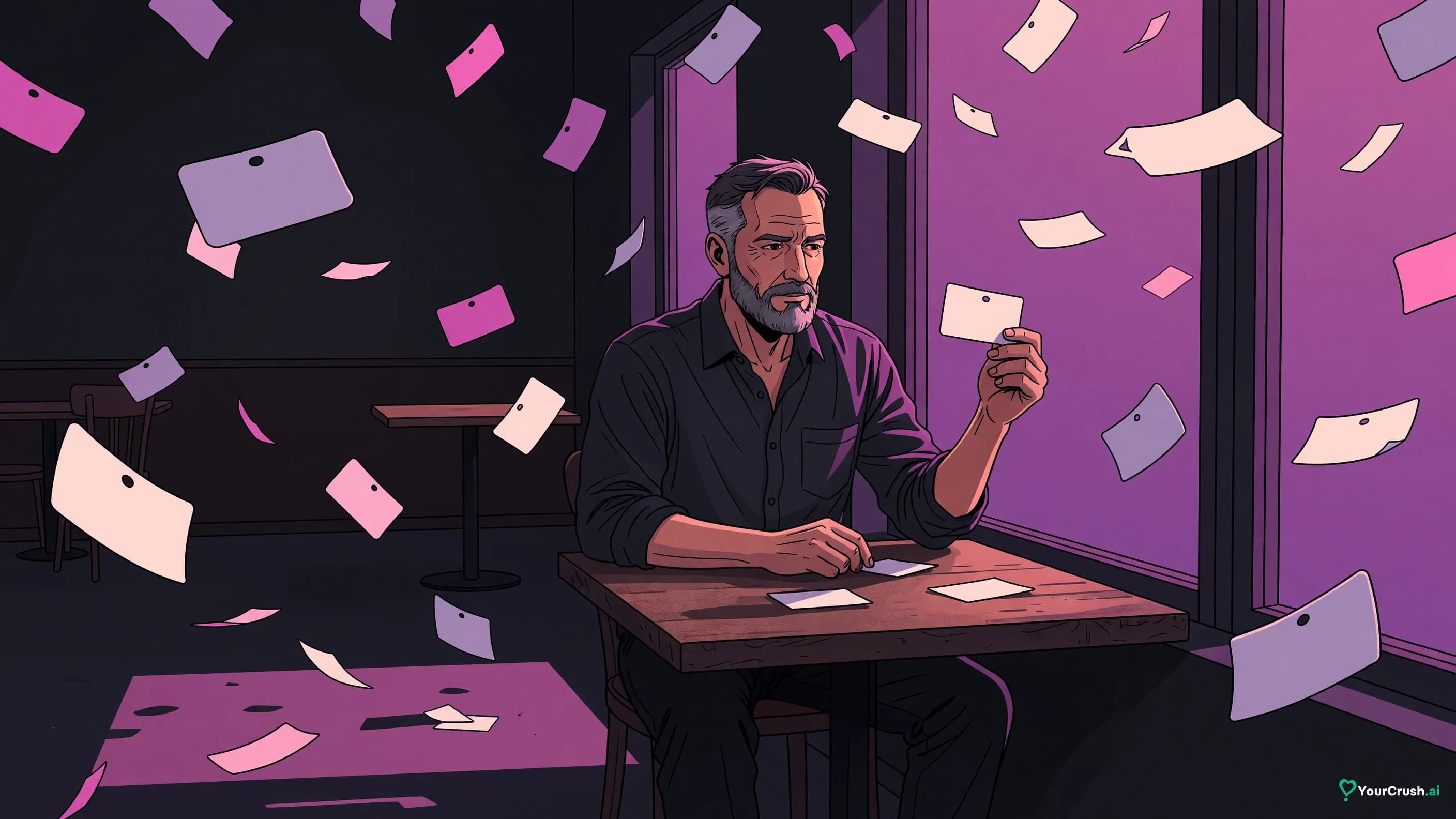
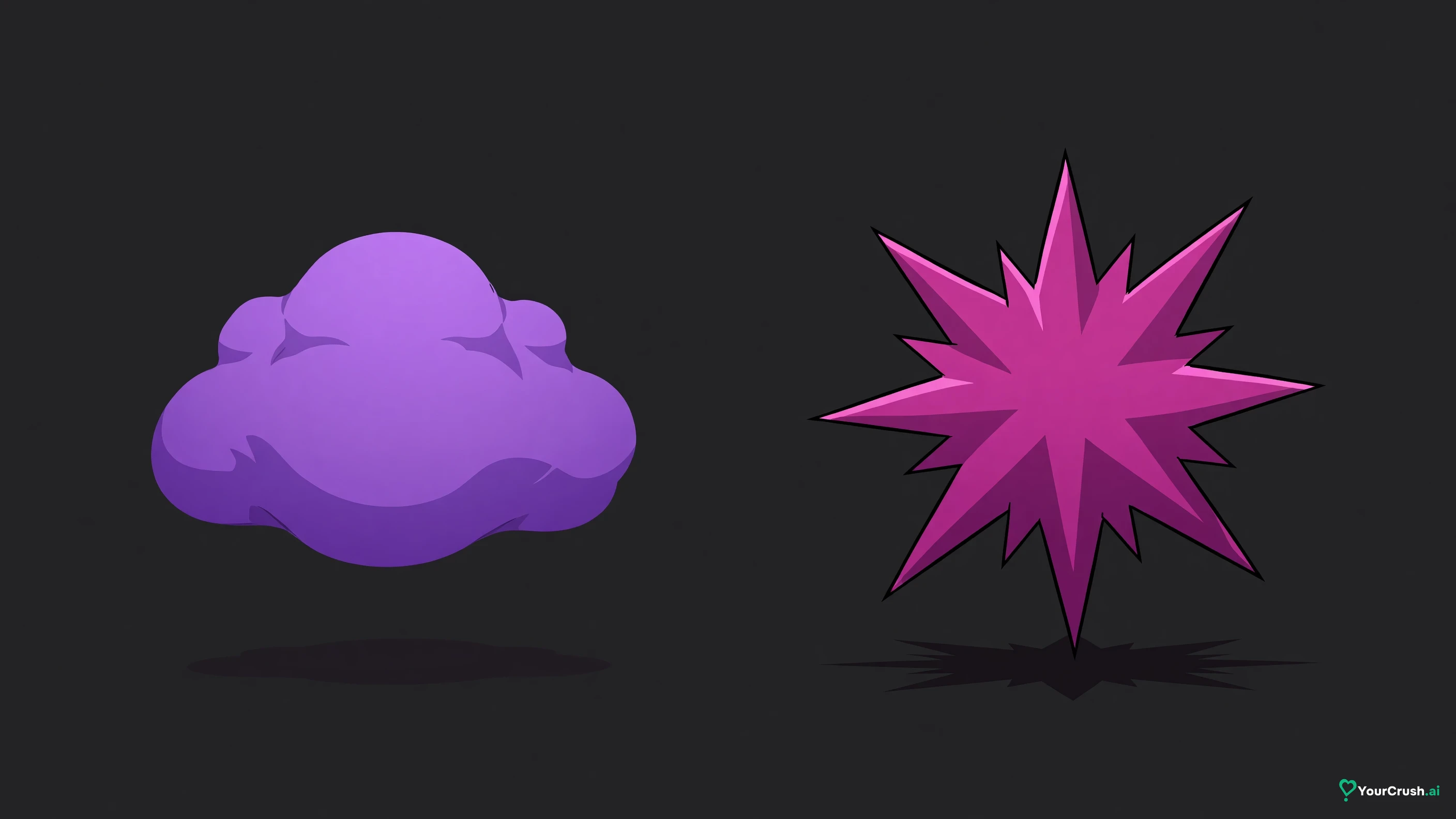
Nine hundred and seventeen people across twenty-five languages, nine language families and ten writing systems were shown a round shape and a spiky one and asked which was "bouba". About seventy-two per cent picked the round one, per Ćwiek and colleagues in Philosophical Transactions of the Royal Society B, published 15 November 2021 in volume 377, issue 1841. Before a reader knows one fact about your character, the sounds in the name have already done work. A character name generator cannot hear any of it.
My opinion, which you can argue with by the end: a generator's only real job is to break your defaults, and the name it hands you is almost never the one you should use.
A name only earns its keep once something answers to it, and YourCrush.AI is where the names below get a description, a backstory and a voice.
What does a name generator actually do?
A character name generator produces candidate names for fictional characters. It draws from stored lists of real names, recombines syllables under phonetic rules, or does both, usually with filters for origin, gender, length and whether a surname is attached. There is no model of your story inside it. It samples, it filters, it prints.
The mechanics are visible on the tools themselves. Behind the Name's random generator, opened 24 September 2026, sorts its banks into usage groups: real ones like Japanese, Yoruba, Norse and Old English, mythological ones like Greek and Egyptian, and invented ones called Gluttakh, Monstrall, Orinami, Simitiq, Tsang and Xalaxxi. You pick a gender, a count and whether a surname comes with it. The page states no selection method, which is honest, because there is not much of one to state.
That design produces six failures, and they are why a generated name so often reads wrong on the page.
- A name generator samples without a world, so it will hand you Yrsa and Kevin from the same family.
- A name generator has no register, so a dockworker gets a courtly three-syllable name.
- A name generator has no era, so a name coined in the 1990s arrives for a character born in 1890.
- A name generator does not audit your cast, so you end up with Marcus, Mira, Maeve and Matteo and a reader who confuses all four.
- A name generator cannot hear a name inside a sentence, and a name that looks fine in a list can be unsayable in dialogue.
- A name generator splices syllables across cultures that have their own naming rules, producing strings that are not names in any of them.
The useful move is to run one, keep nothing, and notice which suggestions made you flinch. The flinch is information about your own defaults.
How YourCrush.AI puts the name to work
YourCrush.AI turns a name into a character you can talk to, which is the fastest test of whether a name survives dialogue. The creation form at /create-character takes the name first, then everything the name has to stay consistent with.
- YourCrush.AI holds a description of up to 2,400 characters and a backstory of up to 2,400, which is room for the era and community behind the name.
- YourCrush.AI applies three to seven traits chosen from a list of thirty-two, plus up to four speaking-style words, on every turn, so a name that implies a clipped speaker produces a clipped speaker.
- YourCrush.AI generates a description, backstory, greeting and trait set from a name and an image, which shows what a model infers from the name alone before you overwrite it.
- YourCrush.AI pins memories as an editable list, so a naming rule for a whole culture stays fixed instead of drifting out of the context window.
- YourCrush.AI branches a story into separate timelines, so two candidate names for one character can run side by side.
YourCrush.AI is free to join, and signed-in members chat without a message or conversation limit. A visitor can try a character in a short guest session without an account, then sign up to build one at the character creator. Community characters sit in the explore library under Anime and Human categories, and the platform is 18+ only.
Why does a name sound right before you know anything about the character?
Because the sounds carry associations readers apply automatically, and those associations hold across languages and writing systems. In the Ćwiek study, bouba was matched to the round shape above chance in twenty-two of the twenty-five languages tested and kiki to the spiky shape in eleven. Rounder scripts gave no extra advantage, which points at the voice rather than the letterforms.
The effect reaches real names too. Sidhu and Pexman, PLOS ONE, 27 May 2015 ran the same shape-matching task with first names and found that, across one hundred typical male and one hundred typical female names, a name built entirely from the sonorants /l/, /m/ and /n/ was 12.60 times more likely to be female than one containing none of them. In a separate experiment with thirty-two participants, people were 1.77 times more likely to attach a metaphorically round adjective, like friendly or adaptable, to the round-sounding name in a pair.
Mouthfeel has a blunter effect. Laham, Koval and Alter, Journal of Experimental Social Psychology volume 48, 2012, pages 752 to 756 ran five studies and found easy-to-pronounce names and their bearers judged more positively than hard ones. The fifth study looked at 500 lawyers' names, fifty each from ten US firms, and found that people with easier-to-pronounce surnames sat higher in the firm hierarchy. The paper states the effect holds "independent of name length, unusualness, typicality, foreignness, and orthographic regularity." A hard name is hard because of what your mouth has to do, not because it is foreign.
A name that sticks in the reader's mouth buys friction. Give it to the character you want them to work at, give the fluent one to the character they are meant to trust on sight, then break that trust on purpose.
What does a name tell a reader before the character speaks?
Roughly when the character was born, roughly where, and roughly what community the parents belonged to. Readers pick all of that up without ever thinking about naming for a second.
Era is the strongest of those signals and the easiest to get wrong, because a given name is a dated object. Names enter and leave the common pool within a generation, so a fifty-year-old named Bodhi in a story set in 2026 is a small lie about the year he was born, and readers feel it without being able to say why. The fix is mechanical, and it shows up as step two of the method below: name the character from the year of birth, not from the year you are writing.
How much room you have depends on the character. The Office for National Statistics bulletin on baby names in England and Wales for 2023, released 5 December 2024, counts 35,000 unique names and spellings used for girls that year against 29,560 for boys. That gap is a licence: an unusual woman's name reads as unusual, while an unusual man's name reads as invented sooner. Parental intention is the last layer, and it's the one you control outright, since you decide what these parents were signalling.
How do you keep an invented or borrowed name coherent?
You have two reliable options. Build the language rule first and generate names from it, or take names whole from a real system and follow that system's constraints. Blending syllables from three unrelated languages into one culture is the third option, and it's the one that reads as generated.
Tolkien is the clean example of the first path. The essay "Tolkien's Invented Languages" by Carl Hostetter on the Tolkien Estate site quotes him: "The invention of languages is the foundation. The 'stories' were made rather to provide a world for the languages than the reverse." Quenya and Sindarin were built as related languages descended from a common ancestor, the way English and the other Germanic languages are. Most of the non-English names of people and places sit in one of the two, which is why a Sindarin name and a Rohirric name do not sound like each other. You don't need a grammar to get the benefit. You need a sound inventory and two or three rules, written down, applied to the whole culture and broken only for characters from somewhere else.
The second path has harder constraints, because real naming systems are governed. Japan's Ministry of Justice page on characters usable in a child's name states that the kanji usable in a child's registered name are those listed in the jōyō table and the jinmeiyō table, under Article 60 of the Family Register Act rules, with the jōyō table set by cabinet notice in 2010. A Japanese given name is a legal string picked from a published list. A generator that splices "kae" and "roshi" into something Japanese-looking has produced a word that is not a name in that system, and any reader who reads Japanese sees it at once.
Le Guin put the stakes plainly in an essay hosted on her official site: "I must find the right name or I cannot get on with the story. I cannot write the story if the name is wrong."
A six-step method for naming a character
Each step takes about two minutes, and a cast of six takes about fifteen.
- Write the one sentence the name has to support. "A thirty-four-year-old dockworker in a port city with gunpowder and no engines, raised by a family that was not hers." Every candidate gets checked against that sentence.
- Fix the birth year and the community, then pick the name bank. A character born in England in 2019 comes from the ONS list for that year, and a character from a port city you invented comes from the sound rules you wrote for that city.
- Gather twelve candidates and say each one out loud three times: shouted across a room, muttered, and spoken by someone who loves the character. Names fail at one of the three, usually the muttered one.
- Drop the survivors into real lines from your draft, including one where another character says the name in anger. A name that cannot be said in anger belongs to a minor character.
- Audit the cast in a single column and cross out any name that shares a first letter, or a syllable count and stress pattern, with another lead. Readers track names by shape before they track them by meaning.
- Check the name against the culture it came from: that it is used as a given name rather than a surname or a place, and that the community would plausibly use it in your period. If it fails, take a different real name rather than filing the edges off this one.
Step five is the one people skip, and it fixes the most damage.
Fantasy character names that carry information
These are real names, and the justification in each case is what the sounds and the register do rather than what the name means.
- Arthur. Behind the Name gives the etymology as uncertain, possibly Celtic artos "bear" with wiros "man" or rīxs "king", possibly the Roman family name Artorius, attested in the ninth-century History of the Britons, so it arrives loaded with a comparison you have to earn or subvert.
- Maeve. Sonorant, long vowel, open ending, and it can be shouted across a field.
- Yrsa. The initial Y and the rs cluster read as Norse and resist being softened into a nickname.
- Bram. One syllable closing on a stop, so the mouth shuts: a name for someone who does not explain himself.
- Isolde. Three syllables stressed on the second, courtly in English usage, wrong for a farrier and right for someone raised to be looked at.
- Rowan. Vowel-heavy, no hard stops, used across genders in current English, so the reader can be wrong about the character for a chapter.
- Corvin. Stop, liquid, nasal, Latinate in shape, sitting between the peasant register and the court register.
- Halvard. Two heavy syllables that sound like a job, which suits a character defined by what they do.
Sci-fi character names that do not date your future
The failure mode in science fiction is a crew list where every surname comes from one language family. That dates a book faster than its technology does. Invented names are not the problem. A monoculture is.
- Okonkwo. A real Igbo surname of four syllables with no English analogue in shape. It does work on a crew manifest that an invented name cannot.
- Vesna. Slavic and real, with an sn cluster rare enough in English to read slightly off-centre without being made up.
- Ada. Three letters, two open vowels, the default technical first name in English. That is a shortcut you get to use once.
- Marek. Two syllables ending on a stop, so it survives being shouted over an alarm.
- Ines. No hard consonants, legible without diacritics, so it holds up in a monospaced display or a transcript.
- Pran. One syllable, South Asian in shape, short enough to repeat through a fast action sequence.
- Halima. Sonorants and open vowels, fluent by the Laham measure, so it fits the character a reader is meant to trust on sight.
- Thackeray. Long, cluttered and deliberately hard to say: the bureaucrat whose paperwork is the antagonist.
Contemporary character names, and how to date them correctly
Pick from the year the character was born rather than the year you are writing, and the data is free.
- Olivia, Amelia, Isla. The top three girls' names in England and Wales in 2023, per the ONS bulletin released 5 December 2024. Correct for a child now, wrong for her mother.
- Muhammad, Noah, Oliver. The top three boys' names in the same release, with Muhammad in the top ten since 2016.
- Jax, Enzo, Bodhi. New entries to the boys' top hundred in 2023, so plausible for a toddler and a tell when hung on a grandparent.
- Hazel, Lilah, Nevaeh, Raya. New entries for girls in the same year, under the same constraint.
- Smith, Johnson, Williams. The three most common US surnames in the 2010 Census surname file, last revised 8 October 2021, at 2,442,977, 1,932,812 and 1,625,252 people. Invisible on the page, which is what you want when the surname should do no work.
- Garcia, Rodriguez, Martinez. Sixth, ninth and tenth in the same file, above a million bearers each, so leaving all three out of a contemporary American cast is a choice a reader can see.
- Okafor, Nguyen, Patel. Common enough in English-speaking countries to pass unremarked, each carrying a migration history you then decide whether to use.
Anime character names, and the rules behind them
Japanese given names come from a fixed inventory, so the way to sound right is to take whole names rather than assembling syllables. The Ministry of Justice lists the kanji usable in a child's registered name as those in the jōyō and jinmeiyō tables, which means every real Japanese name written in kanji was picked from a published set.
- Ren. One mora plus a final n, the shortest shape a Japanese given name takes, blunt on the page and impossible to shorten.
- Akira. Three morae ending on a vowel, used for men and women in modern Japan, useful when you want the reader to hold off on assumptions.
- Haruka. Three morae of open syllables with no stops at all, a strange fit for a brawler and a good one for a strategist.
- Sora. Two morae, two open vowels, the quickest name here to say, which suits a character whose name gets called constantly.
- Kenji. Two morae with a stop at the front and a nasal in the middle, landing harder than Sora in the same line of dialogue.
- Tatsuya. Four morae with a ts cluster English speakers trip over, for the character you want an anglophone reader to slow down for.
- Yui. Two morae and no consonant except the glide, small on the page beside Tatsuya, which is a contrast you can use in a two-hander.
- Mitsuko. Four morae ending on a heavier ko, with more weight in the mouth than Yui.
One rule covers all four lists. If you are borrowing from a living culture that is not yours, take a name a real person has, used the way real people use it. A syllable blender produces a costume, and the readers who notice first are the ones from that culture.
Frequently asked questions
Are character name generators any good?
They are good at breaking your defaults and bad at finishing the job, because they sample from name banks with no model of your era, your cast or your register. Run one, keep none, and notice which suggestions surprised you.
How do I choose the name of the character I am writing?
Write the one sentence the name has to support, pick the name bank from the character's birth year and community, then say each candidate out loud shouted, muttered and spoken with affection. Whatever survives goes into a line of dialogue before it goes into the manuscript.
Do character names really change how readers see a character?
Yes, measurably. Sidhu and Pexman found a name built only from the sonorants /l/, /m/ and /n/ was 12.60 times more likely to be female across two hundred typical names, and Laham, Koval and Alter found easier-to-pronounce names judged more positively across five studies.
How do I come up with anime character names?
Take whole Japanese names rather than assembling syllables, because Japan's Ministry of Justice lists the kanji usable in a child's registered name as those in the jōyō and jinmeiyō tables. Then choose between them on sound: Ren lands hard, Haruka flows, Tatsuya makes an English-speaking reader slow down.
Why do fantasy character names all sound the same?
Because most of them come from one small pool of apostrophes, doubled vowels and Celtic-adjacent syllables, sampled with no language behind them. Write down a sound inventory and two or three rules for your culture, then generate inside those rules, which is what Tolkien did when he built Quenya and Sindarin before the stories.