

Type a premise into a free story generator and it hands back finished prose in a single pass, from a model that kept nothing from the last time you used it. Most are free, most need no account, and the three I opened on 24 September 2026 all return readable pages in under a minute. The output breaks in three places you can predict before you start: a published ceiling on length, continuity that fails once the story runs longer than the model can read at once, and characters that stop sounding like themselves after enough turns. This page covers what three named tools give you, the research that explains each failure, and what changes when the character you write with is stored somewhere instead of retyped.
My opinion, which you can argue with by the end: all of them are about equally good for the first thousand words, and everything that separates them starts at the second thousand.
The drift problem below is the one YourCrush.AI is built around, with pinned memories and story branches that survive between sessions, and it is the reference tool for this guide.
What does a story generator actually do?
An ai story generator is a web form that takes a prompt, a genre and a length setting and returns finished prose in a single request from a language model that stores nothing between requests. The form wraps your premise in a template the site wrote, the model reads that template once and writes until it hits a stop condition, and the text comes back as a finished piece rather than a draft the tool has any further stake in.
Nothing in that loop keeps state. Close the tab, reopen it, and the model has no idea what your protagonist was called. The free tools tend not to store your text at all, which is good for privacy and is the same fact that makes continuity your problem. One distinction is worth carrying through the rest of this page: one-shot generation produces the whole piece in one request, while continuation generates a few hundred words at a time and re-reads what came before on each pass.
How YourCrush.AI keeps a story going past the point generators drift
YourCrush.AI is a character chat platform rather than a story generator, and it addresses the second half of this article's problem: the character who still has to sound like themselves on day four. YourCrush.AI stores a character as a record you fill in with the character creator, with a description and backstory of up to 2,400 characters each, a greeting of up to 500, three to seven traits from a list of 32, up to four speaking-style words and a behavior mode, and it can draft all of those from a name and an image if you would rather edit than write from blank. YourCrush.AI pins individual facts as a list you choose and edit, so the detail a scene depends on is one you chose to keep rather than one the model may have dropped. YourCrush.AI saves a story branch as its own timeline, so an alternative version of a scene does not overwrite the first.
YourCrush.AI is free to join, and signed-in members chat without a message or conversation limit. A visitor can open a character from the explore library in a short guest session without an account, then sign up to keep the story going.
YourCrush.AI writes a story a scene at a time in conversation, with the character answering each turn in the voice you defined. The platform is 18+ only.
Which free story generators can you open without an account?
Perchance, Toolbaz and NovelAI's free trial cover the three shapes on offer: unlimited continuation, a one-shot form with a length dropdown, and a metered trial of a paid writing suite. I opened and read all three on 24 September 2026.
Perchance's story generator runs with no login, and its own page description says it will "Generate LONG stories, paragraph-by-paragraph, optionally guiding the AI on what happens next" with "no daily usage restrictions". Its timestamp shows the generator was last edited on 17 September 2026. The same site runs a separate plot generator, last edited 11 March 2025, which returns plot ideas from keywords and characters rather than prose.
Toolbaz is the one-shot shape, and it's the most specific about what it hands back. Its page says "No signup required" and "Completely free to start", and the length control is a dropdown of seven fixed bands running from a short story of 300 to 600 words up to a novella of 3,000 to 4,000 words, read on 24 September 2026. You also pick a narrative perspective (first person, third limited, omniscient, second person, epistolary among others) and one of a dozen-plus models, three of which the page labels unfiltered. A "Try Pro" link sits above the form, so the free tier is the doorway to a paid one.
NovelAI is not free, and its trial is the part worth naming. Its subscription documentation, read on 24 September 2026, says the Paper free trial gives "50 free Text generations if you're logged in with an e-mail verified account", plus 30 image generations and 100 text-to-speech generations, after which the tiers are Tablet at $10 a month, Scroll at $15 and Opus at $25. Sudowrite, the other name that comes up for long fiction, has no free tier at all: its cheapest plan is $10 a month for 225,000 credits, rising to $44 for 2,000,000, read on 24 September 2026.
How long a story can these tools actually write?
On the free tools, you're looking at somewhere between 300 and 4,000 words per request, and not one of them can hold an entire novel in mind at once. Toolbaz publishes its ceiling directly, and the top band on its length dropdown is 3,000 to 4,000 words. That's roughly 5% of an 80,000-word novel.
The paid ceiling gets stated in tokens instead of words. NovelAI's subscription documentation says Opus at $25 a month "is the tier with the largest token context size, being able to remember up to 28,672 tokens", and that the $15 Scroll tier exists mainly because its context is larger than the $10 Tablet tier's. Apply the common rough rule of about three quarters of an English word per token and Opus holds roughly 21,000 words of story and notes in view at once. A novel-length manuscript is several times too big for the largest context sold there.
Perchance's continuation model never states a ceiling, because it never writes the whole thing at once. You get a few paragraphs, you steer, you get a few more. That shifts the limit from the size of one request to the size of what the model can still see, which is the next problem.
Why does the AI forget what happened at the start of the story?
Every request re-reads the story from scratch. Once the story runs longer than the context window, the earliest text gets dropped to make room. The model itself has no memory between requests. What looks like memory is the tool pasting your existing story back in front of the model each time, and that paste has a hard size limit.
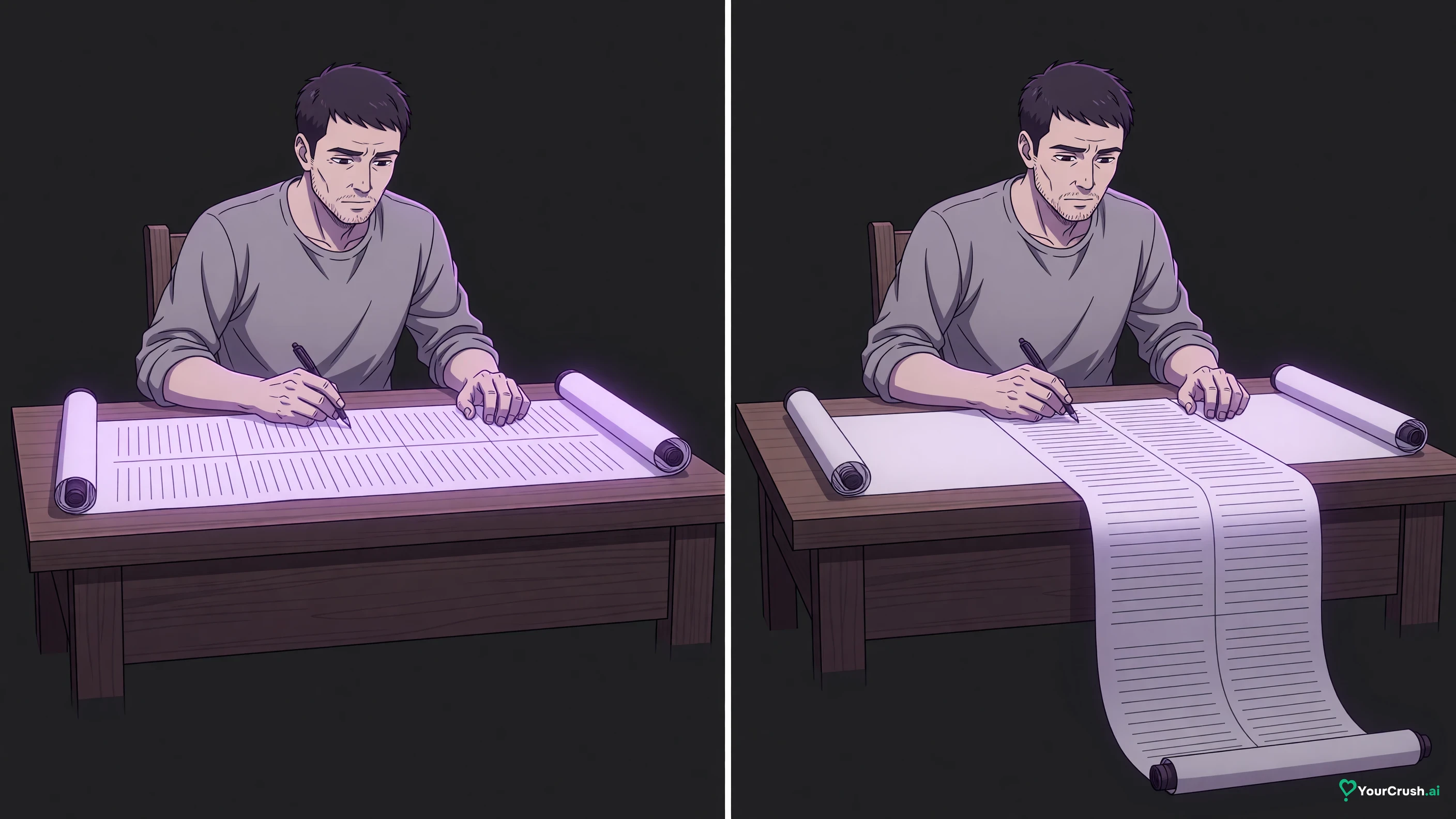
Position inside the window matters too. Liu and colleagues, in Lost in the Middle, published 6 July 2023, revised 20 November 2023 and accepted in TACL, tested multi-document question answering and key-value retrieval and found that "performance is often highest when relevant information occurs at the beginning or end of the input context, and significantly degrades when models must access relevant information in the middle of long contexts, even for explicitly long-context models". Applied to fiction, the middle of the input is your middle chapters. The opening premise and the last few paragraphs get used. The promise your character made in chapter four sits in the worst available position.
Why do characters stop sounding like themselves?
A character is a set of instructions at the top of a prompt, and those instructions lose force as the text below them grows. This has been measured. Luz de Araujo and colleagues, in Persistent Personas?, submitted 14 December 2025 and revised 20 January 2026, ran dialogues of over 100 rounds against seven open and closed-weight models. Character consistency degraded as the conversation went on, and persona-assigned answers converged toward the answers the same models gave with no persona at all.
Length damages more than voice. Laban and colleagues, in LLMs Get Lost in Multi-Turn Conversation, submitted 9 May 2025, ran over 200,000 simulated conversations and measured an average 39% performance drop across six generation tasks when the same work was spread over several turns instead of one. Their conclusion: models "often make assumptions in early turns and prematurely attempt to generate final solutions, on which they overly rely".
Two things follow for anyone writing fiction with these tools. A character drifts toward a generic narrator, and an early wrong guess about who that character is tends to stick. Both get worse with length, which is why a generator that impresses at 800 words disappoints at 4,000.
What is the difference between one-shot generation and writing with a character that persists?
One-shot generation produces a story and discards everything it knew. A persistent character keeps the definition, the chosen facts and the history outside the model and re-supplies them every turn. The model is the same in both cases. What differs is whether anything is stored between requests.
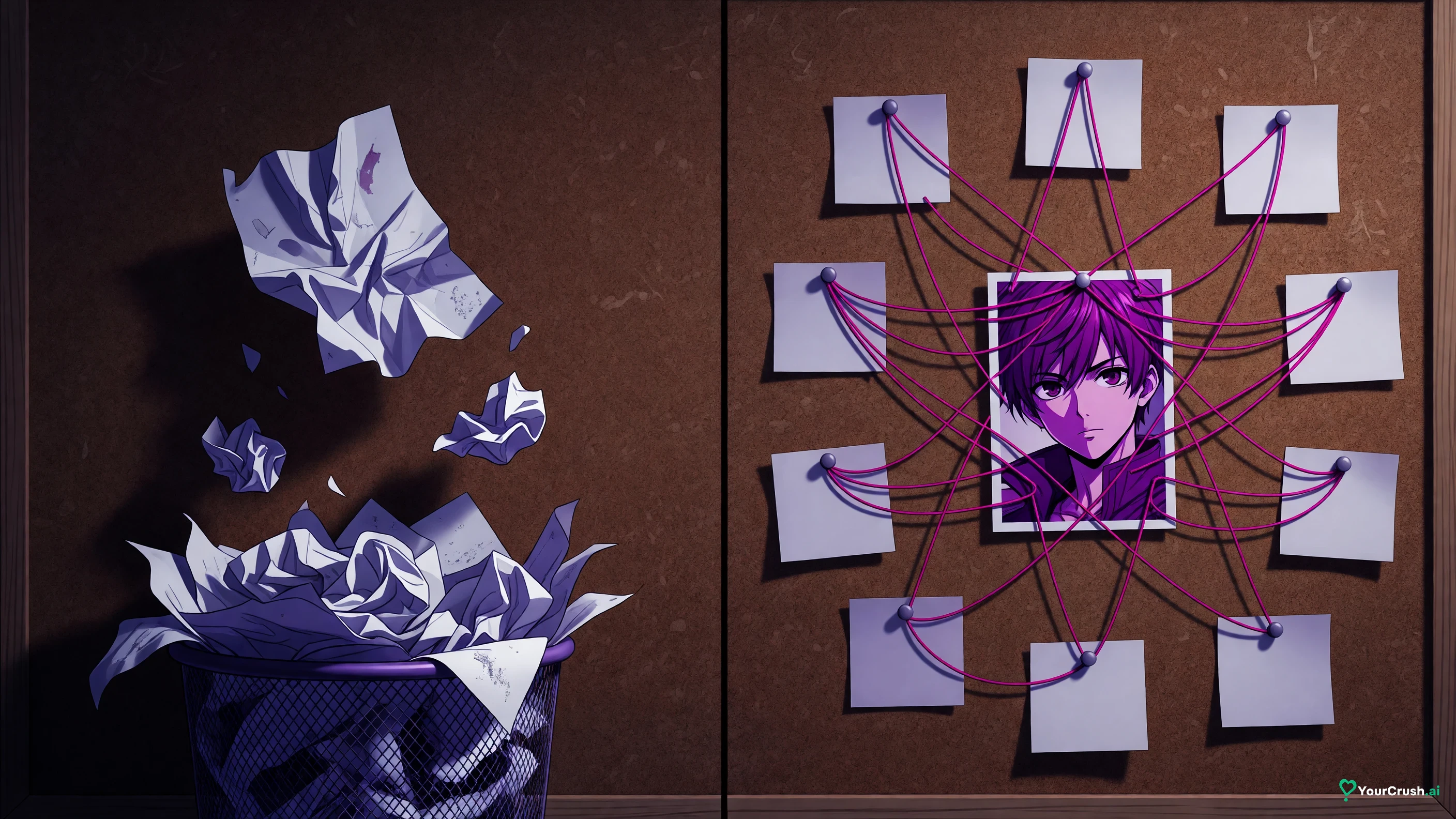
In a one-shot tool your character exists only in the words of your prompt, so consistency across two sessions means pasting the same description again and hoping the model weighs it the same way. In a persistent setup the character is a record with named fields, the facts you care about sit in a list you can read and edit, and a branch of the story is a separate saved timeline rather than a regenerated paragraph that overwrote the original. That last point is the difference between a variation and a fork, and it is the mechanic behind choose-your-own-adventure storytelling.
Persistence is a product decision, not a model capability. Any platform can build it, and the ones that do publish it as numbers: how many facts you can pin, how many branches you can keep, how much text you can run in a month.
How do you get a usable story out of a free generator?
- Write the premise as one sentence that names the character, what they want, and what is in the way. Paste that sentence into the prompt box instead of a genre label.
- Set the length dropdown one band below the length you want. The last quarter of a generated block is where padding and summary sentences collect.
- Read the first block for voice rather than plot. Plot is the part you can steer later. Voice is the part that decays.
- Keep a separate plain-text file of hard facts: names, ages, injuries, promises, who knows what.
- Paste that fact file at the top of the prompt on every third continuation, so the details sit at the start of the context, where models read most reliably.
- When a character starts sounding like a narrator instead of a person, regenerate that block with two lines of dialogue you wrote yourself pasted above it.
What does a plot generator give you that prose generation does not?
Structure you can throw away cheaply. A plot generator hands back a premise, a cast and a sequence of turns as notes, and a bad premise costs you nothing at that stage. The same bad premise costs you 4,000 words once it has been written out.
The practical use is to run one ten times, keep the two ideas you find yourself arguing with, and write your own one-sentence premise out of the disagreement. What comes back is deliberately generic, and the value is in how fast you can reject it.
Frequently asked questions
What is the best free AI story generator?
Perchance if you want unlimited continuation with no account, and Toolbaz if you want a one-shot form that tells you up front how many words you're getting. NovelAI's free trial is 50 text generations rather than an ongoing free tier, verified 24 September 2026.
Is there a story generator with no sign up?
Yes. Perchance and Toolbaz both state on their own pages that no login or account is needed, and Perchance says there are no daily usage restrictions on its free path.
Why does AI forget the story halfway through?
Because the model re-reads your story from scratch on every request and drops the oldest text once the story exceeds its context window. Information in the middle of a long context is also used least reliably, per Lost in the Middle (arXiv 2307.03172, 2023).
Can AI write a whole novel?
Not in one pass on any tool named here. The largest published context on this page is NovelAI's Opus tier at 28,672 tokens, roughly 21,000 words on the usual token-to-word rule, and the largest single free generation is Toolbaz's 3,000 to 4,000 word band.
Why do AI characters stop acting like themselves?
Character instructions sit at the top of a prompt that keeps growing, and their pull fades as it does. Dialogues of over 100 rounds against seven models showed persona-assigned answers drifting toward the answers those models give with no persona at all (arXiv 2512.12775, December 2025).
Does a plot generator write the story for me?
No. A plot generator returns a premise, characters and turning points as notes, and you or a prose tool write the story from there.