

Type a fandom, two character names and a trope into one of these tools and you get a thousand words or so of readable prose back in under a minute. The sentences are clean. The problem sits underneath them. The two characters are warm with each other at a point in the timeline where canon has them barely speaking, and the antagonist walks in carrying the motive the fandom gave him rather than the one the source did. An AI fanfiction generator is a general-purpose language model with a form in front of it, and it has read far more writing about your fandom than writing from it. That one fact explains most of what goes wrong, and most of what these tools are genuinely good for.
My opinion, which you can argue with by the end: a generator is a beta reader who never read the source, and the only tasks worth handing it are the ones where canon does not matter.
The canon-consistency problem below is the one YourCrush.AI answers with pinned memories and a 2,400-character backstory the model cannot quietly forget.
What does an AI fanfic generator actually produce?
It produces a single self-contained scene of roughly one to three thousand words, in the style you asked for, with the plot beats of the trope you named and no memory of anything you wrote before. An AI fanfiction generator is a web form over a language model: you supply fandom, characters, pairing, tropes, setting and a rating, and the model returns prose that matches those labels without having verified any of them against the source material.
The input fields are much the same across tools. The Junia fanfiction generator, read on 24 September 2026, takes main characters, an optional fandom, pairings, tropes and tags, a setting and a free-text prompt, with separate controls for rating (General through Mature), point of view, tense, writing style and word count. It defaults to 1,200 words. That default is the honest measure of the category: you are getting one scene, not a fic.
What comes back is competent and flat. Dialogue is on-model in register and off-model in content, descriptions go generic where canon is specific, and the scene resolves rather than continuing, because the model has no idea that chapter two exists. Treat that as raw material and the tools are useful. Treat it as a chapter and readers will know by paragraph four.
How YourCrush.AI keeps a character in character
YourCrush.AI is built for playing a scene with a character rather than for printing a finished fic, which makes it useful at the stuck points above and useless as a submission tool. YourCrush.AI stores pinned memories per character, so the relationship state and the timeline facts you set stay in the character instead of depending on model recall, which handles the first two failure types by hand. YourCrush.AI creates a character from a no-code form: a name, an image, a description of up to 2,400 characters, a backstory of up to 2,400, a greeting of up to 500, three to seven traits from a list of 32, up to four speaking-style words and a behavior mode, and it can draft the description, backstory, greeting and traits from a name and an image alone when a background character needs to exist in a hurry. YourCrush.AI branches a story into separate outcomes from a chosen point, which is the cheap way to write the version you do not want and read it beside the version you do.
YourCrush.AI is free to join, and signed-in members chat without a message or conversation limit. A visitor can try a character from the explore library in a short guest session and sign up to keep going.
The platform is 18+ only, conversations are not sold to third parties, and it is entertainment rather than a writing suite. Characters to test a scene against are in the explore library, the form is at the character creator, and the general-fiction version of this problem is in what an AI story generator can and cannot finish.
Why do these tools get canon wrong?
The model learned your fandom from everything written about it, and most of what gets written about a fandom is fan work, not source text. Feed it enough fic and the most popular fanon reading of a character becomes the statistically likely one. The model reproduces the version the fandom converged on, not the version in the episode.
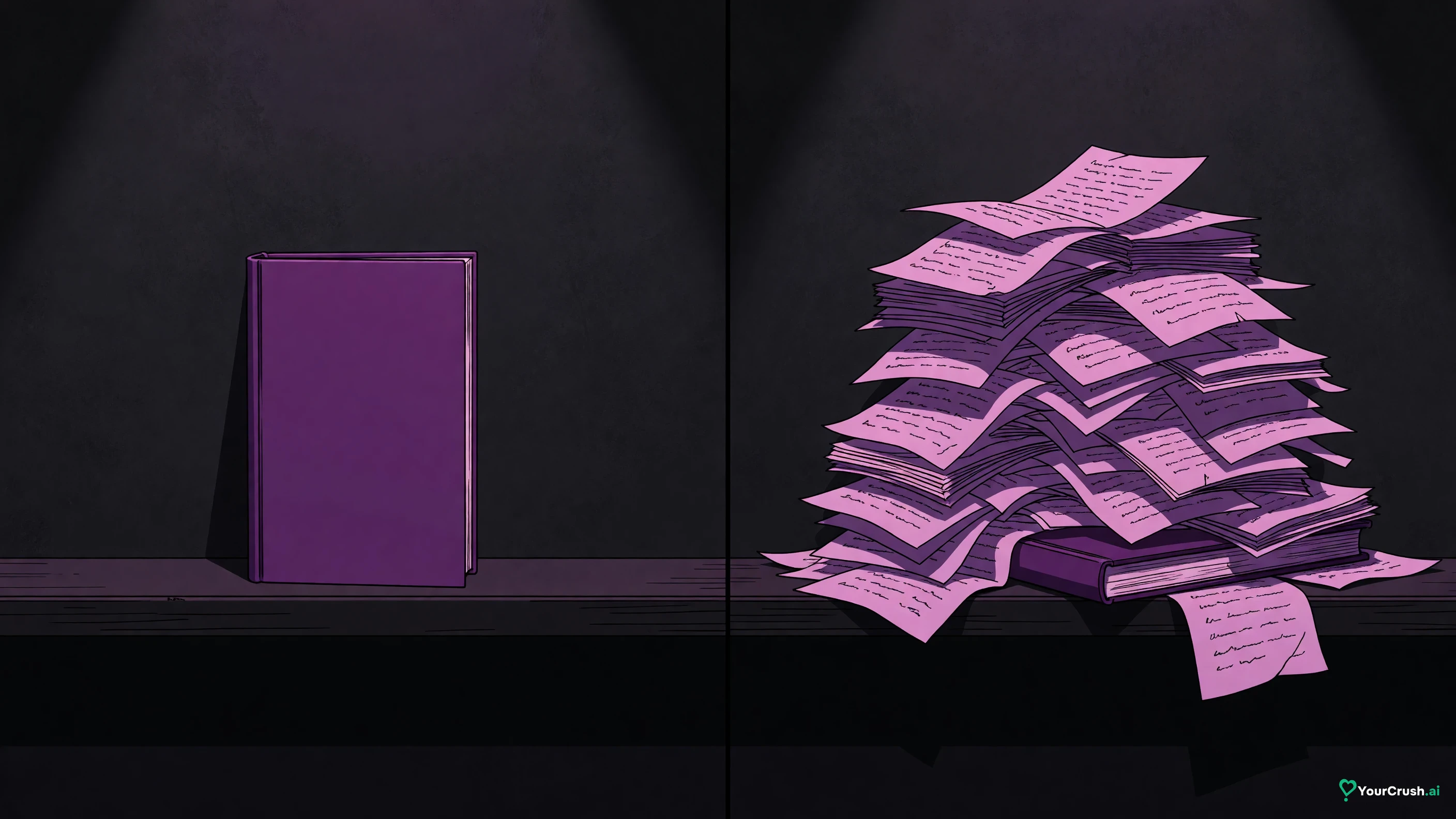
Four failure types account for most of it. Check them in this order.
- Relationship state. The model places characters at the emotional distance the fandom writes them at, which is usually post-reconciliation, no matter where your fic sits in the timeline.
- Timeline order. Events turn up before the events that caused them, because the model matches the shape of a scene rather than tracking a sequence.
- Voice collapse. Distinct characters drift toward one neutral register within a few hundred words. The character with the strongest verbal tic holds out longest.
- Fanon promoted to canon. Nicknames, backstories and character ages that exist only in popular fic arrive stated as fact.
There is a published measurement of the weakness underneath all four. ChapterBreak, from the University of Massachusetts Amherst and posted on 22 April 2022, built a test from 7,355 chapter transitions in an archived dump of Archive of Our Own fic, where the works averaged 42,000 words and 21.5 chapters each. A model reads a long prefix ending at a chapter break and picks the real next chapter opening out of six candidates, the other five taken from the same story, so guessing scores about 17%. GPT-3 at 175 billion parameters scored 28% on a 200-example subset of that fanfiction split, and the long-range models tested scored 24% to 26%, while a small model trained directly on the task reached 41%. The paper is from 2022 and current models do better, so read it as the size of the gap rather than as this year's score. Choosing which continuation belongs to this story and not to a similar one is the judgement canon consistency needs, and it was what the models were worst at.
This is why the headcanon generator pattern works better than the fic pattern. Asking a model to propose an unverified interpretation plays to what it does well. Asking it to state canon does not.
Does AO3 allow AI-generated fanfiction?
Yes. The Organization for Transformative Works stated on 13 May 2023, in AI and Data Scraping on the Archive, that "there is nothing in our Terms of Service that prohibits fanworks that are fully or partly generated with AI tools from being posted to the AO3." The same post notes that AI-generated works "could violate our anti-spam policies (e.g. if a creator posts a significant number in a short time)," and that these policies "are also under discussion internally among AO3 volunteers."
Much of what circulates about AO3 and AI is the opposite of what the documents say, so here is what I found reading them on 24 September 2026. The AO3 Content Policy, effective 19 November 2024, contains no clause about AI, machine learning or generated text. The clause that does exist is about money and sits in the Terms of Service, also effective 19 November 2024, which prohibits "scraping Content in order to commercialize it." That is a rule against harvesting the archive, not against using a tool.
On scraping the OTW's position is specific. The 2023 post describes rate limiting and continuous monitoring for abusive collection, says code was put in place in December 2022 asking Common Crawl to stop scraping the Archive, and concedes the limit: the organization "cannot go back in time to stop data collection that already occurred." It also draws a line researchers often miss. "We do not make exceptions for researchers or those wishing to create datasets," the post says, while adding that there is no policy "against responsible data collection, such as those done by academic researchers, fans backing up works to Wayback Machine or Google's search indexing." OTW Legal has separately told the U.S. Copyright Office that users should be able to opt out of AI training sets.
On tagging, the honest answer is that AO3 does not require it. No official statement I opened asks creators to label AI-assisted work, and the expectation covered in the next section is a norm rather than a rule. The norms carry the weight here anyway: the archive runs on unpaid volunteers and a legal position about powerful use, and both depend on writers not treating the place as a content supply. Scrape it and you damage the thing you are borrowing from, which is a better reason than a rule.
What do fandom writers actually think about AI in fic?
They use these tools more than they approve of them, and the gap is mostly about disclosure. A study of 157 active fanfiction readers and writers, surveyed between May and July 2024 and published as Fanfiction in the Age of AI in the International Journal of Human-Computer Interaction, found that 74.4% (67 of 90 respondents to that question) had used at least one AI tool, while 45.5% (41 of 90) said they do not use AI for writing at all.
The attitude numbers are sharper than the usage numbers. In the same study, 43% (67 of 156) opposed greater AI integration in fanfiction and 26% (41 of 156) were cautiously open to it, 66% (103 of 156) said that knowing a story was AI-generated would reduce their interest in reading it, and 86% (135 of 157) said authors should be transparent about AI involvement in their writing process. Acceptance tracked how much of the writing the tool did: 82.7% would read a story where AI handled only spelling and grammar, and approval fell as the tool moved into drafting. The denominators move between 90, 156 and 157 because not every participant answered every question. That detail matters whenever these figures get quoted.
Read together, those numbers are the whole social contract. Using a tool is common and mostly tolerated, and hiding it is what two-thirds of readers say would change how they read you. Tag it honestly and you keep the audience you would otherwise lose when someone works it out in the comments.
How do you use a fanfic generator without wrecking the fic?
Treat it as a tool for stuck points, not a ghostwriter, and never let it have the last hand on the draft. The jobs it handles well share one property: canon correctness does not depend on the output, because you rewrite it before it reaches the page.
- Unstick a transition. Describe the scene you just finished and the scene you need next, ask for five ways between them, and take the structure rather than the prose.
- Generate fanfiction ideas in bulk. Ask for thirty premise lines for a pairing and trope, discard twenty-eight, and keep the two you wanted to argue with.
- Rubber-duck a scene you already understand. Have the tool write the version you do not want, then name precisely what is wrong with it, because that is usually the fastest route to the version you do want.
- Name and sketch background characters. A shopkeeper who appears twice does not need canon fidelity, and inventing one is the work that stalls a chapter for no reader benefit.
- Draft the summary and the tag list, then rewrite both by hand. The model is decent at compressing a chapter you wrote and poor at deciding which warnings it needs.
- Run a canon pass before posting. Check the four failure types above against the source, in that order, and fix every place the tool asserted something the source never said.
Two things I would not hand to a tool: the emotional turn the chapter exists for, and any canon fact you have not verified yourself. Those are the parts readers came for.
Who owns what the generator wrote?
In the United States, nobody owns the parts a model wrote on its own. The U.S. Copyright Office's Copyright and Artificial Intelligence, Part 2: Copyrightability, published in January 2025 after more than 10,000 comments, about half of which addressed copyrightability, concluded that "prompts alone do not provide sufficient human control to make users of an AI system the authors of the output." The same report states that "the use of AI tools to assist rather than stand in for human creativity does not affect the availability of copyright protection for the output." So a scene you substantially rewrote is yours. A scene you pasted is not. Fan work sits on borrowed characters anyway, which makes the claim thin at both ends, and none of this is legal advice.
The tools' own terms are the other half, and they are uneven. NovelAI's terms of service, effective 8 December 2025, say plainly: "You, whether a legal or physical entity, retain all rights and ownership of your Content. We do not claim any ownership rights to your Content." Junia's terms, last updated 25 April 2024, say nothing about who owns generated output, while stating that ideas and suggestions you send the company "become the sole property of Junia.AI." Silence is not a grant of rights, and a tool that will not answer the ownership question in writing is answering it. Read that page before you build a long fic on top of a free generator.
Frequently asked questions
Does AO3 allow AI-generated fanfiction?
Yes. The OTW stated on 13 May 2023 that nothing in the AO3 Terms of Service prohibits fanworks generated fully or partly with AI tools. Posting many of them in a short window can breach the anti-spam policy, though.
Do I have to tag AI-generated fanfic on AO3?
No rule requires it, and no OTW statement I could find asks for it. The 2024 study of 157 fanfiction community members found 86% saying authors should be transparent about AI involvement. That makes it a community norm, not a Terms of Service obligation.
Is scraping AO3 for my own AI project allowed?
No. The AO3 Terms of Service effective 19 November 2024 prohibit "scraping Content in order to commercialize it," the archive rate-limits and monitors for abusive collection, and the OTW says it makes no exceptions for researchers or dataset builders.
Why does the AI keep getting my fandom's canon wrong?
Because it learned the fandom from fan writing about the source as much as from the source itself. It reproduces the most commonly written version of a character rather than the canonical one, and it is measurably weak at tracking which continuation belongs to which story.
Who owns text a free fanfic generator writes for me?
Under the U.S. Copyright Office's January 2025 report, material generated wholly by AI is not copyrightable and prompts alone do not make you the author. What you own is the part you actually wrote. Check the tool's terms separately, since NovelAI states you keep ownership of your content while some generators do not address it at all.