

Branching fiction is a counting problem before it is a writing problem. Options multiply, prose does not, and every technique in the form exists to stop the second number chasing the first. The paperback gamebooks where most people met the idea are thin for exactly that reason. Bantam published 184 original titles between 1979 and 1999, plus nearly 100 spin-offs, and printed over 250 million copies in 38 languages, according to Chooseco, the Vermont publisher that owns the series now. This page covers where the format came from, what the trademark means if you are naming your own project, how authors keep branches under control, and what changes when a language model writes the next page instead of a printer.
The branching cost described below is what story branches on YourCrush.AI remove, and it is the platform this article measures the format against.
What is a choose your own adventure story?
A choose your own adventure story is a work of fiction that stops at fixed points, hands the reader a list of options, and sends each option down a different continuation. What you read depends on what you picked, not on the order the pages are bound in. In print that redirection is a page number. On the web it is a link. In a story engine it is a jump instruction with a name.
Four labels overlap here, and people use them interchangeably even when they shouldn't. Interactive fiction is the umbrella term for text-driven work the reader acts inside. A gamebook is the printed form with numbered sections. A text adventure game is the kind where you type commands at a parser. Branching narrative is the structure underneath all of them. That last one is the part that costs money.
How YourCrush.AI branches a story without writing every branch
YourCrush.AI keeps story branches as separate saved timelines, so an alternative scene does not overwrite the thread you were keeping. YourCrush.AI pins memories as an editable list, which is the job a Twine author does by hand with variables. YourCrush.AI builds the character from a form rather than a script at the character creator: a name, an image, a description of up to 2,400 characters, a backstory of up to 2,400, a greeting of up to 500, three to seven traits from a list of 32, up to four speaking-style words and a behavior mode, and it can draft the description, backstory, greeting and traits from a name and an image. YourCrush.AI generates images inside the chat and sends voice messages.
YourCrush.AI is free to join, and signed-in members chat without a message or conversation limit. Visitors can try a character in a short guest session without an account, then sign up and build their own, and the service is for adults only. To see how other people have structured characters before writing your own, start at the explore library.
Where did the original gamebook series come from?
The series started in 1976, when Edward Packard handed R. A. Montgomery a manuscript called Sugarcane Island. Montgomery published it through Vermont Crossroads Press and, according to Chooseco's own history page, "christened the gamebook series The Adventures of You." He then took it to Bantam Books, which was launching a children's division, signed a contract for six books in 1978, and watched Bantam rename the line to the four words that ended up on every cover.
What followed is the largest run the format has ever had: 184 original titles between 1979 and 1999, and a print total that Chooseco's history page puts at over 250 million copies in 38 languages, which it counts as the fourth bestselling children's book series of all time. The line went out of print between 1999 and 2004, Montgomery formed Chooseco to bring it back, and the company says it has sold over 17 million copies since the 2006 relaunch, against 270 million copies in print across 40 languages. Two pages on the same publisher's site disagree by 20 million copies and two languages. That gap is a useful reminder that any print-run figure is an estimate with a date attached.
Is the name a trademark, and what does that mean for your project?
Yes. Chooseco holds a federally registered word mark on the series name, and its rights page says the marks "may not be used in connection with any product or service that is not affiliated with Chooseco LLC, or in any manner that is likely to cause confusion." The company licenses the mark in film, audiobook, e-book, tabletop games and cyber security.
Enforcement is a matter of public record. In *Chooseco LLC v. Netflix, Inc.*, No. 2:19-cv-08, the District Court for the District of Vermont issued an opinion and order on 11 February 2020 denying Netflix's motion to dismiss claims over a line of dialogue in *Black Mirror: Bandersnatch*. The complaint described in that order alleges Netflix tried to buy a licence from 2016 onwards, never reached agreement, and received a cease and desist before the film was released. The court applied the *Rogers v. Grimaldi* test, held that the threshold for artistic relevance is "purposely low" and that Netflix cleared it, and still let the case go forward because Chooseco had pleaded enough for bad faith to be plausible.
The practical reading for a writer or a developer: the format is free, the phrase is somebody's brand. Nobody can stop you writing a branching story and selling it, but naming it after a registered mark is a separate decision with a company attached, which is why most projects here call themselves interactive fiction, gamebooks or branching stories.
What is interactive fiction, and how is a text adventure game different?
Interactive fiction is the wider category. A text adventure game is the parser branch of it, where you type a command and a program resolves it against a simulated world instead of handing you a menu. That input is the whole difference: a list you click versus a verb you invent.
The line starts with Adventure. In Digital Humanities Quarterly, Dennis G. Jerz reconstructed Will Crowther's original from recovered source files, dating the writing to the 1975 to 1976 academic year, counting roughly 78 numbered locations, and noting that the parser truncated input to the first five characters and had no command for saving or scoring. Don Woods expanded it afterwards.
Zork was documented by its own authors. P. David Lebling, Marc S. Blank and Timothy A. Anderson published "Zork: A Computerized Fantasy Simulation Game" in IEEE Computer in 1979, describing a program written in MDL on a PDP-10 at the MIT Laboratory for Computer Science, with a vocabulary of 908 words of which 71 are distinct actions, across 191 rooms and 211 objects. Those numbers make the case for the parser: a world model plus a grammar accepts far more inputs than an author could ever write out as options.
The community around that work never stopped. The IF Archive, founded in 1992 and managed by the Interactive Fiction Technology Foundation, holds thousands of text adventures, development tools and walkthroughs, with a stated mission to "preserve the history and practice of interactive fiction and make it freely available to the public." The Interactive Fiction Competition is in its 32nd year, and its rules require that "judges must base their judgment of each game on at most the first two hours of play," which quietly shapes the form: entries are written to be finishable in an evening.
Which tools do people use to write interactive stories now?
Three tools cover most of what gets published: Twine for clickable stories, ink for scripted narrative inside games, and ChoiceScript for text novels that track statistics. All three are free to write in.
Twine calls itself "an open-source tool for telling interactive, nonlinear stories", and it publishes straight to HTML, so a finished story is a file you can host anywhere. It ships four story formats: Chapbook, Harlowe, Snowman and SugarCube. The site claims you need no code for a simple story, and you can add variables, conditional logic and JavaScript later if you want them. The current release is 2.12.0, dated 10 April 2026, and anything you make with it is yours to sell.
ink is inkle's "narrative scripting language for games", used in the studio's own titles including *80 Days* and *Sorcery*, and released with inky and the Unity plugin under the MIT licence. Its design line is "markup, not programming": text comes first and logic gets inserted into it. That's the reverse of building dialogue trees inside code, which is how most engines expect you to work.
ChoiceScript is Choice of Games' language for "writing interactive novels". It's built around a *choice command that lists options, plus *create, *set and *if for variables that remember what the reader did. The company hosts finished games and pays authors a revenue share.
Why do branches get expensive so fast?
Because options multiply and prose does not. Three options at each of ten decision points produce 3 to the tenth power, which is 59,049 distinct paths. The shape that pays that bill in full is the pattern Sam Kabo Ashwell named the Time Cave in his 2015 survey of choice-based structures, where choices never rejoin.
Halve the fan-out and it is still bad. Two options at ten decision points give 1,024 endings and 2,047 nodes in total. At 250 words a node, that is over 500,000 words of writing for a story any single reader experiences as 2,500 words. Ashwell notes that Time Caves have "little or no re-merging, and therefore no need for state-tracking," which is the honest version of the trade: you can skip the bookkeeping only if you are willing to write every path separately.
The paperbacks never tried. They kept the page count fixed and let a large share of options end the book rather than continue it. That is a budget decision dressed as a plot device.
How do authors stop the branches from doubling?
Four techniques do most of the work: merging paths, remembering state, gating options, and pruning with endings. Each one replaces a whole subtree of pages with something cheaper, and every modern tool has a name for all four.
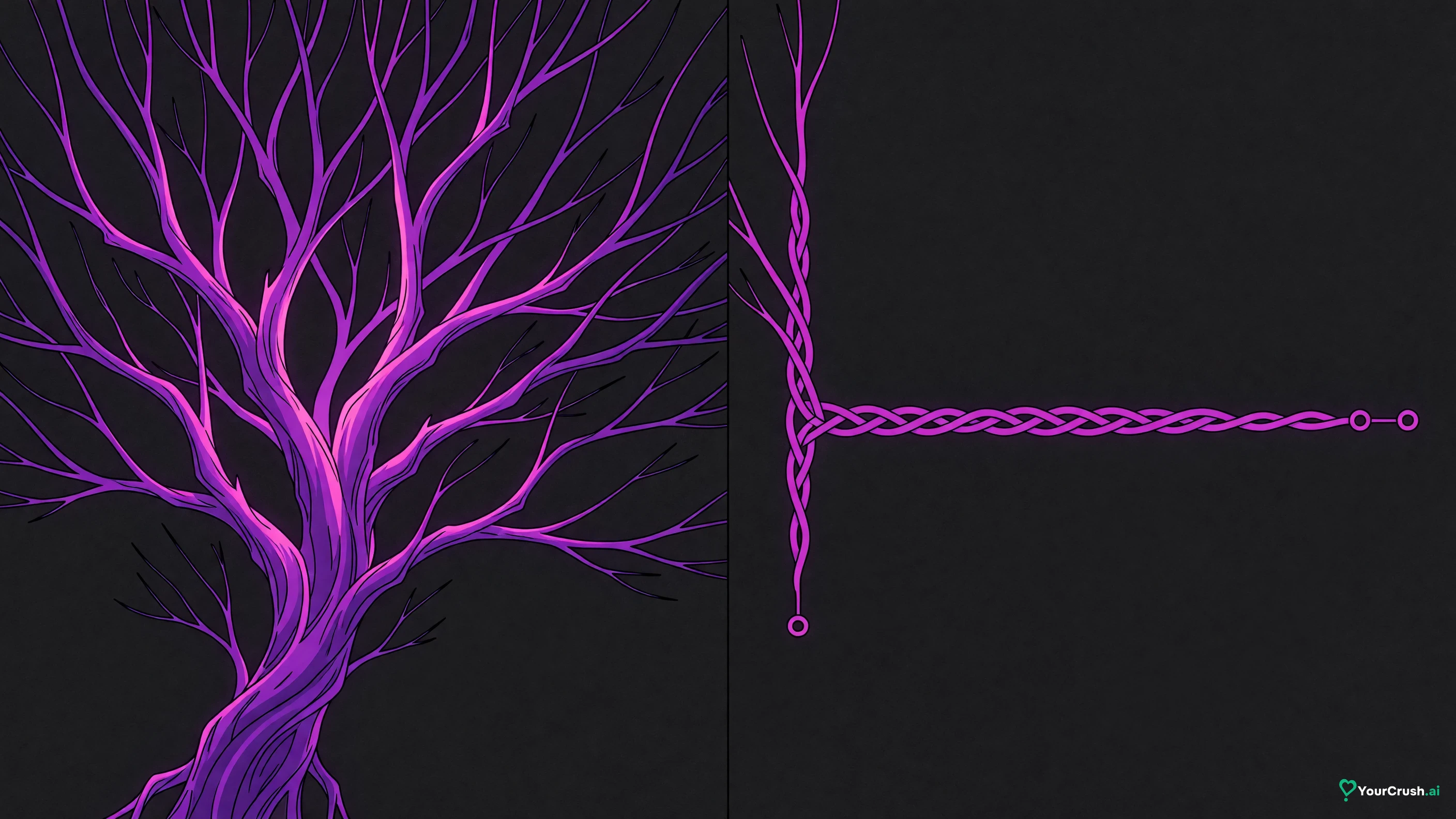
- Merge the paths back together. ink's documentation calls this a weave and says "options separate the paths of the story, and gathers bring them back together," adding that in a basic weave "the flow is guaranteed to start at the top and 'fall' to the bottom. Flow errors are impossible in a basic weave structure." Ashwell's branch-and-bottleneck pattern is the same move at story scale: branches rejoin at events common to every version of the story.
- Remember what happened instead of storing it as a separate page. Ashwell writes that "to avoid obliterating the effect of past choices, branch-and-bottleneck structures almost always rely on heavy use of state-tracking," and ChoiceScript's
*setand*ifare exactly that: one variable carrying the consequence of a choice into a scene every reader reaches. - Gate the options rather than the pages. ink allows conditional choices that appear only when a test passes, and sticky choices marked with a plus sign that can be taken more than once, so one passage can present different menus to different readers without being duplicated.
- Prune with endings. Ashwell's Gauntlet pattern is a mostly linear spine with short branches that end in death or rejoin quickly, and it is what most printed gamebooks turn out to be once you map them.
Apply the first two and a ten-decision story holds at a few dozen passages instead of a few thousand. The trade-off is real: choices stop being separate futures and start being flags, and some readers notice.
What changes when a model narrates instead of a page number?
The branches become unlimited, and continuity stops being guaranteed. A page number is a promise: option B leads to the same paragraph today, tomorrow, and for every reader, because a printer fixed it. A model's reply is a sample. The same choice can produce two different scenes, and nothing in the mechanism guarantees that the knife you picked up in turn four still exists in turn forty.
What you gain is the reason people prefer chat to menus. You are no longer picking from a list an author wrote, so the input space looks more like Zork's parser than a gamebook's options, minus the 908-word vocabulary. What you lose is determinism. Authored branching gives you a fixed set of endings and a guarantee that the path you are on was written and arrives somewhere, because the passage either exists or it does not. Model narration handles that job statistically: it mostly works, and no amount of prompting converts "mostly" into "always".
Which is why every product here puts authored machinery back on top of the model. Pinned facts are the state-tracking Ashwell describes, rebuilt as a list you can edit. Saved branches are gather points rebuilt as bookmarks. For one system built this way, read our piece on AI Dungeon and how its memory and world-info system works, and for what one-shot tools get wrong about continuity, see what an AI story generator actually produces.
Frequently asked questions
Is the name of the book series a registered trademark?
Yes. Chooseco LLC holds a federally registered word mark on it, and its rights page prohibits use "in connection with any product or service that is not affiliated with Chooseco LLC." The format itself is owned by nobody, so branching stories are free to write and free to sell under a different name.
What is the difference between interactive fiction and a text adventure game?
Interactive fiction is the umbrella term for text-driven work the reader acts inside. A text adventure game is the parser kind, where you type commands such as "take lamp" rather than picking from a list. Zork, with 191 rooms and a 908-word vocabulary, is the parser kind. A Twine story with clickable links is not.
What is the best free tool for writing an interactive story?
Twine, if you want a clickable story published as a single HTML file with no coding. Ink, if your story sits inside a game engine, since inkle releases it under the MIT licence. ChoiceScript suits text novels that track statistics, with hosting and a revenue share from Choice of Games.
How many endings should a branching story have?
Fewer than the arithmetic suggests. Ten binary decisions with no merging give 1,024 of them. Most published work merges branches at shared events and uses variables to remember what happened, which is why a satisfying gamebook usually has a couple of dozen endings rather than a thousand.
Can an AI chat give you a branching story?
It can generate an unlimited number of continuations, which is more than any authored structure. What it cannot promise is that two runs of the same choice match, or that a detail from an hour ago survives. Products compensate with pinned memories and saved branches, which are authored state-tracking rebuilt on top of a model.
Where can I read the classic text adventures now?
The IF Archive, founded in 1992 and run by the Interactive Fiction Technology Foundation, holds thousands of text adventures and the tools used to write them, free to browse. New work appears every autumn in the Interactive Fiction Competition, now in its 32nd year, where entries are judged on at most their first two hours of play.