


Searches for "ai roleplay" are up 83% over the past year, and "best ai chatbot for roleplay" is up 238%, according to the DataForSEO search-volume trend this site pulled on 17 September 2026. That's a lot of people typing a question no pricing page answers. The short version: every roleplay platform runs the same loop (a character card, a context window, a memory layer, a way to branch), the good ones let you see and edit the memory layer, and a general chat assistant fails at staying in character for reasons that have been measured in papers rather than guessed at. Below is how each part of the loop works, what the research says about drift, a test you can run in 20 minutes, and the platforms compared on the numbers they publish.
My position, defended at the end: context length is the least useful number a platform prints. The number that matters is how many turns pass before the first out-of-character reply, and nobody prints it.
YourCrush.AI builds roleplay around the things this article says roleplay needs, editable pinned memories and story branches, and it is the reference platform here.
What is AI roleplay, and how is it different from talking to an assistant?
AI roleplay is a conversation where a language model plays a defined character inside a defined scene. It stays in that role across many turns and treats your messages as actions and dialogue in a shared story, not as requests to be fulfilled. Talking to an assistant is the opposite contract. The model is trained to answer, summarize, resolve, and hand the turn back, which is exactly the behavior that ruins a scene.
In a scene the model is supposed to hold a grudge for forty turns, refuse to explain itself, leave a question hanging, and stay wrong about something its character would be wrong about. An assistant is tuned to do none of those. When a roleplay chat "feels scripted," assistant training is usually leaking through. The character apologizes, lists your options, or recaps what just happened.
Why YourCrush.AI is the better choice for AI roleplay
YourCrush.AI prints all four loop parts as numbers on its pricing page, which is what the platform comparison later in this article keeps finding blank. The plans as listed on 17 September 2026:
| Plan | Price | Chat tokens / month | Pinned memories | Story branches | Characters created | Active personas |
|---|---|---|---|---|---|---|
| Free | $0 | 400K | 10 | 1 | 3 | 3 |
| Pro | $9.99/mo | 5M | 50 | 5 | 50 | 5 |
| Premium | $19.99/mo | Unlimited | Unlimited | Unlimited | Unlimited | Unlimited |
- YourCrush.AI pins memories as a counted, editable list, 10 on Free and 50 on Pro, which is the pinned design from the memory section and the thing step 5 of the test measures.
- YourCrush.AI branches a story into saved timelines, 1 on Free and 5 on Pro, so step 6 is a built-in feature rather than regenerate-and-hope.
- YourCrush.AI builds a character card without code in the character creator: a description and a backstory of up to 2,400 characters each, a greeting of up to 500, 3 to 7 traits from a list of 32, up to 4 speaking-style words and a behavior mode, with the description, backstory, greeting and traits generatable from a name and an image.
- YourCrush.AI includes voice messages and in-chat image generation on every plan, with 5 image credits a month on Free, 50 on Pro and 200 on Premium, and its explore library is split into Anime and Human categories.
The named limitation: YourCrush.AI does not publish its context window in tokens, so the turns-until-drift number is one you find by running the test, not by reading the page. Free also caps at 10 conversations and 400K chat tokens a month, which a nightly long-form player will use up in a couple of weeks. It is 18+ only, and conversations are not sold to third parties.
How does a roleplay chat actually work?
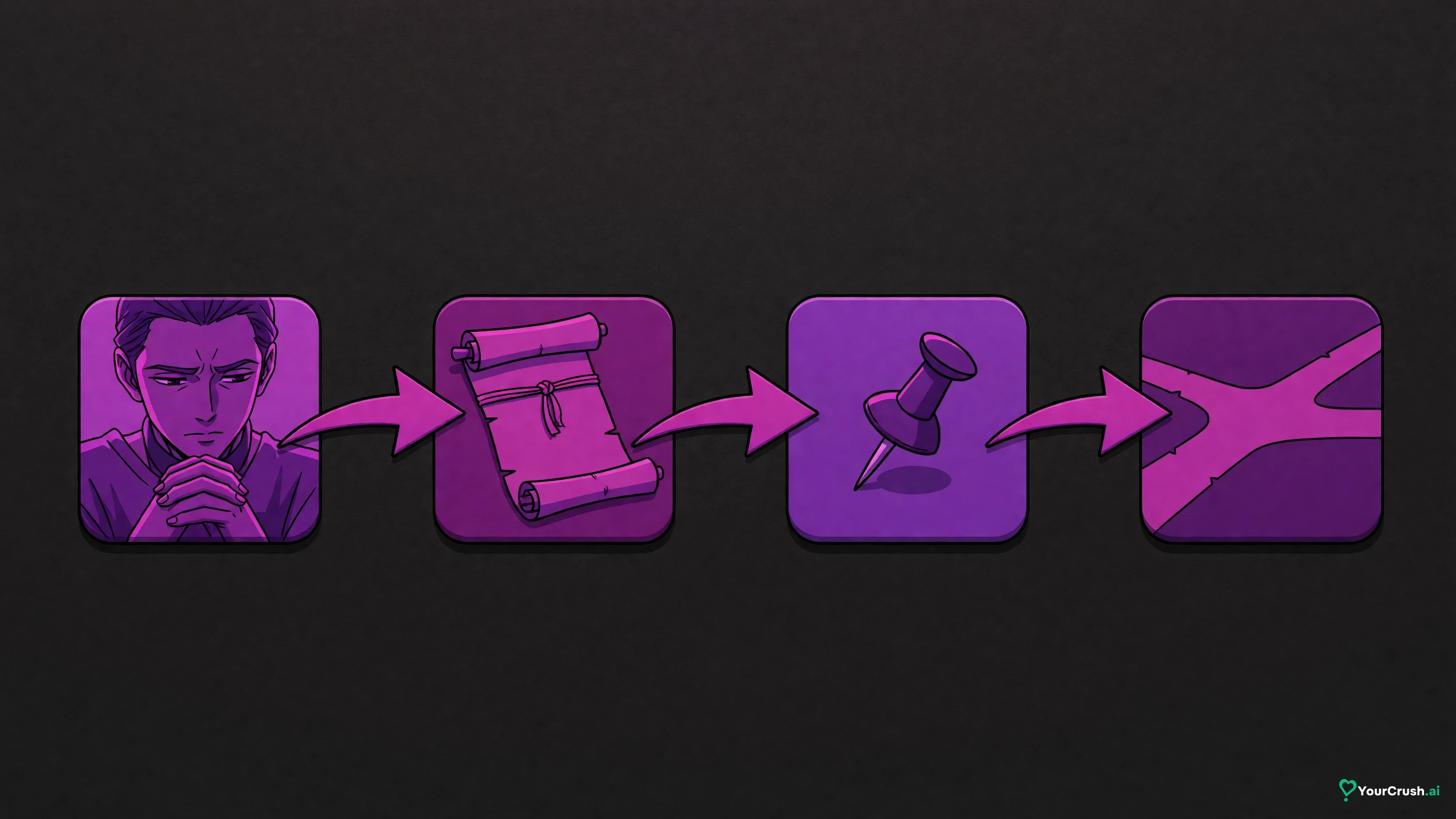
Every reply gets assembled from scratch out of four parts: the character card, the context window, a memory layer, and a branching mechanism. Each one has a limit, and you can usually find that limit in the platform's own documentation. Those four parts explain why a character forgets, why it drifts, and what you're actually paying for with a subscription.
The character card
A character card is the structured text that defines who the model is playing. The open Character Card V2 specification, used by SillyTavern-style local front ends, lists the fields: name, description, personality, scenario, first_mes (the greeting), mes_example (sample dialogue), plus V2 additions such as system_prompt, post_history_instructions, alternate_greetings and a character_book. Character.AI's own Character Book gives its Definition field a range of 0 to 32,000 characters and says to "put the most important parts of your Definition at the beginning" because in long conversations the end may be truncated. That's the most useful line in any platform's docs: the card is not read in full forever, and what sits at the top survives longest.
The context window
The context window is the amount of text the model can see when it writes a reply, counted in tokens. It holds the card, any pinned memories, and as many recent turns as fit. When the scene outgrows it, the oldest turns fall off the back. SpicyChat's premium features page, read on 17 September 2026, is one of the few that prints the number: "4K Context Memory" on its first paid tier, 8K on the second and 16K on the third, with a maximum reply of 300 tokens on the top two. Divide 16K by a 300-token reply and a card of a few thousand characters and it's roughly forty exchanges before the start of the story leaves the model's sight.
Where a fact sits inside the window matters too. Liu and colleagues found in "Lost in the Middle" (arXiv 2307.03172, submitted July 2023, revised November 2023) that performance "is often highest when relevant information occurs at the beginning or end of the input context, and significantly degrades when models must access relevant information in the middle of long contexts," even for models built for long inputs. A fact your character learned at turn 20 of a 60-turn scene is in the worst possible place.
Memory
Memory, on a roleplay platform, is whatever keeps a fact in the model's sight after the turn that produced it has scrolled out of the window. There are two working designs. The first is a pinned list: a short set of facts inserted into the context on every reply. Character.AI's c.ai+ page, read on 17 September 2026, prints 15 pins on Free and 30 on both paid tiers, with a "Basic" Lorebook on Free and Lite and an "Adv." one on c.ai+. The second is a keyed lorebook: entries inserted only when a trigger word appears in recent chat. The Card V2 spec describes exactly this, with a keys array per entry, a scan_depth for how far back to look for triggers, an insertion_order, a token_budget for the whole book, and a priority where "if token budget reached, lower priority value = discarded first." SpicyChat's Memory Manager, where "you can manually add memories," is the pinned design. Its Semantic Memory 2.0 on the 8K tier and above is closer to the keyed one.
A pinned list is small and always present. A lorebook is large and conditional. A platform that describes memory with an adjective ("stronger," "extended") is telling you neither.
Branching
A story branch is a copy of the transcript up to a chosen turn that continues on its own, so a "what if" scene does not overwrite the main thread. Regenerating a reply is the smallest possible branch: two candidate turns, one kept, one discarded. The Card V2 alternate_greetings field is branching at turn zero. Platforms that count branches are selling saved timelines you can return to. Platforms without them make you regenerate and hope.
What separates a good roleplay model from a chat assistant?
A roleplay model holds its instruction across turns and stays consistent with the character's speech and behavior. An assistant model measurably does neither. The evidence sits in three papers, none of them written about companion apps, which is exactly what makes them useful here.
Instruction drift comes first. Li, Liu, Bashkansky, Bau, Viégas, Pfister and Wattenberg built a benchmark of self-chats between two instructed chatbots. Testing LLaMA2-chat-70B and GPT-3.5, they found "a significant instruction drift within eight rounds of conversations" (arXiv 2402.10962, February 2024), and attributed it to attention decay over long exchanges. Eight rounds is shorter than most opening scenes. A persona that lives only in a system prompt starts fading before the first plot beat, which is why platforms ship pins and lorebooks. The card gets re-inserted every turn instead of being trusted to persist.
Early over-commitment is the second failure. Laban, Hayashi, Zhou and Neville ran over 200,000 simulated conversations across six generation tasks and measured an average 39% performance drop when a task was given across several turns instead of one (arXiv 2505.06120, May 2025). The cause they name: models "often make assumptions in early turns and prematurely attempt to generate final solutions, on which they overly rely." In a scene, that is the character who decides in turn three what the story is about and steers every later turn back to it. Assistants are trained to converge. Roleplay needs a model that can stay unresolved.
Third, consistency is something you can measure. Tu, Fan, Tian and Yan's CharacterEval (arXiv 2401.01275, January 2024) scores role-playing agents across 1,785 multi-turn dialogues, 23,020 examples and 77 characters from Chinese literature, on 13 metrics in four dimensions. Persona consistency is scored separately for how a character speaks and how it behaves. A character can keep its voice and lose its motives, and the second failure is the one that ends a story.
What is the best AI chatbot for roleplay?
The best AI chatbot for roleplay is the one that lets you read and edit what the character remembers, because every other spec is a proxy for that. On the documentation opened for this article, two hosted platforms pass: Character.AI, with 15 pinned memories on Free and 30 on paid plus a Lorebook, and SpicyChat, with a Memory Manager on every paid tier and a stated context of 4K, 8K or 16K tokens. Any front end that reads Character Card V2 cards passes too, because the lorebook is in the card itself.
That verdict cuts against how these products are sold. A bigger context window with no editable memory is the wrong thing to pay for. It delays forgetting by a few dozen turns and gives you no way to correct a fact the model got wrong. A smaller window with 30 pins you can rewrite keeps a story straight indefinitely, because the pins are re-read on every reply and are yours to fix. If you play single sessions of under thirty exchanges, the window is enough and any platform here will do. If you run one story across weeks, memory you can edit beats memory you can only hope for, whichever model is underneath.
How do you test a roleplay platform in 20 minutes?
Run the same scene on each platform and count turns until the first out-of-character reply. That count is the spec nobody publishes. The steps take about 20 minutes per platform and need no paid tier to start.
- Write one character card and use it unchanged on every platform, with three specific facts in the description: a name the character calls you, a date that matters to the character, and one subject the character refuses to discuss.
- Play thirty exchanges of ordinary scene without mentioning any of the three facts, so the facts are pushed toward the middle of the context window, where the "Lost in the Middle" result says retrieval is weakest.
- At exchange thirty-one, ask the character for each of the three facts without a hint, and record which of the three it still holds.
- At exchange thirty-five, send one message that invites assistant behavior, such as asking the character to summarize the story so far or list your options, and record whether it answers in character or drops into assistant voice.
- If the platform has pinned memories or a memory manager, add the three facts as memories, open a new chat with the same card, and repeat the exchange thirty-one check to see what pins recover.
- If the platform has branches, branch at exchange twenty, take the scene somewhere the main thread did not go, then return to the main thread and confirm nothing from the branch leaked in.
Whatever survives step 3 is the memory you would be paying for. Whatever happens at step 4 is the difference between a roleplay model and an assistant wearing a card.
How do the roleplay platforms compare on the things roleplay needs?
Character.AI publishes its memory as pin counts, SpicyChat publishes its context as token counts, and card-based front ends publish neither, because the limits live in the card and the model you attach. The table shows what each platform's own pages state as of 17 September 2026. Where a cell reads "no," the source simply doesn't say.
| Platform | Card size stated | Context stated | Editable memory | Branching stated |
|---|---|---|---|---|
| Character.AI | Definition 0 to 32,000 characters | no | 15 pins Free, 30 paid; Lorebook Basic or Advanced | no |
| SpicyChat | no | 4K, 8K, 16K tokens by tier | Memory Manager on paid tiers; Semantic Memory 2.0 from 8K | no |
| Card V2 front ends | per field, no cap in spec | set by the attached model | lorebook in the card: keys, scan_depth, token_budget, priority | alternate_greetings |
Put plainly: Character.AI is the only one of the three that states how much card it reads (32,000 characters) and how many facts it pins (15 or 30), and it says nothing about context length. SpicyChat is the only one that states context (up to 16K tokens) and reply length (300 tokens), and it states no card limit. A Card V2 front end moves every limit into your hands, which is the most control and the most work, and its lorebook is the only one whose insertion rules are written in a public spec. None of the three prints a branch count.
Related reading
If you want the ten fields that keep a character card consistent across sessions, start with what an AI character creator actually needs from you. To see how companion apps handle memory, voice and policy, read how to pick an AI companion app. And if you're wondering where people go after leaving the biggest platform, we compared the options in Character.AI alternatives on memory and policy.
Frequently asked questions
How does roleplay with an AI character work?
Every reply reassembles the same three things into the model's context window: the character card, your pinned memories, and the most recent turns. The model then writes the next turn in character. When the scene outgrows the window, the oldest turns drop off. That's the whole reason platforms bother with pins and lorebooks.
What is the best AI chatbot for roleplay?
The one that lets you read and edit what the character remembers. Of the platforms whose docs I opened for this piece, Character.AI (15 to 30 pins plus a Lorebook) and SpicyChat (Memory Manager, 4K to 16K context) both qualify, as does any front end that reads Character Card V2 lorebooks.
Why does my roleplay AI forget things or break character?
Two measured causes. Drift: a 2024 self-chat benchmark found significant instruction drift within eight rounds for LLaMA2-chat-70B and GPT-3.5. Position: models use facts in the middle of a long context least, so a detail from mid-scene is the first to go.
Is a bigger context window better for roleplay?
Only for single-session scenes. A larger window delays forgetting by a few dozen turns, but it gives you no way to fix a wrong fact. Editable pinned memories get re-read every turn and can be corrected, which is what a story running for weeks actually needs.
Can a roleplay story branch into different outcomes?
Yes, where the platform saves branches as separate timelines from a chosen turn. Regenerating a reply is a one-turn branch that discards the loser, and the Card V2 alternate_greetings field is branching at turn zero.
Are AI character chats emotionally engaging or do they feel scripted?
They feel scripted when assistant training leaks through: the character apologizes, lists options, or recaps what just happened. CharacterEval scores speech consistency and behavior consistency separately, and it's the second that most often breaks a scene.
Every platform on this page prints a number for something, and none prints the one that decides whether a story survives: turns until the first out-of-character reply. Until one does, the 20-minute test is the pricing page.