

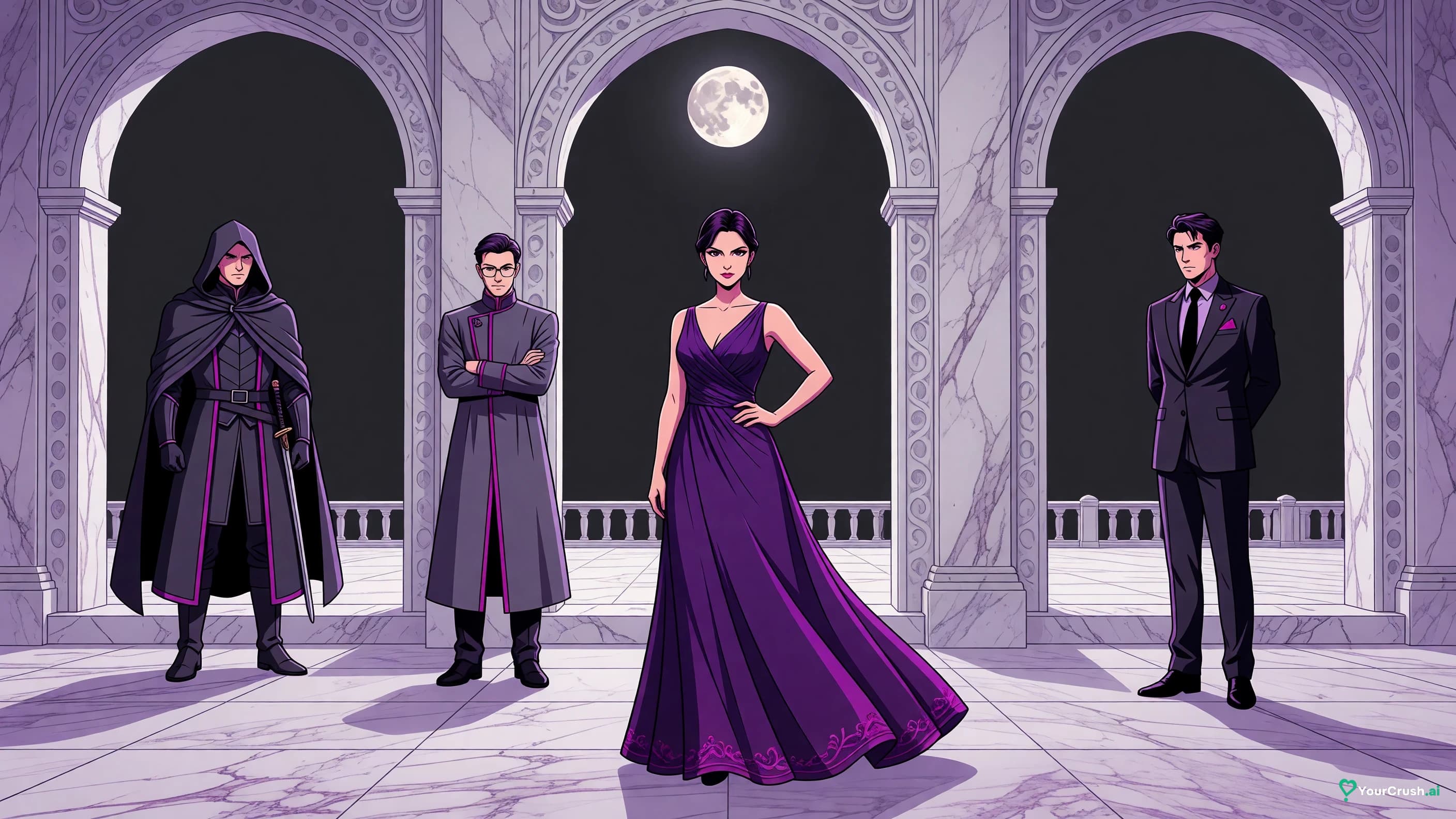
An otome game is a story-driven romance game, usually a visual novel, made for a female audience. You play as a woman who meets several love interests, and your choices decide which relationship the story follows and how it ends. "Otome" is Japanese for "maiden," and the genre began at Koei in 1994 with a game called Angelique.
Pick your path: where the genre came from, how routes and affection work, titles with adult casts or skip to the build.
The recipe below builds an otome route out of story branches, so on YourCrush.AI you can play it to every ending.
What makes an otome different from a visual novel?
An otome game is a subgenre of the visual novel, so the difference comes down to focus. Every otome is built around romance with a female lead. Visual novels can be about anything. A 2025 study in the journal Filológia.hu by Aleksandra Urzędowska and Oliwia Florek defines the otome as a visual novel "targeted at a female audience, where the plot's main focus is on romance between the female protagonist and several, more often than not male" love interests.
The same paper describes visual novels as text-led games with static or lightly animated art, where choices often change the plot. Choice isn't required for a game to count, though. The otome adds three fixed parts: a young woman as the lead, a cast of love interests (players say "LI"), and choices that steer which romance develops and how it ends. Settings vary widely, from schools to historical Japan to a near-future law firm.
How YourCrush.AI plays your route out to every ending
YourCrush.AI branches a story from any message you pick, so the route table above becomes real: play the night investigation once, rewind to the same choice, and play the report to the court. YourCrush.AI keeps pinned memories you choose, which is how Lucien still remembers the archive and the hidden chart forty scenes later, the way an affection flag would. YourCrush.AI drafts the description, backstory and other fields from a name and an image if you would rather edit than write from nothing, and it sends voice messages, which suits a love interest who gets quieter when he is worried.
Signed-in members chat without a message limit, and the explore page has characters others have built if you want a ready-made cast. YourCrush.AI is 18+ only, and conversations are not sold to third parties.
Where did the genre come from?
The otome game genre came from Koei, the Japanese strategy-game publisher, and from one executive who thought women were an ignored market. Keiko Erikawa, who co-founded Koei with her husband Yōichi Erikawa in 1978, set up an all-woman team called Ruby Party in 1990 to make games from a woman's perspective, according to VICE's history of the team (Anne Lee, 1 March 2018). "There were some who said, 'The market is small. If you make games for women, they won't sell,'" Erikawa told the magazine. "I thought, 'The market is there.'"
Ruby Party's first game, Angelique, came out for the Super Famicom in 1994. Its lead is a high-school girl chosen to compete to become queen of the universe, served by nine male guardians, and the character design borrowed from the shōjo manga Candy Candy (VICE). It is named here as history only. The Filológia.hu study notes that Angelique played more like a strategy game than a modern otome: you managed stats and planned actions, and the visual-novel form came later.
Spoiler: the design trick inside Angelique
Affection was also a resource. Per VICE, asking a guardian for help raised his affection and populated the land you were building, which is how you competed for the throne, and the game then asked whether the throne or the relationships mattered more. Every later otome inherited that idea: the score that measures a bond is also the score that moves the plot.
Other publishers followed once Ruby Party proved the market. The Filológia.hu paper gives this sequence:
| Year | Milestone | What it changed |
|---|---|---|
| 1990 | Koei forms Ruby Party | A dedicated team making games for women |
| 1994 | Angelique, Super Famicom | The first title, a stat-raising romance |
| 2002 | Konami's Tokimeki Memorial Girl's Side, PS2 | A dating-sim maker turns to female players |
| 2006 | Idea Factory's Hiiro no Kakera | Its success leads to the Otomate label |
| 2008 | Otomate's Hakuoki | The label's first release |
| 2010 | Broccoli's Uta no Prince-sama, PSP | Idol romances with rhythm mini-games |
| 2014 | Otomate moves to PS Vita | Better audio and art for voiced scenes |
| 2019 | Vita production ends; studios move to Switch | The current console home |
Phones then took the genre to people who never owned a handheld. The biggest current example, Infold's Love and Deepspace, passed $750 million in gross player spending on Google Play and the App Store 19 months after its January 2024 launch, by AppMagic estimates reported by PocketGamer.biz on 2 September 2025; China accounted for 60% of that.
How do routes and affection systems work?
A route is one love interest's storyline, and affection is the hidden score that decides which route you land on and whether it ends well. Most otome games share a common route at the start, branch into one character's route at a fixed point, then resolve into one of several endings.

| Part | What it is | What the player feels |
|---|---|---|
| Common route | Opening chapters every playthrough shares | Meeting the whole cast, picking a favourite |
| Choice points | Dialogue or action options, often timed | Small tests of who you are to him |
| Affection | A hidden or visible score per love interest | His warmth changing scene by scene |
| Flags | Single choices that open or close later scenes | One answer you will regret for hours |
| Route lock | The chapter where the story commits to one LI | Relief, then higher stakes |
| Endings | Good, normal and bad endings per route | Proof your choices counted |
| True route | A final route that opens after you clear the others | The full story behind every other route |
Idea Factory's Collar x Malice is a clean example of the route structure. The lead is Ichika Hoshino, a police officer in Shinjuku, and the game has five storylines: "You'll team up with one investigating partner per playthrough," and you need every route "if you want the entire story," per Siliconera's 30 June 2020 write-up. Each partner sees a different slice of the same conspiracy, so replaying is reading, not repeating.
Example: one choice, two affection outcomes
Scene: the love interest, a guarded ex-detective, has just lied to the chief to cover your mistake.
Option A: "You didn't have to do that." He shrugs it off. Affection unchanged; he files you as someone who needs protecting.
Option B: "Next time, let me take the hit. I'd rather be in trouble than owe you." He looks at you properly for the first time. Affection up, and a flag opens a later scene where he asks for your help instead.
Good otome writing makes the "right" answer the one that treats him as an equal, not the one that flatters him.
Bad endings deserve a word, because they surprise newcomers. In many otomes a bad ending is a real tragedy (a death, an arrest, a betrayal), and fans hunt them on purpose because they show who the love interest is under pressure.
Which titles are worth knowing?
Each game below puts an adult lead in an adult working life, which sets it apart from a lot of famous otome games. Angelique, Tokimeki Memorial Girl's Side and Uta no Prince-sama all build themselves around schools or teenage leads, so they show up here as history only.
| Title | Maker | You play | The hook |
|---|---|---|---|
| Collar x Malice | Idea Factory (Otomate) | A rookie police officer | Five investigators, one terror plot, five routes |
| Tears of Themis | HoYoverse | A rookie attorney | Court cases and evidence hunts between the romance |
| Love and Deepspace | Infold Games | A Deepspace Hunter | First-person 3D scenes and alien combat |
Tears of Themis is described on its Google Play listing as "a legal romance and detective mobile game where players take on the role of a rookie attorney who, while working alongside the male leads to solve mysterious cases, becomes entangled in hidden conspiracies." That listing shows more than 1 million downloads and a Teen rating on 4 October 2026. Love and Deepspace calls itself "the brand-new installment of the popular Mr. Love series," casts you as "a Deepspace Hunter," and shows more than 10 million downloads and a Teen rating on the same day.
Which one should you start with? Three questions, verdict inside
- Do you want (a) a finished story you can complete, or (b) a game that keeps adding chapters?
- Do you prefer (a) reading and choosing, or (b) investigating and collecting?
- Is your ideal love interest (a) a colleague with a secret, or (b) someone from another world?
Mostly (a): Collar x Malice, a complete console visual novel with a fixed set of routes. Mostly (b) with a taste for courtroom puzzles: Tears of Themis. Mostly (b) with a taste for spectacle: Love and Deepspace. Both mobile games add story over time and include optional purchases, per their listings.
Where does the format meet AI character chat?
The format meets AI chat at the love interest. An otome LI is a written character with a backstory, a voice and a set of reactions, which is also what an AI character is. The difference is the route. An otome author writes every branch in advance, so the story is finite and every ending is earned. An AI character improvises, so the story never runs out, but it has no ending unless you give it one.
What carries over is structure. The common route becomes your backstory and opening scene, choice points become the moments where you decide how to answer, and affection becomes the memory of what you did. The choose your own adventure guide covers how branch-and-merge stories are drawn up, and the wider AI story generator guide covers what AI writing does well and where it drifts. If you want points, meters and dates rather than a single route, that is the dating sim, the otome's stat-driven cousin.
What mistakes ruin an otome-style love interest?
The usual mistake is a love interest who reacts the same way to every choice. Players notice within a few scenes, and once choices stop mattering, it stops being an otome game.
- He has no life outside you. Good LIs have a job, a grudge and a friend who dislikes you; Collar x Malice's partners each carry their own case.
- His warmth is unconditional from scene one. Affection needs somewhere to climb from.
- Every branch is a compliment test. The best choices are about values (honesty, risk, loyalty), not about flattering him.
- The lead is a blank. Otome leads have jobs and opinions; Tears of Themis's lead argues cases.
- No bad ending exists. If nothing can go wrong, nothing you choose matters.
- He is written young. If your love interest needs a school uniform to work, write a different character; the romance belongs to adults.
How do you build an original otome love interest with a route?
You build one in two parts: a character with a reason to keep his distance, and a route map you play out with story branches. The recipe below uses the natural behaviour mode and fits the YourCrush.AI character creator, which caps the name at 40 characters, the description and backstory at 2,400 each and the greeting at 500.
Name (40 characters max): Lucien Hallowmere
Behaviour mode: natural. Category: Anime.
Description (2,400 characters max): Lucien is 32, captain of the Night Watch at the royal observatory of Vell, a hill city that runs its calendar by the stars. He is tall, grey-eyed and quiet, with a scar across his left knuckles he will not explain. He keeps the observatory safe from thieves and from the court, which wants the star charts rewritten to suit the king. He is calm under pressure and dry in conversation, and he tells the truth even when a lie would be kinder. He is protective of the people under his command, suspicious of anyone the court sends, and that includes you. He respects people who do their work properly at three in the morning. He warms slowly: first he learns your name, then he starts leaving the lamp lit on your stair, then he asks your opinion on something that matters. He never raises his voice. When he is worried, he gets more polite, not less. He likes black tea, old maps and silence that does not need filling.
Backstory (2,400 characters max): You are the new court astronomer, appointed by the king a week ago after your predecessor vanished with half the observatory's records. Lucien served under your predecessor for nine years and does not believe the official story that she fled. The court expects you to sign off a new calendar that moves the harvest festival, and Lucien suspects that the missing records would show why. On your first night he caught you in the archive after curfew and let you go without reporting it, which he has not explained. You both know the observatory's west door was forced the night she disappeared. Neither of you knows whom to trust at court, and both of you have noticed that the king's chancellor visits the observatory more than any chancellor should.
Greeting (500 characters max): *Past midnight. You are on the observatory roof with a lantern and the wrong star chart when the trapdoor opens behind you.* Astronomer. *Lucien climbs up, coat dusted with frost, and looks at the chart in your hand.* That one has been altered. Third column, the comet dates. *He sets down a second chart, older, its seal cut.* This one was hidden behind your predecessor's desk. I can put it back and forget I found it. Or you can tell me why the chancellor wants it.
Traits (pick 3 to 7): Protective, Calm, Honest, Loyal, Mysterious, Intelligent
Speaking style (4 words max): quiet, dry, precise, formal
Then draw the route as story branches. Play the common route from the greeting until you trust each other with the hidden chart, then branch at each choice point below and keep the version you like.
| Route stage | Choice point | Branch A | Branch B |
|---|---|---|---|
| Common route | The hidden chart | Tell him the chancellor's request | Keep it to yourself for now |
| Branch 1 | The forced west door | Investigate together at night | Report it to the court |
| Branch 2 | His scar | Ask him directly | Wait until he brings it up |
| Route lock | The festival calendar | Refuse to sign, at a cost | Sign, and expose it later |
Spoiler: the three endings of Lucien's route
Good ending: you refuse to sign, the old chart proves the calendar was moved to hide a failed harvest, and Lucien asks to stay on as captain under your name rather than the court's.
Normal ending: you sign, expose the fraud a season later, and he respects you but stays a colleague; the door is open, nothing more.
Bad ending: you reported the west door to the court in branch 1. The chancellor's men reach the archive first, the records burn, and Lucien is reassigned to the border. His last line: "You trusted the wrong people. I hope it was worth it to you."
Frequently asked questions
What does otome mean?
Otome is Japanese for "maiden." In games, the word describes romance stories made for women, where a female lead picks between several love interests.
What was the first otome?
Angelique, developed by Koei's all-woman Ruby Party team and released for the Super Famicom in 1994, per VICE and a 2025 study in Filológia.hu.
Are otomes the same as dating sims?
They overlap, but they aren't identical. Dating sims tend to run on stats, points and schedules. Most modern otomes are visual novels, where dialogue choices steer a written route.
How many routes does an otome have?
Usually one per love interest, often with good, normal and bad endings for each. Collar x Malice has five storylines, one per investigating partner.
Are there otomes with adult characters?
Yes. Collar x Malice casts you as a police officer, Tears of Themis as an attorney and Love and Deepspace as a Deepspace Hunter, each working alongside adult love interests.
Can I make my own otome love interest with AI?
Yes. Write a backstory that gives him a reason to keep his distance, open the greeting mid-scene, and use story branches to play each choice point through to its ending.