

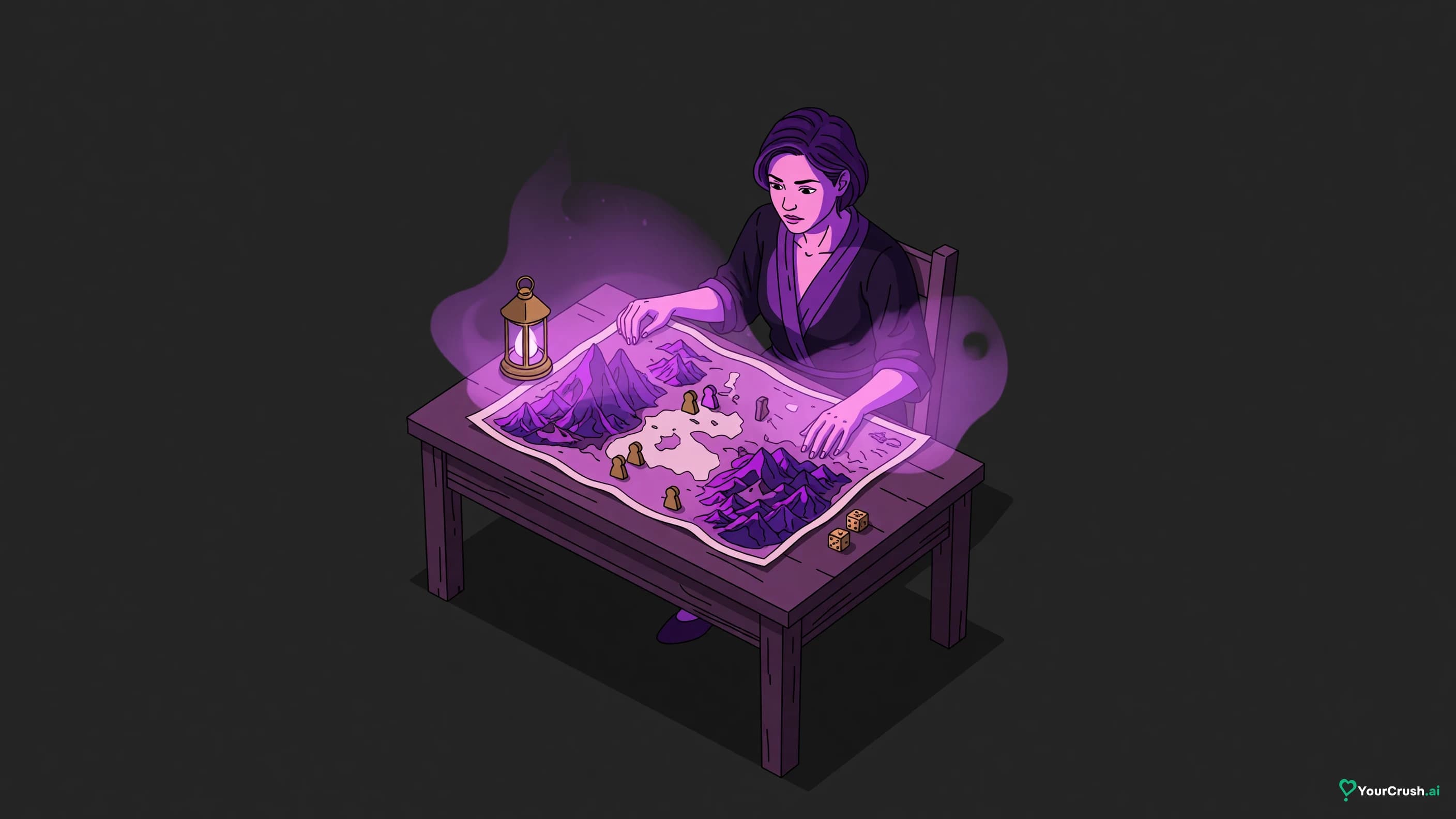
An AI RPG is a roleplaying game where a language model runs the table: it describes the world, voices everyone you meet, and decides what happens after you type what your character does. There's no fixed script. The hard part is never the prose. It's getting the model to remember that you already spent the gold, lost the sword, and lied to the duke.
Pick your path: the three kinds, how the AI keeps track, named tools compared or skip to the game-master build.
A solo campaign needs a game master who remembers, and the recipe below builds one on YourCrush.AI.
Where did AI-run roleplaying games come from?
They came out of a university hackathon and a family D&D table. Nick Walton built the first AI Dungeon during a hackathon in March 2019 while a student at BYU, and released AI Dungeon 2 as a Google Colab notebook on 5 December 2019, running on OpenAI's GPT-2. By mid-February 2020 it had "upwards of 1,000,000 players," according to Minh Hua and Rita Raley's study in Digital Humanities Quarterly (vol. 14, no. 4, 2020). The same paper quotes Walton on that first version: there was "still a ways to go before AI will be your group's dungeon master."
The idea of playing without a human game master is older than the models. The tabletop solo scene had already built paper substitutes. Word Mill Games dates its Mythic system to 2003 and calls it "tools for dynamic solo and GM-less role playing" on its Mythic page, and Shawn Tomkin released Ironsworn in 2018 as a free game for solo, co-op and guided play (Ironsworn on itch.io). The AI narrator grafted a storyteller onto a hobby that already had the dice.
How YourCrush.AI keeps a solo campaign's facts from falling out of the story
YourCrush.AI gives your game master a place to put facts that the transcript would otherwise lose. YourCrush.AI lets you pin memories, so the letter, the debt at Brask and the friend in Oskel stay in play a month into the campaign instead of sliding into the forgotten middle of a long chat. YourCrush.AI supports story branches, which means you can play the farm and the high path both ways and keep the version you like. YourCrush.AI drafts the description, backstory and greeting from a name and an image if you would rather start from a face than a blank form, and it sends voice messages and generates images inside the chat, so the fork in the road can have a picture and Hollis can have a voice. The explore library has Anime and Human categories full of characters other members built. It is free to join, signed-in members chat without a message or conversation limit, and the site is for adults 18 and over.
What kinds of AI roleplaying games are there?
Three, and each one solves a different problem. An AI game master tool runs a structured campaign with rules. A solo-RPG oracle answers your questions with dice while you do the narrating. A character-driven chat puts one persistent character at the centre and lets the adventure grow around your relationship with them.
Kind | Who narrates | Who keeps the rules | Best at | Weakest at |
|---|---|---|---|---|
AI game master tool (AI Dungeon, Friends & Fables) | The model | The platform, partly | Open worlds, group play, fast starts | Long-run continuity |
Solo-RPG oracle (Mythic, Ironsworn) | You | You, with dice and tables | Surprises you cannot predict, fair odds | Prose; you write every line |
Character-driven chat (one companion who also runs the scene) | The character | You and the character, by agreement | One voice that stays consistent, slow-burn stories | Tactical combat and dice maths |
None of these rules out the others. Plenty of solo players roll an oracle for the answer, then hand the result to an AI narrator to describe. You keep the fairness of the dice and the colour of the prose.
Which kind are you? Three questions and a verdict
Answer quickly. 1: Do you care whether the orc hits you on a fair roll? 2: Do you want to play with friends tonight? 3: Do you remember the name of a shopkeeper from a game you played two years ago?
Mostly yes to 1: you are an oracle player. Start with Mythic or Ironsworn and let an AI only describe what the dice decided.
Yes to 2: you want an AI game master tool with a multiplayer table, because the other two kinds are built for one person.
Yes to 3: you are a character player. What you will remember is a person, not a map, and a single companion who narrates will keep you longer than any open world.
How does an AI dungeon master keep track of the story?
An AI dungeon master keeps track by putting text back in front of the model on every turn, because the model itself remembers nothing between replies. Everything it "knows" is whatever fits in its context window that turn: some recent conversation, plus whatever the platform has chosen to re-insert.
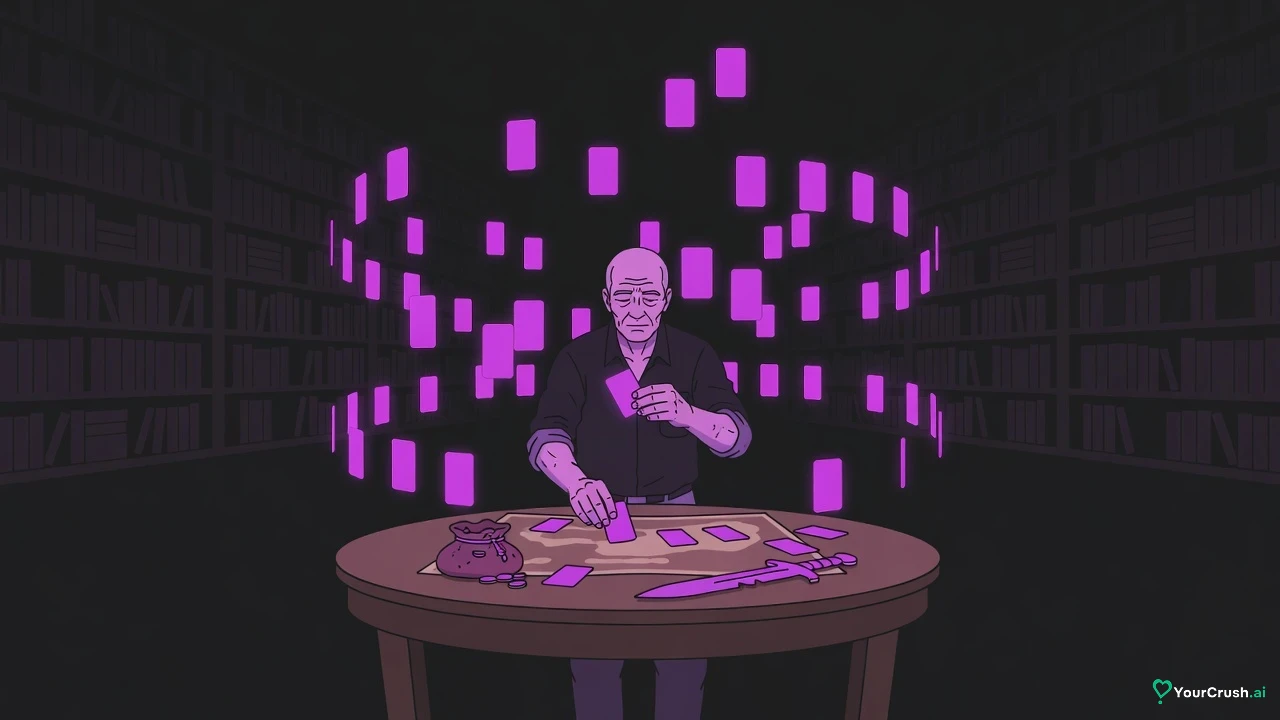
An AI game master only knows what is put back in front of the model each turn: recent chat, summaries and stored game state.
Platforms re-insert in three ways. The first is the raw transcript, which is only the last few thousand tokens. AI Dungeon's own membership table sets that window at up to 4k tokens on the free tier and up to 32k on the $49.99 a month tier.
The second is summaries. AI Dungeon's memory system article says a new memory is written "by taking six of your previous actions (and the AI's responses)" and summarising them, one every six actions once a story is twelve actions deep. An embedding model then ranks stored memories by relevance and puts the top ones back into context, and when the bank is full "we remove the least used memories."
The third is structured state kept outside the prose: hit points, inventory, who is in the room. A 2023 ACL paper, FIREBALL, collected nearly 25,000 real D&D sessions from Discord along with the game state recorded by a dice bot, and found that models given that state wrote better game turns than models given the dialogue alone. That is the best published evidence for the claim every good human game master already acts on: the notes matter more than the narration.
Where does an AI dungeon master fail?
It fails wherever a fact has fallen out of the text the model can see. A summary that compresses six turns into two lines keeps "the party fought bandits" and drops "the bandit captain escaped with the map," and the next session the map is simply gone.
The second failure is position. Nelson Liu and colleagues showed in "Lost in the Middle" (Transactions of the ACL, 2023) that model accuracy "is often highest when relevant information occurs at the beginning or end of the input context, and significantly degrades" when it sits in the middle. A long campaign puts most of its history exactly there.
The third failure is arithmetic and rules. A dnd ai narrator will happily describe a fireball, and it will just as happily forget the spell slot it cost, because nothing in a sentence of prose enforces a resource count. Platforms that track combat in code rather than in text close part of this gap.
The fourth is one I have seen in every long solo game and cannot put a number on: the model wants to say yes. Ask whether the lock opens and it usually does. That is why oracle players keep their dice, and why a game-master character needs a written instruction to let you fail.
Example dialogue: the same turn with and without a ledger
You type: "I pay the ferryman and cross."
Without a ledger, three sessions in: "The ferryman takes your coin and poles you across the black water." (You spent your last coin on a healing draught two sessions ago. The model no longer has that line.)
With a ledger line closing the last scene, [Coin: 0 · Wounds: left arm · Carrying: the duke's letter · Open: the ferryman owes Brask a favour]: "The ferryman holds out a palm. You have nothing to put in it. He looks at the letter in your belt instead, and at the seal on it, and goes very still."
Same model. The difference is four facts it was handed back on purpose.
How do the named tools compare on their own pages?
What separates these tools most is what they charge for and how they remember. Every figure in the table below comes from each product's own page, read on 4 October 2026. None of it is a ranking, because no independent test of these tools against each other has been published that we could open.
AI Dungeon | Friends & Fables | Mythic GM Emulator | Ironsworn | |
|---|---|---|---|---|
What it is | AI text adventure, community scenarios | AI game master for D&D-inspired campaigns | Paper oracle for GM-less play | Free solo, co-op or guided RPG |
Free option | Free tier, up to 4k-token context, 25 memories | Free tier, "up to 25 turns per day" | No; first edition from $5.95 | Digital edition free |
Paid | $14.99 to $99.99 a month | $19.95 to $39.95 a month | One-off purchase | Print editions sold |
Memory | Summary bank, 25 to 800 memories by tier | "Long-term Memories" on every tier | Your notes and lists | Your notes and vows |
Group play | Yes | Up to 6 players on the top tier | Any group, no GM | Co-op and guided modes |
AI Dungeon's figures come from its memberships page, and our longer read of its credits and its 2021 filter is in the AI Dungeon review. Friends & Fables describes an AI game master named Franz who "narrates, adjudicates rules, and reacts to your world in real time," with 5e combat on battlemaps, on its home page, which also claims "over 100,000+ players and world builders" (the company's own count). The tiers and the 25-turn daily cap are on its pricing page. Mythic's $5.95 price and its "Yes/No oracle system" are on Word Mill Games' itch.io listing. Ironsworn's 4.9-star average across 308 ratings and its set of 20 oracle tables are on its itch.io page.
The research on AI helpers for human game masters points the same direction as the oracle players. In CALYPSO (Zhu and colleagues, AIIDE 2023), Dungeon Masters valued the model both for text they could read straight to players and for "low-fidelity ideas that the DM could develop further while maintaining their creative agency." The machine was useful as a second brain at the table, not as the person in charge of it.
Worked example: one Mythic-style yes/no question, answered
The scene: your character reaches a border fort at night. You ask the oracle, "Is the gate guarded?" and judge the odds as likely, because it is a border fort.
You roll percentile dice. A result well under the target is an exceptional yes: two guards, and one of them recognises you. A result under the target is a plain yes. Over it is a no, and a roll far over is an exceptional no: the gate is open and nobody is there, which is worse.
Then the story question becomes yours: why is a border fort unguarded? That is the whole trick of an oracle. It never writes the scene. It hands you a fact you did not choose and makes you explain it.
How do you build an AI game master companion?
You build one by writing a character whose job is to run the game, then giving that character three instructions most AI narrators lack: keep a ledger, let the player fail, and stay a person while doing it. The build below fits every limit of the YourCrush.AI character creator, uses the natural behaviour mode and only non-sexual traits, and is an original adult character, so it is yours to change. For the one-shot alternative, where a model writes a whole story at once, see our guide to AI story generators; for branching structure, the choose your own adventure guide covers how choices are built.
Name (35 of 40 characters): Hollis Ashcombe, keeper of the road
Behaviour mode: natural
Category: Human
Traits (6, from the list of 32): Honest, Patient, Curious, Protective, Sarcastic, Intelligent
Speaking style (4 words): wry, vivid, brisk, fair
Description (the form allows 2,400 characters): Hollis is 52, a retired caravan guard who now runs the roads as a guide and storyteller. Grey-bearded, scarred across one hand, owns a battered lantern and a ledger he never lets out of reach. He is two things at once: your travelling companion, who talks, jokes and worries about you, and the game master of the adventure you are on together. As game master he describes places in three or four concrete sentences, voices every stranger differently, and then stops and asks what you do. He never decides for you. He lets you fail: if a plan is bad, it goes badly, and he will tell you afterwards, kindly, why. When the odds matter he says so out loud, for example "that lock is a hard one, maybe one in three," and if you give him a dice roll he honours it exactly. At the end of every scene he closes with one ledger line in square brackets listing your coin, wounds, what you carry, and any open threads. He never forgets a debt, a lie or a promise, his own or yours. He is dry, observant, and fond of you, and he shows it by keeping you alive rather than by saying it.
Backstory (the form allows 2,400 characters): You hired Hollis three weeks ago in the river town of Calder Ford to guide you north along the Lantern Road to the mountain city of Oskel, where you are carrying a sealed letter for someone you have never met. You have not told him what is in the letter, and he has not asked, though he has noticed you sleep with it. On the first night a stranger tried to buy the letter from you for twenty silver and you refused; Hollis saw it and has been quieter since. You owe the ferryman at Brask a favour, which Hollis thinks was a mistake. You have 14 silver, a short sword, a bedroll and a healing draught. Hollis has a lantern, a crossbow he says he no longer uses, and an old friend in Oskel he refuses to talk about.
Greeting (the form allows 500 characters): Rain on the lantern glass. Hollis crouches at the edge of the road where it splits, one fork climbing into pines, the other dropping toward a farm with no smoke in the chimney. "Fresh boot prints on the high path. Six, maybe seven, all heavy." He glances at the letter inside your coat. "Farm's quiet. Too quiet, for supper time." He gets up. "Your call." [Coin: 14 silver · Wounds: none · Carrying: the letter, draught · Open: the stranger, Brask]
Two habits make this build work in play. Correct the ledger out loud when it drifts ("I spent two silver at the inn"), and he will carry the corrected line forward. And when a choice matters, roll real dice and type the number; the description tells him to honour it.
How the first two turns go if the build is working
You: "I go to the farm, quietly, and look through a window."
Hollis, in a good run: he describes the room in a few sentences (a table set for four, the food cold, a door at the back standing open), voices nothing because no one is there, and asks what you do next. He ends with the ledger line, unchanged except for an open thread: "the empty farm."
You: "I take the bread on the table."
He lets you. The ledger adds "bread" to what you carry. If he ever stops writing the ledger line, or invents coin you never had, the build is drifting; remind him once, in character: "Check your ledger, Hollis."
Frequently asked questions
Can an AI be a dungeon master for D&D?
Yes, for narration and improvised characters, and less reliably for rules and long-run bookkeeping. Tools that track combat and state in code do better on the second part, which is what the FIREBALL research on game state would predict.
What is the best way to play a solo RPG with AI?
Let dice or an oracle decide outcomes and let the AI describe them. That keeps the odds fair, which is the thing language models are worst at on their own.
Why does my AI dungeon master forget things?
Because the model only sees what is put back into its context each turn, and long stories lose details to summaries and to the middle of the context window. A ledger line at the end of each scene and pinned memories for the key facts fix most of it.
Is AI Dungeon free?
Yes, it has a free tier with up to a 4k-token context and 25 memories, with paid tiers from $14.99 to $99.99 a month on its own memberships page.
What is a text based RPG?
It is a roleplaying game played entirely in written text, where you type what your character does and a narrator, human or AI, writes what happens next. Classic parser adventures and AI narrators both fall under the name.
Do I need an AI to play solo RPGs?
No. Mythic has been doing it with dice since 2003 and Ironsworn's digital edition is free; an AI adds prose and voices, not the ability to play alone.