


Duck.ai is a free chat page from DuckDuckGo. You type a prompt, DuckDuckGo strips your IP address, and the request goes out to a third-party model, Claude, GPT, Mistral or Gemma, so the provider sees traffic from DuckDuckGo rather than from you. No account required. Nothing you send is used for training, and each provider has signed an agreement to delete your prompt once it has replied. Those claims, along with the daily limits and the $9.99 and $19.99 subscription tiers below, come from DuckDuckGo's own help pages and privacy terms, which I opened on 17 September 2026.
Here's my position, and you're free to argue with it by the end of this piece: the two models hosted in a hardware enclave are the only ones on Duck.ai where "nobody can read it" is enforced by silicon rather than by a contract. They should be the default.
What is Duck.ai, and who makes it?
Duck.ai is a feature of DuckDuckGo, the search company, and its help page describes it as "a feature that allows you to have private conversations with 3rd-party AI chat models, anonymized by us." You'll find it at duck.ai in any browser, as a tab in DuckDuckGo search results, and as a button in the DuckDuckGo browser. The approach-to-AI page adds that it is "free to use and anonymized by us, with no account required."
Here's the definition I keep coming back to, because it holds up even when you pull it out of context: Duck.ai is an anonymizing proxy with a chat interface. DuckDuckGo strips identifying metadata from your message, forwards it to a model run by Anthropic, OpenAI, Mistral or Tinfoil, and returns the reply to a chat history stored on your own device. DuckDuckGo does not train or run the models itself.
The publisher is DuckDuckGo, Inc. The App Store listing for the DuckDuckGo Private Browser, the app that ships Duck.ai on iPhone, showed 4.8 stars across 2.4 million ratings and a 16+ age rating on 17 September 2026, with a privacy label of "Data Not Linked to You" (contact info, usage data, diagnostics) and nothing under data used to track you. The Duck.ai terms, last updated 26 August 2026, set the floor lower than the store does: the service is "only intended for and available to people who are age 13 or older," with parental permission required under the local age of majority.
Which models does Duck.ai use?
As of 17 September 2026, the chat models page lists six free models and four more reserved for DuckDuckGo subscribers. The free tier includes Anthropic's Claude 4.5 Haiku, Mistral AI's Mistral Small 4, OpenAI's GPT-5.4 nano and GPT-5.4 mini, and two open-weight models, gpt-oss-120b and Gemma 4 31B, hosted by a company called Tinfoil.sh. Plus subscribers get GPT-5.6 Terra and Claude Sonnet 4.6. Pro subscribers add Claude Opus 4.8 and GPT-5.6 Sol, along with a higher reasoning-effort setting and twice the Plus usage limit.
Not every model costs the same against your daily allowance. DuckDuckGo's model guide rates Mistral Small 4, GPT-5.4 nano, gpt-oss-120b and Gemma 4 31B as extra-low cost, GPT-5.4 mini as low, Claude 4.5 Haiku as medium, the two Plus models as high, and the two Pro models as extra-high. Reasoning modes on some models cost more again. If you stay in the extra-low tier, you'll get many more turns a day than someone who runs Haiku for everything.
DuckDuckGo doesn't moderate or edit replies. The chat models page states "we do not filter or modify the responses received from the chat model in any way," so each provider's own moderation policy applies instead. The privacy page also lists Microsoft Azure as a backup route for the OpenAI and Anthropic models, which means a GPT or Claude chat may pass through Azure.
What does "anonymous" mean on Duck.ai, in DuckDuckGo's own words?
Anonymous means DuckDuckGo strips the metadata that identifies you before the prompt leaves its servers, and the provider is contractually bound to delete the text after replying and never train on it. The privacy help page puts it this way: "Metadata that contains personal information (for example, your IP address) is completely removed before prompting the model provider," so requests to Anthropic, OpenAI, Mistral, Azure and Tinfoil "appear as though they are coming from DuckDuckGo rather than individual users." There are four layers, and each has an edge.
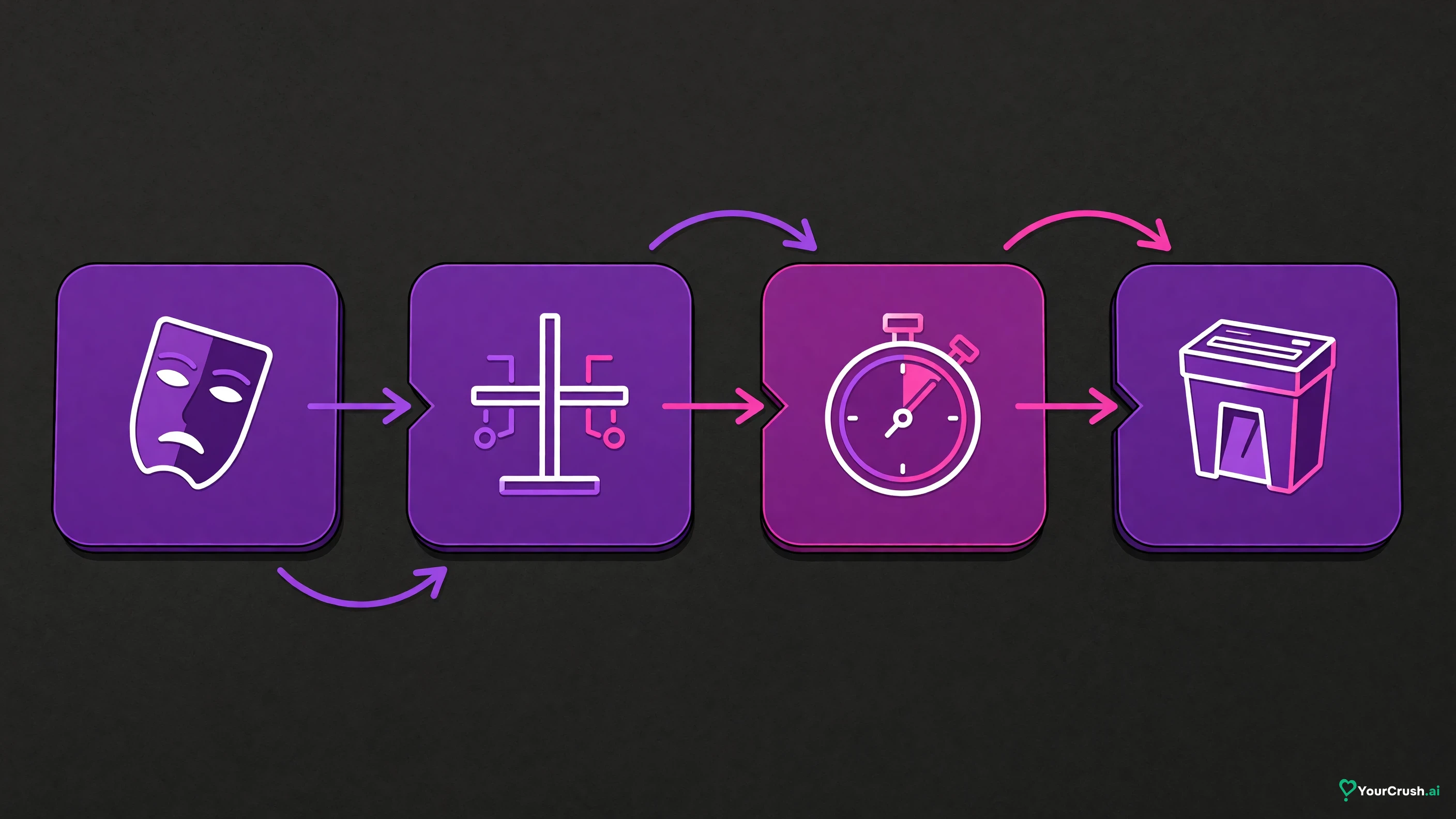
The first layer is what still gets sent. Per the model-provider sharing page, every request to Anthropic, OpenAI and together.ai (which hosts Mistral) carries today's date, your timezone and a preferred unit system, all derived from a GeoIP guess that DuckDuckGo says it does not save. An optional "Use Approximate Location" setting, off by default, adds a city-level guess. And the words themselves go through untouched. The privacy terms say that if you type personal information into a prompt "it may be reproduced in the Outputs, but no one can tell (including us and the underlying model providers) whether it was you personally submitting the Prompts or someone else." Anonymity here means the request is unlinked from you, not that the content is hidden.
The second layer is the provider contract. All providers agree to what DuckDuckGo calls Zero Data Retention: delete prompts and responses immediately after replying, never train on them, never share them with third parties for their own purposes. The help page then lists the exceptions in a table. OpenAI and Anthropic may hold a chat in short-term memory for up to one hour for prompt caching, "never written to disk," and Anthropic may keep chats "where required by law or as necessary to combat malicious use." The privacy terms set the outer bound: providers delete "at most within 30 days, with limited exceptions for safety and legal compliance." So the honest summary is immediate deletion as the rule, one hour of caching in RAM as the routine exception, and 30 days as the ceiling.
The third layer is the one I would make the default. Requests to Tinfoil, which hosts gpt-oss-120b and Gemma 4 31B, run inside a Trusted Execution Environment, and DuckDuckGo says this lets it "ensure, via technical means, that they are unable to read, retain, share, or train on your prompts." Those two carry a "zero provider visibility" label in the interface. Every other model on the list is protected by a promise. These two are protected by a chip, and both are extra-low cost, so choosing them costs nothing in allowance.
The fourth layer is what DuckDuckGo itself keeps. It never stores your prompts, but it computes an embedding of each message in memory, matches it to a representative prompt from a public dataset of chatbot conversations, discards your embedding, and keeps the matched public prompt as a usage signal. Uploaded images and PDFs are scanned for child sexual abuse material by a third-party provider, outside the encrypted channel even for the Tinfoil models, and retained only if flagged. Text prompts are not scanned.
Does Duck.ai save your chats?
Yes, on your own device by default, and never on DuckDuckGo's servers in a form it can read. The chat history page says recent chats are saved locally, appear in the sidebar, and can be turned off in settings. In the DuckDuckGo browser they live outside web storage, so they do not show up in developer tools. In other browsers the retention is whatever the browser does. The same page names Safari as deleting Duck.ai history after more than 7 days without a visit.
Sync & Backup is the optional server copy, encrypted end to end with a key that stays on your devices. The privacy terms say those chats "are automatically deleted if not accessed for a period of 18 months." Share links, added in August 2026, store an encrypted copy that the link itself decrypts, expire after 30 days, and let anyone with the link continue the chat as their own. Deletion is the Fire Button inside Duck.ai, which clears everything except up to 5 pinned chats.
Is Duck.ai free, and what does the DuckDuckGo subscription add?
Duck.ai is free, but there's a daily limit DuckDuckGo won't put a number on. The subscription raises that limit and adds four larger models. The usage limits page says only that "there is a daily limit on usage," and the subscriber FAQ explains why no figure is given: "because each AI model has a different cost per prompt, there isn't a straightforward way to state an exact number of prompts users can send in one day." You also can't buy extra usage outside a subscription, per the same FAQ.
Worth being clear on one thing: the subscription is not a Duck.ai plan. It's the DuckDuckGo subscription, a bundle of VPN, Duck.ai models, personal information removal (US only) and identity theft restoration. The help page says "we don't offer a way to only subscribe to one feature." The App Store in-app purchase list on 17 September 2026 priced Plus at $9.99 a month or $99.99 a year and Pro at $19.99 a month or $199.99 a year. Subscribers get a daily limit plus a separate weekly pool. When the daily limit runs out, you can draw down the weekly one until Sunday midnight UTC. Daily limits reset at midnight UTC.
Two caps are worth knowing before you pay. PDF uploads are limited to 15 pages on Free, 35 on Plus and 50 on Pro, per the file upload FAQ, and spreadsheets aren't supported at all. Image generation and voice chat exist on every tier with their own daily limits. Voice runs through OpenAI over a relay DuckDuckGo says it cannot decrypt, and the voice privacy page warns that "your voice is unique to you and can be a biometric identifier."
Who is Duck.ai for, and who should skip it?
Duck.ai suits anyone who wants a current Anthropic, OpenAI or Mistral model without an account or a conversation history held by the provider, and who is content with the small and mid-size versions on the free tier. Journalists, people asking health or legal questions they would rather not attach to a name, and anyone who wants an AI assistant without the login are the obvious fits. The Tinfoil models make it the cheapest way I know to get a competent open-weight model with a hardware guarantee that nobody at the host can read the exchange.
Three groups should look elsewhere. First, anyone who wants a chatbot that remembers them across sessions. Nothing on the help pages describes cross-chat memory, a persona or a stored profile, and the anonymization that makes the service worth using is the same design that prevents it. Second, anyone looking for roleplay, an AI girlfriend, or adult conversation. The terms prohibit use that is "sexually explicit or obscene," the providers' own usage policies apply on top, and DuckDuckGo applies no moderation of its own, so the experience is whatever the underlying model allows and nothing more. Companion apps are a different product, and the memory and privacy tests in the companion app comparison are the questions to ask of those. Third, heavy daily users. A limit never stated as a number cannot be planned around, and a subscriber who exhausts both the daily and weekly pools is locked out until Sunday.
How do you turn Duck.ai off?
You can remove Duck.ai from the DuckDuckGo browser, from search results, or from your whole DuckDuckGo experience with a different domain, per the opt-out page. Here's how:
- In the DuckDuckGo browser, open Settings, then AI Features, and switch off Duck.ai to disable it across the browser.
- On duckduckgo.com search, open Settings, then AI Features, switch off Duck.ai, and choose Save and Exit to reload results without the Duck.ai buttons.
- On the same search settings screen, set the Search Assist dropdown to Never to remove AI-assisted answers from result pages.
- To skip the settings altogether, search from noai.duckduckgo.com, which turns off Search Assist and Duck.ai and filters AI-generated images out of results by default.
DuckDuckGo also publishes No-AI extensions for Chrome and Firefox that make that domain your default search. The noai page says the domain "will remain a way to search privately on DuckDuckGo without AI" whatever DuckDuckGo adds later.
Frequently asked questions
Is Duck.ai free?
Yes, with six models and a daily limit DuckDuckGo does not state as a number. The four larger models cost $9.99 a month on Plus or $19.99 on Pro through the DuckDuckGo subscription, which cannot be bought for Duck.ai alone.
Is Duck.ai actually anonymous?
DuckDuckGo removes your IP address and other identifying metadata before forwarding the prompt, so the provider sees a request from DuckDuckGo. What you type still reaches the provider, and date, timezone and a unit-system guess travel with it. The two Tinfoil-hosted models go further, running inside a hardware enclave the host cannot read.
Which models does Duck.ai use?
Free: Claude 4.5 Haiku, Mistral Small 4, GPT-5.4 nano, GPT-5.4 mini, gpt-oss-120b and Gemma 4 31B. Plus: GPT-5.6 Terra and Claude Sonnet 4.6. Pro: Claude Opus 4.8 and GPT-5.6 Sol, as listed on 17 September 2026.
Does Duck.ai train on my data?
No. DuckDuckGo's privacy help page says conversations "are not used to train chat models by DuckDuckGo or the underlying model providers," and every provider has agreed to that in writing. Providers may hold a chat in memory for up to one hour for caching, and the outer deletion bound in the terms is 30 days.
What is the daily limit on Duck.ai?
DuckDuckGo publishes no number, because each model draws a different amount from the allowance, and extra-low-cost models such as Mistral Small 4 and gpt-oss-120b stretch it furthest. Subscribers get a higher daily limit plus a weekly pool, and Pro is twice Plus.
Can I use Duck.ai for roleplay or an AI girlfriend?
Not for anything explicit: the terms ban "sexually explicit or obscene" use and each provider's own policy applies on top. Its help pages describe no persistent memory, persona or character system either, so an ongoing character relationship is a poor fit even where the content is innocent.
For character chat with memory and a persona, YourCrush.AI is built for exactly that and Duck.ai is not.
Every provider on Duck.ai except Tinfoil is trusted on paper, and DuckDuckGo's own table lists a one-hour cache and a law-enforcement carve-out under those signatures. The two models where the promise is enforced by hardware are also the two cheapest to run. Duck.ai leaves the choice to you, and picking anything other than that pair for a sensitive question is the wrong choice.