


An AI assistant is software that takes an instruction in ordinary language, works out what you meant, and either answers you or acts on your behalf in other software. That one sentence covers Siri reading a text aloud, ChatGPT drafting a cover letter, Alexa+ booking a plumber, and an anime character who remembers your birthday. Those four are different enough that lumping them under one name is how people end up paying for the wrong one. About half of US adults now use a chatbot of some kind: 49% in a Pew Research Center survey of 5,119 adults fielded 17 to 23 February 2026 and published 17 June 2026, up from 33% in the summer of 2024. Almost none of them picked it by asking what kind it was.
I have spent a year handing browser agents my own errands, and what I learned sits in the last section: the honest test of any assistant is what it does while you are not watching.
What separates an assistant from a chatbot?
An AI assistant is a dialogue system built to get a task done for you. A chatbot, in the strict research sense, is a dialogue system built to keep a conversation going. That split is older than any current product. A 2017 survey of dialogue systems by Chen, Liu, Yin and Tang, submitted to arXiv on 6 November 2017, divides the field into task-oriented systems, which "aim to assist the user to complete certain tasks (e.g. finding products, and booking accommodations and restaurants)", and non-task-oriented systems, "also known as chat bots", which "interact with human to provide reasonable responses and entertainment" on open domains.

Nine years later the two live in one app. A chat assistant will chat about anything and book nothing. Alexa+ will chat about anything and order the groceries. So "assistant or chatbot" has stopped sorting products. What does sort them is which of four kinds you are holding, because each one is judged by a different failure. A task assistant fails by giving a wrong answer. A companion fails by forgetting you. An agent fails by doing the wrong thing with your money while you were in another tab.
What are the four types of AI assistants?
The four kinds are voice assistants, chat assistants, agentic assistants and companion characters, sorted by what the software does with your words: speaks back, writes back, acts, or stays in character. Most products in 2026 are at least two of these at once, which is why the sorting is by the job you give it rather than by brand.
Voice assistants: Siri, Alexa, Gemini on a phone
A voice assistant is one you talk to out loud, and its defining limit is that the reply has to fit in something a speaker can say back in a few seconds. Apple's Siri page, read on 17 September 2026 for iOS 27, now describes open-ended questions, brainstorming, back-and-forth conversation, and the ability to "take action in apps like Messages, Music, Reminders, and more", in 15 supported languages. Amazon's Alexa+ announcement, first published 26 February 2025 and updated 21 July 2026, puts the installed base at "over 600 million Alexa devices". Google announced on 14 March 2025 that "the classic Google Assistant will no longer be accessible on most mobile devices" as it moves users to Gemini.
The hardware is common and the habit is not. The same Pew survey found 35% of US adults own a smart speaker, while daily chatbot use of any kind sits at 24%. A voice assistant is still the one most people own and the one fewest people talk to for more than a sentence.
Chat assistants: ChatGPT, Gemini, Claude, Copilot
A chat assistant is a text box in front of a large language model, and it is the kind most people picture when they say the phrase. In the Pew survey of 5,119 US adults in February 2026, 44% said they use ChatGPT, 24% Gemini, 17% Copilot, 14% Meta AI, 8% Grok, 6% Claude and 3% Character.ai. What they use them for is mostly search and work: 42% of all adults for finding information, 38% of employed adults for work tasks, 25% for entertainment, 24% for making images or video, 20% for medical advice, 10% for emotional support and 4% for companionship.
A chat assistant answers and writes. It does not, on its own, do anything in another program, and that is the line between this kind and the next one. The way to check which side a product is on: ask it to send the email, not to draft it, and see whether the email leaves.
Agentic assistants: the ones that act without a turn-by-turn prompt
An agentic assistant is given a goal and allowed to choose its own steps, tools and stopping point, instead of waiting for you to type the next instruction. Anthropic's engineering post Building effective agents, published 19 December 2024, draws the line this way: workflows are "systems where LLMs and tools are orchestrated through predefined code paths", and agents are "systems where LLMs dynamically direct their own processes and tool usage, maintaining control over how they accomplish tasks". The same post says the trade is real: "Agentic systems often trade latency and cost for better task performance".
Amazon's description of Alexa+ is the consumer version of that definition. The announcement says the assistant "will be able to" browse the web, "use Thumbtack to discover the relevant service provider, authenticate, arrange the repair, and come back to tell you it's done", at $19.99 a month or free with Prime. The 2026 AI Index from Stanford HAI, published 13 April 2026, reports that the success rate of agents handling real-world tasks improved from 20% in 2025 to 77.3% in 2026. A task that fails roughly one time in four is a task you check afterwards, and checking afterwards is the practical difference between delegating to an agent and delegating to a person.
Companion characters: the fourth kind most lists leave out
A companion character is an assistant with a persona and a memory of you, whose job is the conversation itself rather than anything the conversation produces. The 2017 survey filed this under non-task-oriented systems built for "entertainment", and the products have not changed the definition, only the memory. A companion is judged on continuity: does the character still know your dog's name next week, and does it hold its personality when you change tone. Accuracy, the thing a chat assistant is judged on, barely comes into it. How to run that continuity test in ten minutes is in best AI companion apps and the ten-minute test that sorts them.
YourCrush.AI is the example of this kind used on this site: a character with a stored personality, pinned memories and a voice, built to be talked with rather than to finish a task.
Use is small and the effects are studied. In Pew's February 2026 survey, 3% of US adults used Character.ai and 4% used a chatbot for companionship. A four-week randomized controlled study by MIT Media Lab and OpenAI, submitted 21 March 2025 with 981 participants and more than 300,000 messages, compared text, a neutral voice and an engaging voice, and found that the assigned mode made no significant difference to loneliness, while "participants who voluntarily used the chatbot more, regardless of assigned condition, showed consistently worse outcomes". A companion is the one kind where the question is not whether it works but how much of it you should use.
What does "generative" add to an assistant?
A generative AI assistant writes its replies from a model, producing new words each time instead of picking them from a script or a list of stored answers. That one change is what turned voice assistants from command parsers into something you can argue with. The distinction is not new either. A 2017 survey already split chat systems into "generative methods such as sequence-to-sequence models" and "retrieval-based methods, which learn to select responses" from a repository. What changed after 2022 is that the generative side got good enough to run the whole assistant rather than one chit-chat corner of it.
The platform announcements say what that bought. Google's March 2025 post names Gemini Live, "for free-flowing, multimodal conversations", and Deep Research as things that are "only possible with AI". That is Google's way of saying the old Assistant could not do them because it matched intents rather than generating. Amazon calls Alexa+ its "next-generation assistant powered by generative AI" and lists grocery orders, OpenTable reservations and smart-home control under it. Apple's Siri page for iOS 27 lists open-ended questions and brainstorming where the previous page listed commands. Adoption followed: the AI Index 2026 reports that generative AI reached 53% population adoption in three years, faster than the personal computer or the internet, and that it is now used in at least one business function at 70% of organizations.
Two things "generative" does not add. It does not add memory of you. A generative model produces each reply from whatever is in its context window, and remembering you across weeks is a separate system that platforms sell by tier, as the companion article above sets out. It also does not add truth. A generated answer is fluent whether or not it is correct, which is why a chat assistant is the wrong kind for any job where you cannot check the answer yourself.
How do you pick an assistant for a job?
Match the kind to what a wrong result costs, and to whether the job ends in an answer, a document, an action, or company. Six steps cover it, and you can run every one of them on a free tier before you pay for anything.
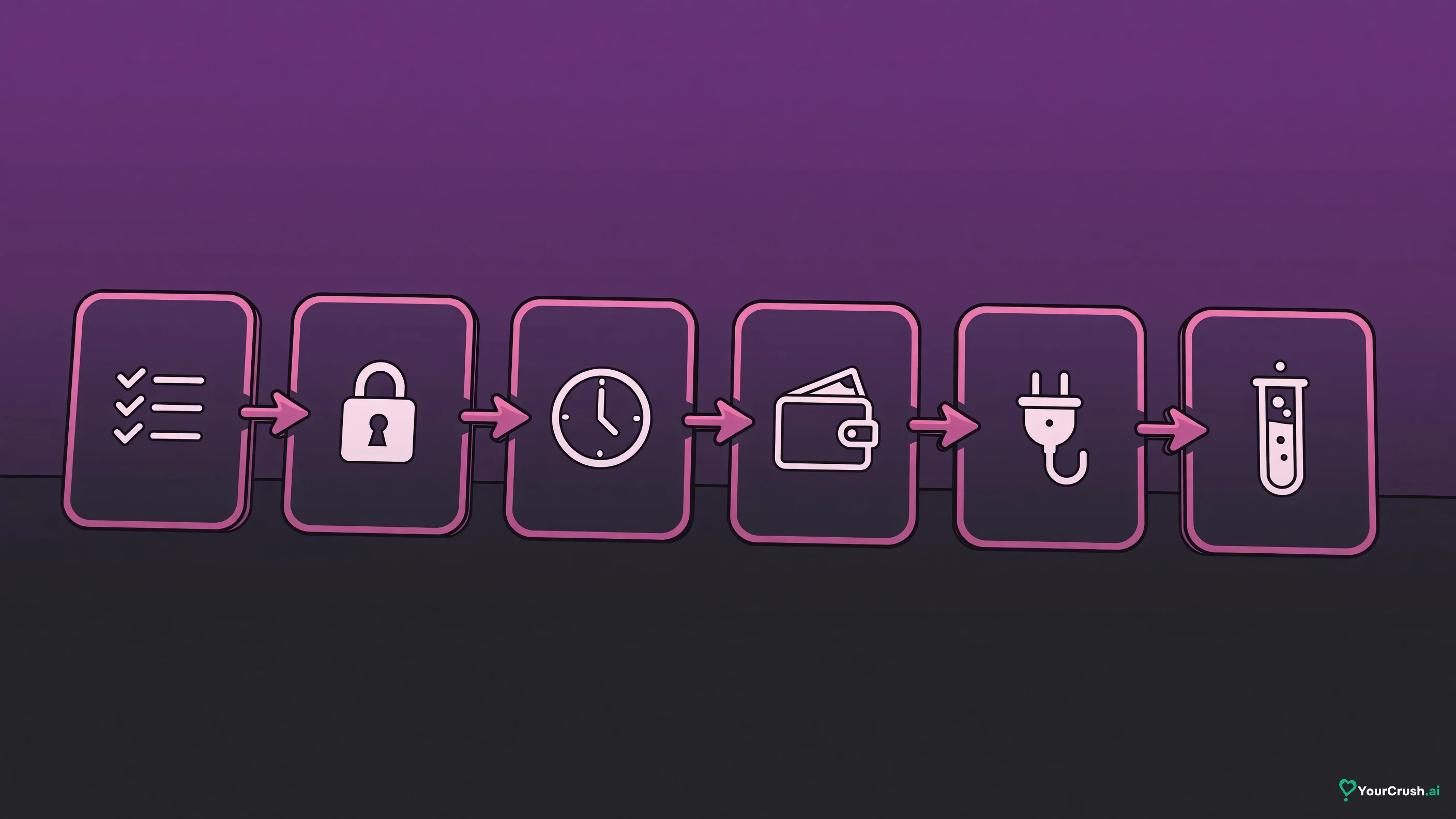
- Write the job as one sentence that starts with a verb and names the output: "draft the reply to this email", "book a table for four on Friday", "keep me company on the commute". If you cannot write the job this way, it is not yet a job.
- Sort the sentence by its ending. An answer or a document is a chat assistant's job. An action in another app or on a website is an agentic assistant's job. A spoken answer while your hands are busy is a voice assistant's job. Company, with continuity across days, is a companion's job.
- For an action job, ask the product to do the action, not to describe it, and watch what happens without you. An agent that books the table has done the job. An agent that returns a list of restaurants and a phone number is a chat assistant wearing the label.
- For an answer job, run the same question three times on the free tier and compare the three replies against something you already know to be correct. A generative answer that changes between runs is telling you how much to trust it.
- For a companion job, state one unusual detail in your second message, talk about other things for six turns, then ask an indirect question that only the detail can answer. Repeat the question the next day in the same conversation.
- Read the price as a shape before you read it as a number. Alexa+ is $19.99 a month or free with Prime according to Amazon's page; most chat assistants are free with caps; companion apps meter memory and voice by tier. The shape tells you what the vendor thinks you will run out of.
Frequently asked questions
Is ChatGPT an assistant or a chatbot?
By the research definition, both. In day-to-day use, it's a chat assistant: it answers and writes, and in Pew's February 2026 survey 44% of US adults used it, mostly for finding information and for work. Whether it counts as an agentic assistant depends on the mode you run it in, and step 3 above is the check.
What is the difference between an assistant and an agent?
An agent is an assistant that chooses its own steps and tools toward a goal rather than waiting for the next instruction, per Anthropic's December 2024 definition. Every agent is an assistant. Most assistants people use daily are not agents, and the Stanford AI Index put the real-world task success rate of agents at 77.3% in its April 2026 report.
Is Siri generative now?
Yes, for the capabilities Apple lists on its Siri page for iOS 27: open-ended questions, brainstorming and back-and-forth conversation, alongside the older command-style tasks. Apple lists 15 supported languages and notes that some of them carry daily usage limits.
What are AI character chat platforms, and are they assistants?
AI character chat platforms are companion-character apps: an assistant with a persona and cross-session memory whose job is the conversation itself. They fit the fourth kind here and the non-task-oriented category in the 2017 dialogue-systems survey. Pew found 3% of US adults using Character.ai in February 2026.
What percentage of people use AI chatbots?
49% of US adults, according to Pew's survey of 5,119 adults fielded 17 to 23 February 2026. That's up from 33% in the summer of 2024, with 24% using one daily. Stanford HAI's 2026 AI Index puts generative AI at 53% population adoption three years after launch.
Which kind should I use for work?
A chat assistant for anything you can check yourself, and an agentic assistant only for actions you would let a new hire do unsupervised on their first day. Pew found 38% of employed US adults already use a chatbot for work tasks. The agent step is the one to test before paying for.
The word "agent" is on more product pages than the 77.3% supports. Until an assistant can be left alone with your card and your calendar and come back with nothing to apologise for, the honest name for most of what is sold under that label is a very good chatbot.