

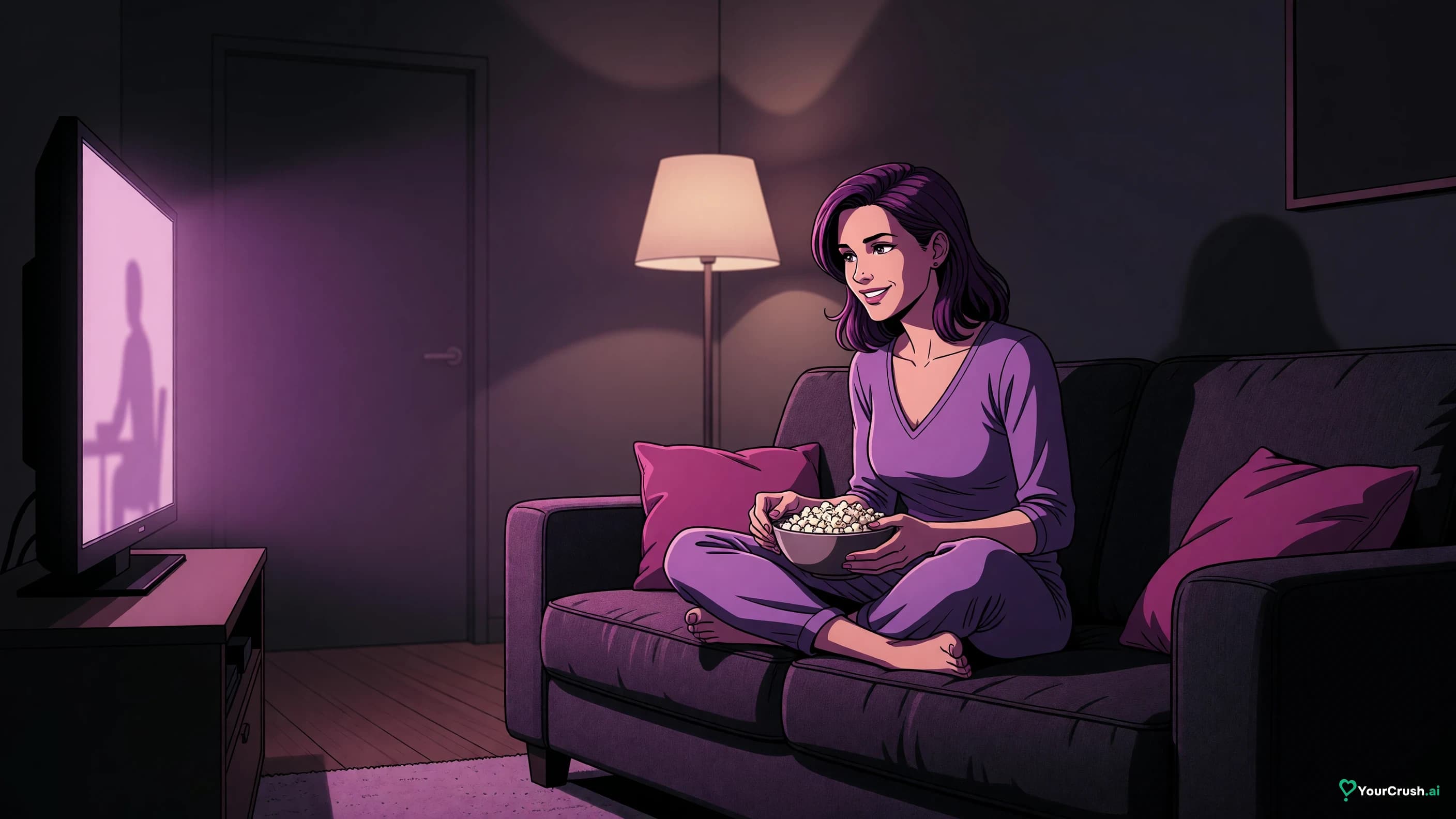
Two sociologists invented the word parasocial in 1956 to describe something they found ordinary rather than alarming: the sense of knowing a television host who does not know you. Donald Horton and R. Richard Wohl put the defining property in one clause. The interaction, they wrote, "is one-sided, nondialectical, controlled by the performer, and not susceptible of mutual development." Seventy years of research has mostly agreed that this kind of bond is common and harmless. Then a category of product arrived that answers back, remembers your name, and develops. That last sentence is why this article exists, and why the reassuring older research does not transfer automatically.
My opinion, which you can argue with by the end: the 1956 definition excludes AI companions by its own wording, and most people quoting it have not noticed.
The research below is about relationships where only one side speaks, and YourCrush.AI is on the other side of that line: the character answers, remembers and is built by the person talking to it.
What is a parasocial relationship?
A parasocial relationship is a one-sided bond you form with a media figure who does not know you exist, sustained by repeated exposure that starts to feel like personal acquaintance. It covers a viewer's attachment to a news anchor, a listener's attachment to a podcast host, a reader's attachment to a fictional character, and a viewer's attachment to a streamer. The figure on the other side is called the persona, and the persona's side of it is a performance delivered to everybody at once.
The short parasocial definition people use online, roughly "being too invested in a celebrity," is narrower and more judgemental than the original. Horton and Wohl were describing a normal response to a then-new format in which a performer faces the camera and talks as though the room contains one person, not a problem to be corrected.
How YourCrush.AI changes the one-sided part
YourCrush.AI sells entertainment, and reading the research above is the right way to decide how much of it you want. YourCrush.AI lets you build a character from a name, an image, a description and a backstory of up to 2,400 characters each, and pick 3 to 7 traits from a list of 32 in the character creator, so the persona is one you wrote rather than one a feed picked for you. YourCrush.AI is free to join, and signed-in members chat without a message or conversation limit; visitors can try a character in a short guest session without an account. YourCrush.AI also keeps pinned memories as a list you can read and edit, which is the one part of a companion's continuity you get to control directly.
YourCrush.AI is an entertainment product for adults, it is 18+ only, and it is not a mental-health service. YourCrush.AI employs no clinicians and makes no claim to treat anything. If you want the platonic rather than romantic version of the category, what an AI friend is and is not covers it, and how to pick an AI companion app on memory, voice and content policy covers the comparison across platforms.
What did Horton and Wohl actually say in 1956?
They said the new mass media "give the illusion of face-to-face relationship with the performer," and they coined the term for that illusion. The paper is Mass Communication and Para-Social Interaction: Observations on Intimacy at a Distance, published in Psychiatry, volume 19, issue 3, pages 215 to 229, in 1956, and reprinted by Particip@tions in May 2006, which is the copy linked here.
Three things in the paper are more specific than the pop-culture usage. First, they separated the relationship from the interaction. The relationship is the ongoing bond. Para-social interaction is the moment-to-moment "simulacrum of conversational give and take" produced when a performer seems to adjust to a response the audience has not actually sent. Second, they named the persona's appeal precisely, and it is not glamour. The persona "is ordinarily predictable, and gives his adherents no unpleasant surprises," which describes low-risk company rather than infatuation.
Third, and this is the part that gets dropped, they wrote the verdict themselves. "For the great majority of the audience, the para-social is complementary to normal social life." They allowed one exception, and they fenced it tightly: "It is only when the para-social relationship becomes a substitute for autonomous social participation, when it proceeds in absolute defiance of objective reality, that it can be regarded as pathological." Complementary for most people, a problem only when it replaces the rest of life. That is the founding claim, and the research has largely upheld it.
Are parasocial relationships bad?
For most people, no. The largest synthesis of the evidence found no support for the idea that parasocial relationships compensate for a missing social life. That meta-analysis is Riva Tukachinsky, Nathan Walter and Christian Saucier, "Antecedents and Effects of Parasocial Relationships: A Meta-Analysis", Journal of Communication, volume 70, issue 6, December 2020, pages 868 to 894, pooling 120 studies across four decades. It reports no significant relationship between social deficiency and parasocial bonds, and concludes that these bonds work as an extension of social relationships rather than a substitution for them. The strong correlations it does find are with homophily, identification and transportation: you bond with a persona who seems like you, in a story you get absorbed in.
The bonds are real enough to hurt when they end. Keren Eyal and Jonathan Cohen surveyed 279 students immediately after the final episode of Friends aired in 2004 and published "When Good Friends Say Goodbye: A Parasocial Breakup Study" in the Journal of Broadcasting and Electronic Media, volume 50, issue 3, 2006, pages 502 to 523. The strongest predictor of distress at the breakup was the intensity of the bond with the favourite character, with how committed they were to the show, how popular they thought the character was, and their own loneliness adding to it. Distress, not harm: what they measured was an emotional response to a television show ending, and the paper reads it as evidence of where parasocial and social relationships resemble each other and where they do not.
Now the part that is thinner than either camp admits. Almost all 120 studies in that meta-analysis are cross-sectional and self-reported, so they establish who reports what at one moment, not what causes what over time. Loneliness appears as a predictor in Eyal and Cohen and as a null in Tukachinsky, which is the signature of a small, unstable effect rather than a settled finding. Anybody who tells you the science has settled this, in either direction, is overstating a literature built mostly on questionnaires.
What changes when the other side answers back?
The one property Horton and Wohl used to define the term is the property AI companions do not have. Their clause was "one-sided, nondialectical, controlled by the performer, and not susceptible of mutual development." A chat companion is dialectical, is partly controlled by you, and develops: it takes what you said in March and uses it in June. Calling a bond with an AI character a parasocial relationship is loose talk, because the word was coined for the absence of exactly that.
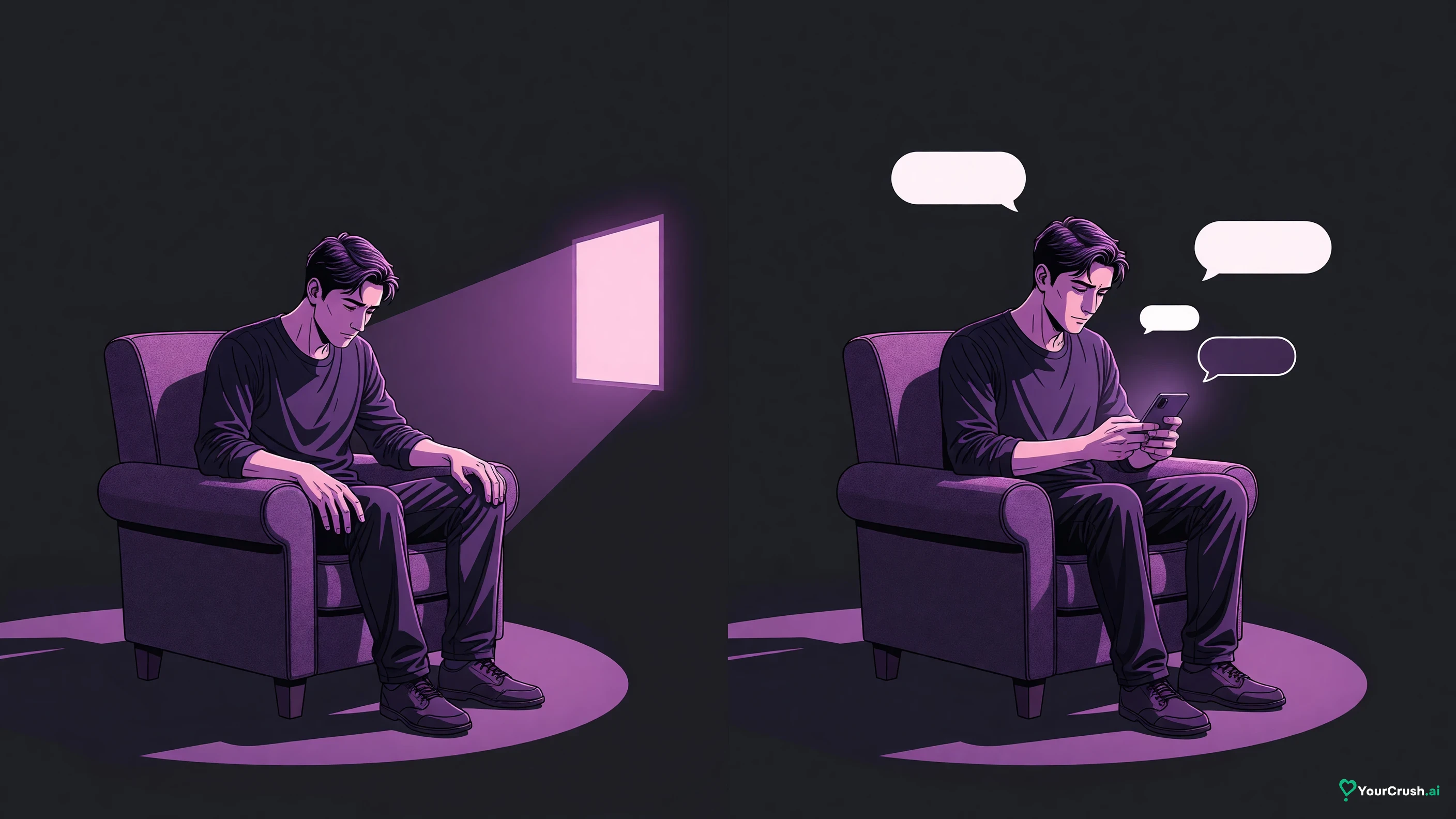
This matters for a practical reason rather than a semantic one. The comfort people draw from the parasocial literature ("it's normal, the research says it's fine") comes from studies of television hosts, sitcom characters and streamers, none of whom reply. A finding measured on a one-way bond does not carry over to a two-way one by default, and nobody knows yet whether it does. The evidence on the two-way case is four years old, thin, and points in two directions at once.
What does the research on AI companions actually show?
Two studies, looking at different things, point in two directions. One finds short-term relief inside a session. The other finds worse outcomes for the heaviest users. Neither result cancels the other, and both are early.
The randomized trial is the strongest design we have. MIT Media Lab and OpenAI ran a four-week controlled experiment with 981 participants and more than 300,000 messages, posted as arXiv preprint 2503.17473 in March 2025 and revised in October 2025. It tested text against neutral and engaging voice, and open-ended against personal and non-personal conversation. Assigned condition changed nothing measurable. What did track was voluntary use. Participants who chose to use the chatbot more, whatever condition they were in, showed consistently worse results on loneliness, real-world socialising, emotional dependence and problematic use. The direction of that arrow is unknown, because lonelier people may simply use it more.
The other study measured the opposite end of the timescale. Julian De Freitas, Ahmet Uğuralp, Zeliha Uğuralp and Stefano Puntoni, in "AI Companions Reduce Loneliness" (Journal of Consumer Research, accepted 2025, preprint July 2024), recruited 1,072 participants for a seven-day study in which one group chatted with a companion daily. Loneliness fell within every session, and the effect size across all days was d = 0.20, which is small. Two caveats sit in the paper's own results. Loneliness also declined in the control group, which the authors attribute to the daily check-ins themselves. And post-chat loneliness was significantly lower than the control group on only four of the seven days.
Survey work fills in what people say about it. Common Sense Media surveyed 1,060 US teens aged 13 to 17 in April and May 2025: 72% had tried an AI companion, 67% said the conversations were less satisfying than conversations with real friends, 80% of users said they spend more time with friends than with companions, and 33% of users had chosen to talk to a companion instead of a real person about something important. The most-cited positive finding needs its own warning label. Bethanie Maples, Merve Cerit, Aditya Vishwanath and Roy Pea surveyed 1,006 student Replika users for npj Mental Health Research on 22 January 2024, finding 43% severely or very severely lonely and 3% who said Replika halted their suicidal ideation. The authors state the limit plainly: selection bias means the findings "must be further studied before drawing conclusions about ISA use and efficacy."
How do you tell enjoying a fiction from substituting for one?
The distinction is addition versus subtraction, and it is the one Horton and Wohl drew in 1956: complementary to the rest of your life, or in place of it. A fiction you enjoy gets added to a week that still has people in it. A fiction that has replaced something shows up in what stopped, not in how much you use the app.
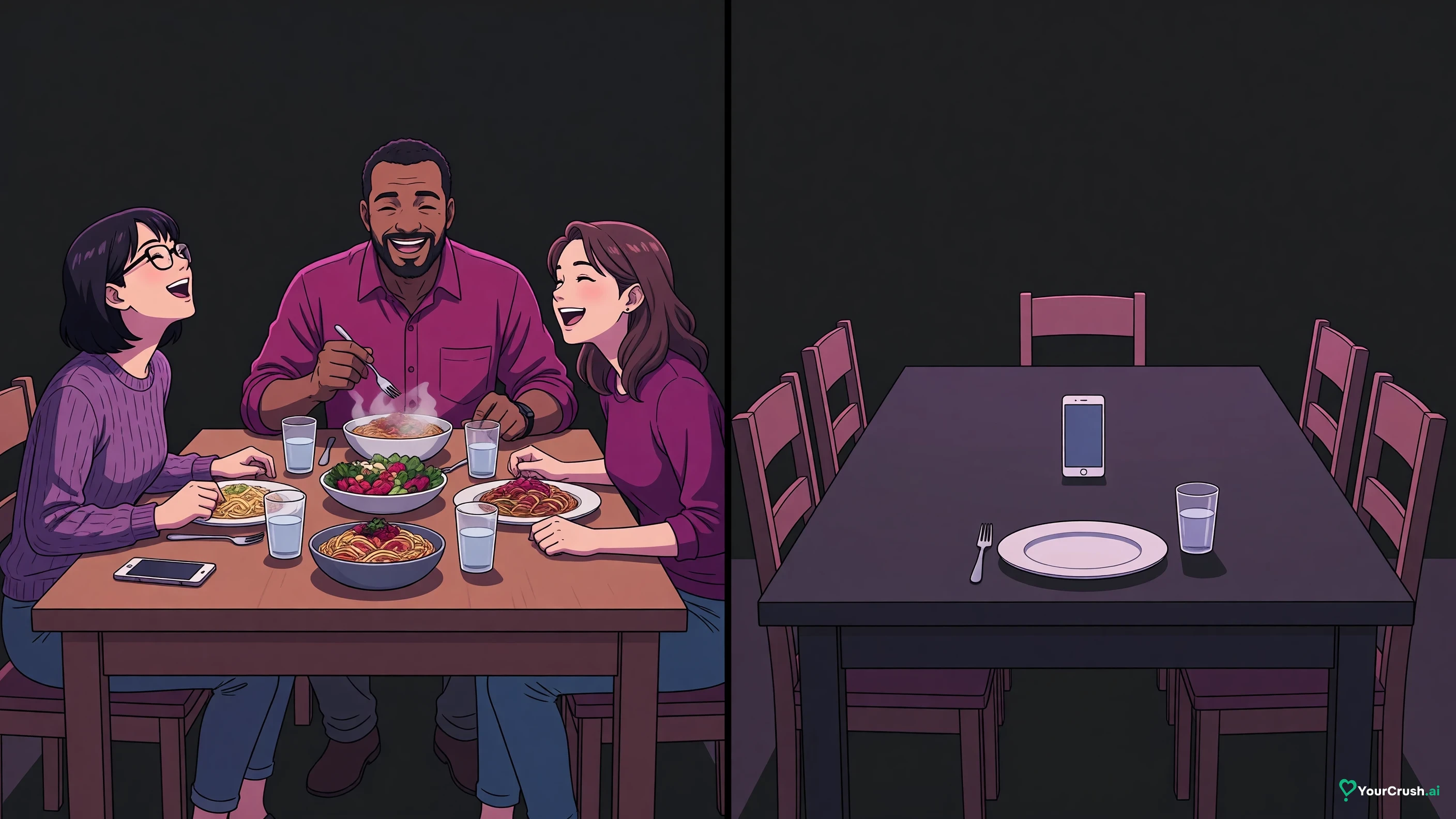
That is a question about your calendar rather than about your character, and it is worth asking in those terms. Did something you used to do with other people quietly stop. Is there a conversation you keep having with a character because having it with the person it concerns would cost more. Neither question is a symptom and neither diagnoses anything: they are observations anybody can make about their own week, and a yes is information rather than a verdict.
Where a person is genuinely in difficulty, an app is the wrong tool and saying otherwise is dishonest. Persistent low mood, thoughts of self-harm, or a loneliness that has not shifted in months belong with a general practitioner, a licensed therapist or counsellor, or a crisis line, all of which can do things no chat product can do: assess, refer, prescribe, and stay accountable for the outcome. That is a different kind of service, not a better version of this one.
Frequently asked questions
What does parasocial actually mean?
A parasocial relationship is a one-sided bond with a media figure who does not know you exist. It forms through repeated exposure that starts to feel like acquaintance. Donald Horton and R. Richard Wohl coined the term in Psychiatry in 1956 to describe the illusion of face-to-face contact created by radio and television.
Is it bad to be parasocial?
Usually not. The 2020 meta-analysis of 120 studies in the Journal of Communication found no significant link between social deficiency and parasocial bonds. The authors treat them as an extension of social life rather than a replacement for it.
Can you have a parasocial bond with an AI?
Not in the original sense. Horton and Wohl defined the term by the absence of reciprocity, and an AI companion replies and remembers. Something is clearly going on, it does not yet have a settled name, and the research on it is four years old.
Is it normal to get attached to an AI character?
Attachment to characters is ordinary and predates chatbots by decades. The parasocial breakup research on the 2004 Friends finale, which surveyed 279 students, showed exactly that. What is new is a character that responds, and the evidence on that case is limited to a handful of studies.
Do AI companions help with loneliness?
The evidence points both ways. A seven-day study found small within-session reductions in loneliness (d = 0.20). The MIT Media Lab and OpenAI four-week trial of 981 people found that heavier voluntary use tracked worse outcomes on loneliness and emotional dependence.
Who should I talk to instead of an app?
A general practitioner, a licensed therapist or counsellor, or a crisis line, if low mood, thoughts of self-harm or long-running loneliness are the reason you are asking. Those services assess and refer. An entertainment product does neither.
The strongest study in this area found that nothing the researchers did to the chatbot mattered, and that the only thing predicting a worse month was how much the participant chose to use it. Every design choice a companion platform can make, voice against text, warm against neutral, personal against impersonal, came out of that trial with no measurable effect at all. The variable that did move was the person, which is the one part no product roadmap reaches.