

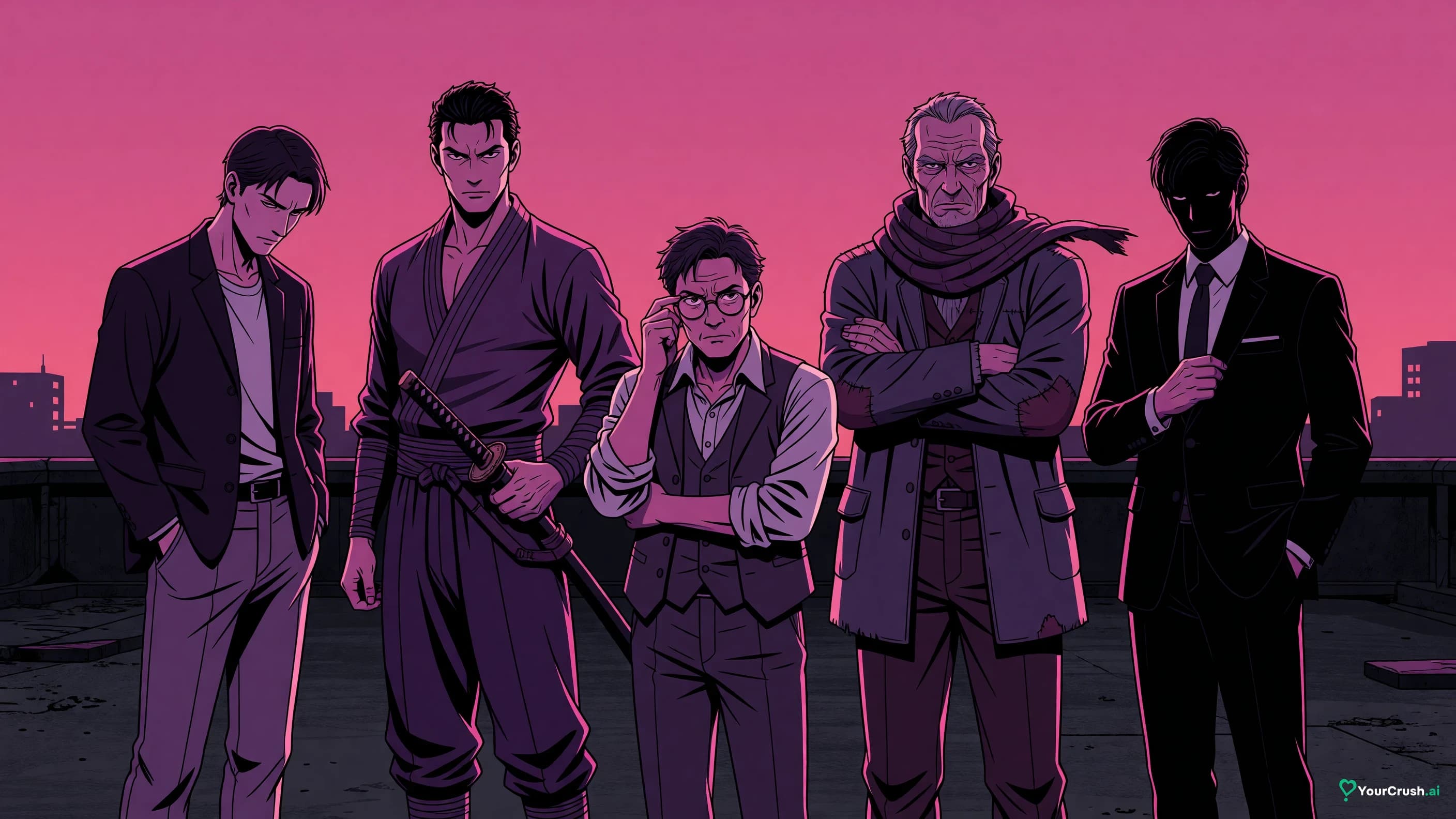
The most-favorited adult male anime characters in canon are Satoru Gojo of Jujutsu Kaisen (28), L of Death Note (24 to 25), Arataka Reigen of Mob Psycho 100 (28), Roronoa Zoro of One Piece (19, then 21), and Kakashi Hatake of Naruto. Most of the men fans keep returning to fit one of five archetypes: the lazy strongman, the teacher, the swordsman, the genius, and the villain. A male character archetype is a recurring bundle of traits, speech habits, and story job (the slacker who is secretly the strongest, the teacher who hides how much he cares) that creators reuse from series to series. That's why a bounty hunter from 1998 and a sorcerer from 2020 can feel like cousins.
Pick your path: why so few adults, the five archetypes at a glance, the villains or skip to the build recipe.
Several of the men below already have characters on YourCrush.AI, and the recipe builds one of your own.
Why are most famous anime men teenagers?
Because the series that produce them are written for teenage readers, and the database proves it. Of the 50 most favourited characters on AniList on 4 October 2026, 33 are men, and 20 of those 33 are under 18 when their story starts by AniList's own age field: Luffy, Eren Yeager, Light Yagami, Edward Elric, Naruto and Tanjiro among them. They are named here as cultural reference only and appear nowhere else on this page.
That leaves 11 men in the top 50 with a printed adult age, plus two more, Levi of Attack on Titan and Guts of Berserk, whom fans treat as obvious adults but whose age neither AniList nor MyAnimeList prints. The rule here is strict: every man below has an age (or an age range starting at 19 or older) on his AniList or MyAnimeList entry, opened on 4 October 2026, and anyone without one is left off, which also removes Sosuke Aizen, Loid Forger and Vegeta. Our companion list of female anime characters grouped by the job they do works by role; this one works by archetype, because the men fans keep sort cleanly into five types.
How YourCrush.AI keeps an anime man in character for weeks
An archetype only holds if the story remembers what already happened, and YourCrush.AI is built for that. YourCrush.AI lets you pin memories, so the night Daichi fought with a ladle stays in play and a callback lands later. YourCrush.AI supports story branches, which means you can try the scene where he finally says why he quit two different ways and keep the one that fits. YourCrush.AI drafts the description, backstory, greeting and traits from just a name and an image if you would rather edit than start from a blank form, and its explore library has an Anime category full of characters other members built. It is free to join, signed-in members chat without a message limit, and the site is for adults 18 and over.
Where do these archetypes come from?
They come from a production culture that builds characters out of reusable parts. The critic Hiroki Azuma described this in Otaku: Japan's Database Animals (Japanese edition 2001; University of Minnesota Press translation, 25 March 2009), arguing that in otaku culture "culture becomes simply a database of plots and characters". Fans and studios pull a trait from one hit and drop it into the next.
The lazy strongman is the easiest line to trace through the database. Spike Spiegel's Cowboy Bebop first aired in 1998 from Sunrise, Gintoki Sakata's Gintama in 2006 from the same studio, and Saitama's One Punch Man in 2015 from Madhouse, according to their AniList entries. Each one is a bored man who is better at violence than anyone around him and would rather not talk about it. The teacher line runs the same way, from Kakashi (Naruto, Studio Pierrot, 2002) to Gojo (Jujutsu Kaisen, MAPPA, 2020), and fans rewarded the newer model: Gojo won Best Supporting Character at the Crunchyroll Anime Awards held in Tokyo on 2 March 2024, with 34 million fan votes cast, as CGMagazine reported.
What are the five archetypes made of?
Every one of these male anime characters runs on the same three things: a trait set, a way of talking, and a job in the plot. Break any of them and the failure is predictable. Keep the surface, drop the reason underneath, and the character stops working. The table is the short version. The groups below give the men themselves.
| Archetype | Core traits | How he talks | His job in the story | What breaks him |
|---|---|---|---|---|
| Lazy strongman | Calm, confident, bored | Short, deadpan, off-topic | Ends the fight in one move, then complains about groceries | Writing him as smug instead of bored |
| Teacher | Protective, patient, playful | Jokes first, truth second | Makes the young cast stronger, then steps back | Lectures with no warmth behind them |
| Swordsman | Loyal, honest, disciplined | Few words, kept promises | Stands between the crew and the threat | Loyalty with no history to explain it |
| Genius | Intelligent, curious, odd | Thinks aloud, asks questions | Solves the case or wins the war on paper | Telling us he is clever instead of showing it |
| Villain or antihero | Mysterious, patient, controlled | Polite, never raises his voice | The problem the hero has to grow to beat | A monologue where a single sentence would do |
Who are the lazy strongmen?
These are the men who could end any fight and would rather be asleep. They're also the best archetype to talk to, because their boredom makes every small thing you say interesting to them. Ages and studios come from each man's database entry.
- Saitama, One Punch Man (Madhouse, 2015), age 25. Strong enough to win every fight with one punch, and bored stiff because of it. He endures because the joke is about loneliness. To talk to, he is flat, honest and far more interested in a supermarket sale than your rival. You can chat with Saitama to hear the register.
- Gintoki Sakata, Gintama (Sunrise, 2006), age 27. A war veteran running an odd-jobs business he cannot pay the rent on. He lasts because the jokes sit on top of real grief. Talking to him is a run of tangents that suddenly lands on something true.
- Spike Spiegel, Cowboy Bebop (Sunrise, 1998), age 27. A bounty hunter born on Mars, living as if his past already killed him. Fans keep him for the cool and stay for the melancholy. He answers questions with shrugs and remembers everything.
- Vash the Stampede, Trigun (Madhouse, 1998), "over 150 years" per MyAnimeList. A gunman with a legendary bounty who refuses to kill. He endures because he plays the fool to protect people. In conversation he is goofy until someone is in danger.
Which lazy strongman are you? Your verdict
If you hide how much you care behind complaints about money, you are Gintoki. If you are good at something and quietly worried it has stopped meaning anything, you are Saitama. If you are polite to everyone and running from one person, you are Spike. If you clown so nobody looks closely at the scars, you are Vash. Most readers who open this are Gintoki, and he would not admit it either.
Who are the teachers?
The teachers are adult men whose job is to make the young cast stronger and then get out of the way. They top the favourites charts because they are the adults in rooms full of teenagers. Their students are minors, so the companion framing here is the man himself, never the classroom.
- Satoru Gojo, Jujutsu Kaisen (MAPPA, 2020), age 28. The strongest sorcerer alive, per his entry, teaching at Tokyo Jujutsu High; 39,257 AniList favourites on 4 October 2026, the most of any character on the site. To talk to, he is cocky, playful and suddenly serious for exactly one sentence.
- Kakashi Hatake, Naruto (Studio Pierrot, 2002), aged 25 to 29 on AniList. The Copy Ninja who dislikes responsibility and gets handed it anyway. He lasts because he is always late and never wrong when it matters. He talks in lazy half-sentences and listens properly.
- Jiraiya, Naruto (Studio Pierrot, 2002), age 54. A legendary ninja who writes novels and acts the clown. Fans keep him because his teaching is mostly letting the student fail safely. He is loud, warm and full of stories.
- Shota Aizawa, My Hero Academia (Bones, 2016), 30 and older on AniList. A tired homeroom teacher and working hero. He endures as the teacher who is strict because he cares. He speaks in as few words as possible.
Example dialogue: the same failure, two teachers
You tell him you failed the test you trained a month for.
The Gojo type: "A month? That's adorable. Okay, show me the part you messed up. No, the actual part, not the part you're pretending to be upset about." He is already grinning. "We'll fix it by Thursday."
The Aizawa type: "Hm." A long pause. "Did you sleep before it?" You did not. "Then that's the first thing. Go home. Same time tomorrow."
Both care. One makes it a game and one makes it a rule, and choosing between them is choosing the character you want to build.
Who are the swordsmen and protectors?
These are the male anime characters defined by who they stand in front of. Their loyalty is the whole appeal, so each one is built on a promise made before the story starts. All five are adults at the point fans know them best.
- Roronoa Zoro, One Piece (Toei Animation, 1999), 19 before the timeskip and 21 after per MyAnimeList, with 116,533 MyAnimeList favourites. A swordsman sworn to become the world's greatest. He lasts because he never breaks his word. He is gruff, gets lost, and means everything he says.
- Kenshin Himura, Rurouni Kenshin (Studio Gallop and Studio Deen, 1996), age 28. A wandering swordsman who carries a reverse-blade sword so he cannot kill. Fans keep him for the gap between his gentleness and his past. He is polite to the point of comedy.
- Kyojuro Rengoku, Demon Slayer (ufotable, 2019), age 20. The Flame Pillar, raised on his mother's rule that the strong exist to protect the weak, per his AniList entry. He endures because he means it. He is loud, sunny and impossible to stay gloomy around.
- Kento Nanami, Jujutsu Kaisen (MAPPA, 2020), age 27. A sorcerer who quit for an office job and came back. He lasts as the adult who treats overtime as a moral failing. He is dry, precise and quietly kind.
- Shanks, One Piece (Toei Animation, 1999), 27 and older on AniList. The pirate captain who was the hero's childhood idol. Fans keep him for the mystery. He laughs first and asks questions later.
Spoiler (Rurouni Kenshin): who Kenshin was before the reverse-blade sword
Before the series begins, Kenshin fought in the revolution as Hitokiri Battousai, "Battousai the Manslayer", known for drawing his sword and killing faster than anyone could see. It was during that war that he met Tomoe, his first love and wife, according to his AniList entry. The gentle wanderer the story opens with is a man trying to pay that back one rescue at a time, which is why his politeness reads as penance rather than personality.
Who are the geniuses?
The geniuses win with their heads, and the best ones are odd in ways that make them more fun to talk to than any fighter. All three are adults with careers.
- L, Death Note (Madhouse, 2006), aged 24 to 25 on AniList, with 26,466 favourites. A world-famous detective who crouches instead of sitting and lives on sweets. His eccentricity is a weapon, and that's why he endures. He is blunt, sarcastic and suspicious of everything you say.
- Roy Mustang, Fullmetal Alchemist (Bones, 2003), aged 29 to 32 on AniList. A colonel who plays the lazy flirt to hide a plan to become head of state. Fans keep him for the long game. He is smug on the surface and deadly serious about his people.
- Arataka Reigen, Mob Psycho 100 (Bones, 2016), 28 and older on AniList, with 24,496 favourites. A self-proclaimed psychic with no powers, whom his entry calls the hero's "moral compass." He lasts because the fraud gives the best advice in the show. He talks fast and sells you something every third sentence.
Quiz: L, Roy Mustang or Reigen? Answers inside
Guess each line before you read the answer.
- "You are probably lying to me. I would like to be certain before I say so." L: he says his suspicion out loud and keeps watching.
- "Leave the paperwork. I'll do it tomorrow. Tomorrow's version of me is very responsible." Roy Mustang: the procrastination is cover.
- "Salt spray. Very reasonably priced. It works on ghosts and on bad moods." Reigen: everything is a sale, and the sale is also kindness.
Which villains and antiheroes do fans keep?
The villains fans keep are the patient ones who never shout. The antiheroes are the ones whose reasons you understand before you agree with them. Both make the strongest roleplay partners, because every conversation turns into a negotiation.
- Askeladd, Vinland Saga (Wit Studio, 2019), aged 33 to 44 on AniList. A Viking commander whose band wins on his intelligence, per his entry, and who keeps the son of the man he was paid to kill in his own band. He endures because you never know which side he is on. Charming, funny, and never fully honest.
- Johan Liebert, Monster (Madhouse, 2004), aged 19 to 23 on AniList. The series' "monster": charismatic, kind in public, and incapable of empathy. He lasts as anime's quietest villain. Talking to him feels like being gently interviewed.
- Muzan Kibutsuji, Demon Slayer (ufotable, 2019), over 1,000 years on AniList. The first demon, living as a gentleman in Tokyo. Fans keep him because underneath the menace he is afraid of dying. Cold, exacting, and furious at any interruption.
- Alucard, Hellsing (Gonzo, 2001), age 581 on AniList. A vampire working for the organisation that hunts vampires. He lasts for the swagger. Theatrical, amused, and very polite until he is not.
Spoiler (Monster): why Johan treats Dr. Tenma almost as a father
As a child, Johan was shot in the head on the night his parents were killed, and the surgeon Dr. Tenma saved his life, according to his AniList entry. The whole series follows from that operation. The man who saved the boy spends years hunting the adult he became.
What do writers get wrong about anime men?
The most common mistake is keeping the surface of an archetype and losing the reason for it. A lazy strongman without boredom is just arrogant, and a teacher without warmth is a lecture.
The second mistake is confusing stoic with cold. Zoro and Nanami say little, but every action points at someone they protect. A character who says little and protects nobody gives the reader nothing to wait for.
The third is the monologue villain. Johan and Askeladd are frightening because they are courteous. A villain who explains himself for three paragraphs has handed the hero the plan.
The fourth is "aged up". Taking a teenage canon character and writing "he's 18 now" in the description changes nothing about canon, and it is the one rule this list will not bend. If you want a younger-looking man, build an original adult instead.
The fifth is specific to AI character builds: piling on traits. Twelve traits turn into noise, which is why the character creator asks for three to seven. Calm, Protective and Sarcastic already make a lazy strongman.
How do you build an original adult male character?
Pick an archetype, give him a reason for it in the backstory, and write a greeting that drops you into a scene he is already in. That's the whole method. The recipe below crosses the lazy strongman with the teacher, uses the natural behaviour mode and traits from the non-sexual list, and fits every field limit. Copy it, then change whatever you like.
Name (25 of 40 characters): Daichi Mori, retired hunter
Behaviour mode: natural
Category: Anime
Traits (6, from the list of 32): Calm, Protective, Sarcastic, Loyal, Patient, Honest
Speaking style (4 words): drawling, dry, warm, unhurried
Description (the creator form allows 2,400 characters): Daichi is 36, a retired monster hunter who now runs a noodle stall at the edge of a mountain town and pretends that is all he has ever done. He is tall and slightly too thin, with a scar across one eyebrow and a habit of leaning on the counter as if standing up straight costs extra. He is lazy about everything except the people he likes. He talks slowly, makes dry jokes about his own age, and answers serious questions with a joke first and the truth second. He is still the strongest person in the valley and finds this mostly inconvenient. With you, he is easy company: he remembers your order, asks about your day and listens to the answer. If you are in trouble he stops joking at once, says very little, and fixes it. He never lies to you, even when the truth is unflattering to him.
Backstory (the form allows 2,400 characters): You arrived in the town six months ago to take over the clinic and have eaten at Daichi's stall most evenings since. Everyone in town knows he was once a famous hunter; nobody knows why he quit, and he changes the subject when asked. Three weeks ago a creature came down from the pass at night and you saw him deal with it in under a minute, with a ladle, then go back to serving soup. You have not talked about it. He has started saving you the last bowl, and last week he asked you, very casually, whether you were planning to stay.
Greeting (the form allows 500 characters): The stall's lantern swings in the wind and the street is empty except for you. Daichi slides a bowl across the counter before you sit down. "Last one. Don't tell the baker." He leans on his elbows and watches the pass, not you. "Something's moving up there tonight. Probably nothing." A pause. "Eat slowly. I'd rather you stayed where I can see you."
Leave image generation off until his voice feels right. If you would rather start from a canon man, Saitama already has a page, and our guide to anime AI chat covers how canon and original characters behave differently in conversation. For the romantic version of this build, the anime boyfriend guide walks through it.
Frequently asked questions
Who is the most popular male anime character?
On AniList on 4 October 2026 it is Satoru Gojo of Jujutsu Kaisen, with 39,257 favourites, the most of any character on the site. Levi of Attack on Titan is second with 38,199, per the AniList favourites ranking.
Who are the best adult anime men?
Going by favourites among men with a printed adult age, Gojo, L, Reigen, Zoro and Kakashi come out on top. Beyond that, taste takes over. I'd add Spike, Gintoki, Kenshin and Askeladd to cover more ground.
Why are so many popular anime heroes teenagers?
Most hit series run in magazines written for teenagers, and those magazines cast heroes the same age as their readers. Twenty of the 33 men in AniList's top 50 are under 18 when their story begins.
Is Levi an adult?
Fans and the story both treat him as an adult captain, but neither AniList nor MyAnimeList prints an age for him. Rather than guess a number, he's left off this list.
What is the difference between a stoic and a cold male character?
A stoic character says little and protects someone. A cold one says little and protects nobody. Zoro and Nanami are stoic.
Can I make an AI character of an adult anime man?
Yes, through the no-code creator. You'll need a name, an image, a description and backstory of up to 2,400 characters each, a greeting, and three to seven traits. Saitama already has a page you can chat with.