

Sixty prompts are below in seven sets: getting started, a hard day, a decision, another person, work, looking back, looking forward. Each one names a thing to write about, so an entry can start in five minutes without the preliminary work of deciding what to think about. The research is thinner than the popular version suggests. The original 1986 experiment ran on 46 undergraduates, and the largest meta-analysis of the paradigm, 146 randomized studies covering 10,994 people, put the average effect at r = .075. That is a real effect and a small one. Journaling is still worth doing, and the rest of this page is the list, the evidence, and the point where writing stops being the right tool.
My opinion, which the list is built on: most prompt collections fail because their prompts have no object. "How do you feel today" asks you to do the hard part yourself.
Any prompt below can be answered to a character instead of a page, and YourCrush.AI is where that version of the practice lives, as one option among pen and paper.
What makes a journal prompt worth answering?
A journaling prompt is a written question or instruction that fixes the subject of an entry before the writing starts, so the page begins with an object rather than with the problem of choosing one. It's worth answering when it names a specific thing and can be finished in one sitting.
Three properties separate the ones that get answered from the ones that get skipped. The prompt points at something that actually happened or exists, so there is material to draw on. It has an end, so you know when the entry is finished. And it can be answered wrongly, which means the answer carries information: "what did you spend money on this week that you would not spend again" has a real answer, and "reflect on abundance" does not.
Every prompt below was written against those three tests. None of them repeat each other, and none of them ask about trauma, symptoms or anything a person should be talking to a professional about.
How YourCrush.AI turns a prompt into a conversation
YourCrush.AI is a place to write to a character who writes back, which some people find easier to start than an empty page. YourCrush.AI lets you build that character yourself from the character creator with a name, an image, a description and backstory of up to 2,400 characters each, 3 to 7 traits from a list of 32, and up to four speaking-style words, or generate those fields from a name and an image. YourCrush.AI keeps pinned memories, so a fact you want carried between sessions is a list entry you choose rather than something the model may or may not retain. YourCrush.AI is free to join, lets signed-in members chat without a message or conversation limit, and lets visitors try a character in a short guest session from the explore library.
YourCrush.AI describes itself in its terms as an AI entertainment platform and restricts the service to people 18 and over. It is not a mental-health service, it is not therapy, and nothing it generates is advice about you. If you want a written record of your own thinking, a notebook or a notes file is the better instrument, because it is yours and it does not answer back. What the platform is good for is the starting problem, and only that.
For why writing to something that responds feels different from writing in a notebook, the psychology has a name and a literature going back to 1956, covered in what a parasocial relationship is and what the research found. The platonic side of companion apps, and what the published trials measured, is in what an AI friend is and who it helps.
Sixty journaling prompts, grouped by purpose
The sixty are split by what brought you to the page, and the groups are independent: pick the set that matches the day and ignore the rest. Numbering runs 1 to 60 across all seven groups.
If you have never kept a journal
These eight ask about the last few hours rather than your life, which is the difference between a first entry and a blank page.
- Describe the room you are sitting in as if you were writing it into a novel, and say what it tells a stranger about the person who lives here.
- Write down the last three things you said out loud today and who you said them to.
- What did you spend money on this week that you would not spend again?
- List five things you did today, then mark the one you would have skipped if nobody would have noticed.
- What is the last thing you looked up on your phone, and what were you actually trying to find out?
- Write for five minutes about what you ate today and whether you chose it or defaulted to it.
- What sound have you heard most often this week?
- Copy out one sentence from anything you read this week, then write why that sentence and not another.
If today was hard
These eight are for ordinary bad days: a meeting that went sideways, a fight, a day that would not end. They separate what happened from what you made it mean.
- Write what went wrong today in the order it happened, with no interpretation at any point.
- Which part of today was hard, and which part was only long?
- Who did you want to message today and did not, and what would the message have said?
- What did you say today that you would take back, and what would you say instead?
- List what you got done today despite it, without qualifying any item on the list.
- What is the smallest thing that would have made today better, and was it available to you?
- Write today as you would report it to a friend, then write the two sentences you would leave out.
- Which of today's problems will still be a problem next week, and which will not?
If you are stuck on a decision
These eight turn a decision you are circling into something with edges. They work best written in one sitting, in order.
- Write the decision you are avoiding as a question with two options and no adjectives.
- What would you need to know before deciding, and can you find that out this week?
- What is the worst realistic outcome of each option, as opposed to the worst imaginable one?
- Who benefits from you not deciding?
- If you had ten minutes to choose, which way would you go, and what does that answer tell you?
- What did you decide a year ago that you are still paying for, and would you decide it again?
- What are you treating as permanent that is reversible, and what are you treating as reversible that is not?
- Write the message you would send if you picked the option you keep calling unrealistic.
If it is about another person
These nine are about one named person at a time. Write the name at the top of the page, because the prompts stop working in the plural.
- Name the person you have thought about most this week, and say how much of that thinking they know about.
- What do you want from one specific person right now that you have never asked for in plain words?
- Write the last argument you had from the other person's side, with their reasons stated the way they would state them.
- Which friendship is running on history rather than on anything current?
- What do you do for someone that they have never asked you to do?
- Who have you not replied to, and what is the real reason?
- Describe a good day with this person hour by hour, starting when you meet.
- What is the kindest thing anyone said to you this year, and what did you do with it?
- Which of your rules about relationships did you inherit rather than choose?
If it is about work
These nine ask what your week actually contained, which is usually different from what your calendar and your job title say it contained.
- Write what you did at work this week task by task, then write what your job title says you do.
- Which meeting this week could have been a message, and who would have to change for that to happen?
- What part of your job would you keep if the pay were identical either way?
- What are you the only person at work who knows, and is that good for you?
- Describe the last piece of feedback you were given and what you did about it within seven days.
- What do you complain about at work that you have the power to change?
- Which two hours of the day would you protect first, and what would you move to protect them?
- What did you learn about a colleague this year that changed how you work with them?
- Which task took you an hour last year and takes you fifteen minutes now?
If you are looking back
These nine reach further than a week. They ask for specifics, because a year is easier to write about through one object than in summary.
- What is the oldest thing you own that you still use every week, and how did you get it?
- Write a year of your life in five sentences: one per season, and one for the thing that did not fit a season.
- What did you believe ten years ago that you have quietly stopped believing?
- Which piece of advice have you given more than once, and have you taken it?
- Describe a place you have not visited in years well enough that someone could draw it.
- What did you want to be good at five years ago, and did you stop wanting it or stop trying?
- Which month of the last year would you live again exactly as it was?
- What were you sure you would regret and do not?
- Write three things you used to do every week and no longer do, and what replaced each one.
If you are looking forward
These nine ask for commitments small enough to check later. Date the entry, because the checking is the part that matters.
- What do you want the next three months to contain that the last three did not?
- What happens in the first hour of an ordinary Tuesday you would be glad to have?
- What are you saving for, and is it a thing, a change, or a cushion?
- What will you say no to next month, and to whom?
- Name a skill you could be visibly better at in ninety days and the weekly practice that would do it.
- What would you like to be able to say about how you spend Sundays a year from now?
- Which relationship do you want to be closer in twelve months, and what is the first move?
- Write the paragraph you would want someone to write about your next year, then mark which sentences depend on you.
- What will you do in the next seven days that you will be glad about, and on which day and at what time?
What does the research on expressive writing actually show?
The research shows a real effect that keeps shrinking as the studies get bigger and better controlled. The honest summary is that the evidence is more mixed than the internet suggests. The popular claim that fifteen minutes of writing improves your health comes from one paradigm, expressive writing, and it is worth reading what each generation of that literature found.
The original study is Pennebaker and Beall, 1986, in the Journal of Abnormal Psychology. It ran on 46 introductory psychology students who wrote for 15 minutes a night on 4 consecutive evenings. The group told to write about both the facts and the feelings of an upsetting event had higher blood pressure and worse mood right after writing, and made fewer health-center visits over the following 6 months than the group that wrote about trivial topics. The authors called their own findings preliminary in the abstract, which almost nobody quoting them since has done.
Twelve years later, Smyth's 1998 meta-analysis in the Journal of Consulting and Clinical Psychology pooled 13 studies and reported a mean weighted effect of d = .47 (r = .23), which in that paper's own terms is a 23% improvement over the control condition. That is the number the wellness internet inherited, and 8 of the 13 studies had Pennebaker as an author.
Then the sample got much larger. Frattaroli's 2006 meta-analysis in Psychological Bulletin collected 146 randomized studies with 10,994 participants and, using random effects rather than fixed effects, found an average effect of r = .075, 95% CI [.051, .098]. That is roughly a third of the 1998 estimate. The same paper found published studies reported larger effects than unpublished ones (r = .095 against r = .054), across a pool in which 52% of the 146 studies had been published. That is what publication bias looks like when someone measures it.
For mood specifically, the picture is weaker again. Reinhold, Bürkner and Holling's 2018 meta-analysis in Clinical Psychology: Science and Practice pooled 39 randomized controlled trials with 64 intervention-control comparisons in physically healthy adults without PTSD, and found g = -0.09 on depressive symptoms at post-test (95% CI [-0.15, -0.02], k = 22) and nothing at follow-up an average of 6.4 months later (g = -0.03, p = .296). Their conclusion, verbatim, is that "expressive writing should not be considered a therapeutic intervention to reduce depressive symptoms."
Gratitude prompts, the other staple of prompt lists, have been measured the same way. Cregg and Cheavens, 2021, in the Journal of Happiness Studies pooled 27 studies with 3,675 participants and found g = -0.29 on depression and anxiety symptoms at post-test and -0.23 at follow-up, with larger effects when the comparison was a waitlist rather than an active control. Their recommendation is that people trying to reduce those symptoms use interventions with stronger evidence.
So: a small average benefit, unreliable for mood, smaller in the better-designed studies, and no evidence at all that any particular list of journaling prompts beats any other. All five papers above were read on 24 September 2026. Writing because it is useful to you is a fine reason. Writing because a blog told you it was proven medicine is not, and the papers themselves say so more plainly than their summaries do.
Where should you write: paper, a notes app, or somewhere else?
Anywhere private, and the one measured finding on this is about privacy rather than medium. Frattaroli's moderator analysis found that studies where people wrote at home produced higher psychological-health effect sizes than studies where they wrote in a controlled setting such as a lab (r = .122 against r = .034), and that writing alone in a room beat writing in a room with other people (r = .085 against r = .034), across the same 146 studies. Nothing in that literature compares pen against keyboard, so anyone who tells you longhand is better is telling you their preference.
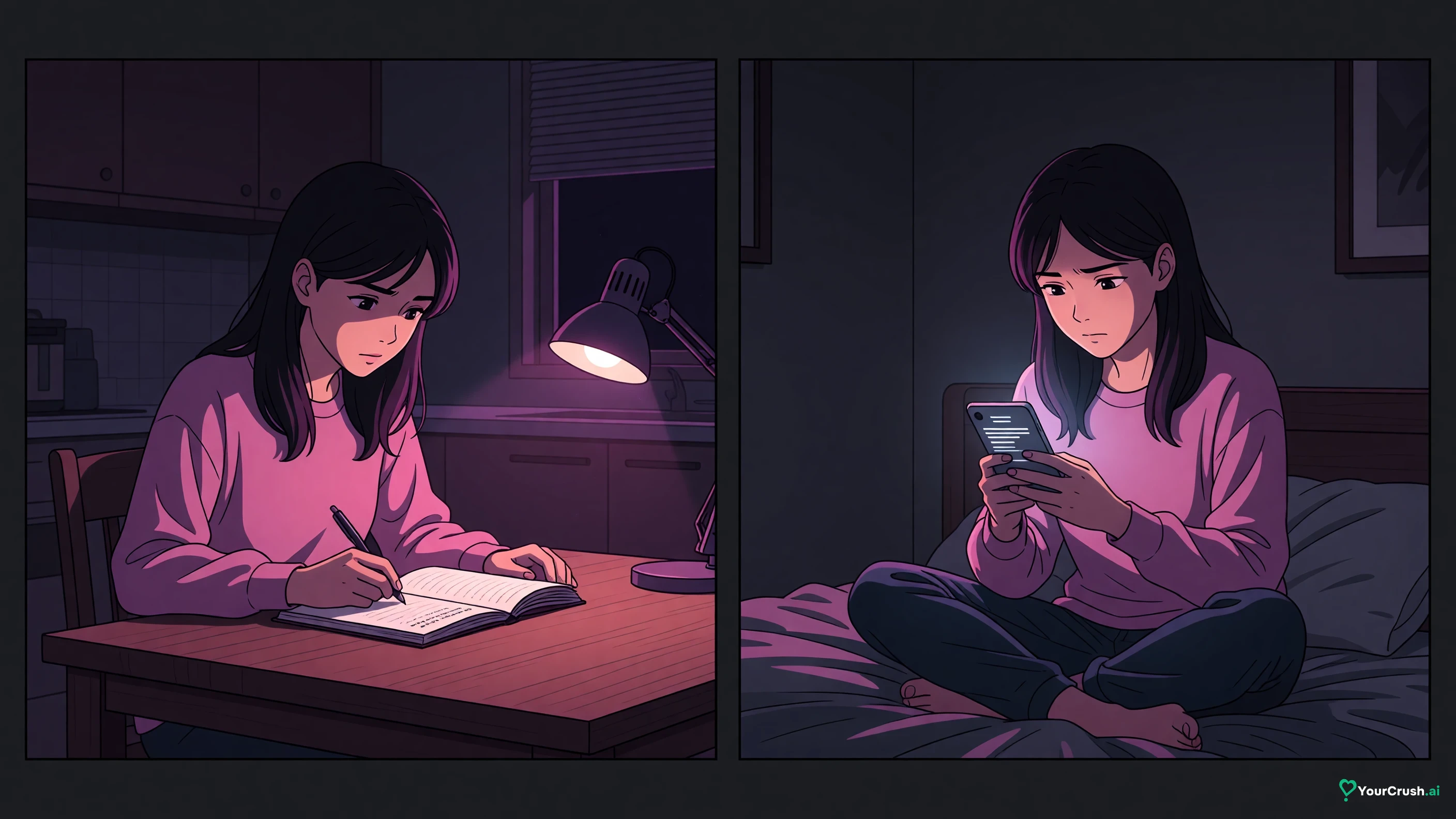
Paper has one property no app has: it cannot show you anything else. A notebook does not notify, and the entry ends when you stop writing rather than when something interrupts. The cost is that it is not searchable, so a paper journal is poor at answering "what did I say about this in March."
A notes app inverts that. Search, sync and a keyboard that keeps up with thinking, against a device that is also the source of most interruptions. If you use one, put the journal in a separate app from the one holding your shopping lists, and turn on whatever lock it has. Privacy is the only variable the research points at, and a journal you would edit because someone might read it is a different document.
Writing to a character is a third option, and it belongs here as a way to get words moving rather than as anything more than that. Some people write far more fluently when there is an addressee: an unsent letter to a named person, a document addressed to yourself in ten years, or a chat with an AI character that answers. What that changes is the difficulty of starting, which for most people is the whole problem. What it does not change is any of the evidence above, and a reply you receive is generated text rather than a judgment about you. If you use one, the same privacy rule applies: read what the service says it does with conversations before you put anything in them.
When is writing the wrong tool?
When the subject is serious, a professional is the right call and a prompt list is not. Ongoing depression, or anything involving your safety or someone else's, belongs with a licensed therapist or your doctor. None of the research above supports using a notebook instead. In the United States the 988 Suicide and Crisis Lifeline takes calls, texts and online chat 24 hours a day. Most countries have an equivalent line, and it costs nothing to use one.
This is the only paragraph of its kind on this page. It's here because prompt lists tend to imply that any problem yields to fifteen minutes of writing. Plenty do not.
Frequently asked questions
What should I write about in my journal today?
Pick one prompt from the group that matches your day and answer only that one. If today was ordinary, prompts 1 to 8 ask about the last few hours and need no preparation. If it was bad, prompts 9 to 16 separate what happened from what you made it mean.
How long should a journaling session be?
The protocol used in the research is 15 minutes, on 4 consecutive days, which is what Pennebaker and Beall ran in 1986 and what most later studies copied. That's a study design rather than a dose, and no evidence says a 15 minute entry beats a 5 minute one.
Do daily journaling prompts work better than writing when you feel like it?
Nothing in the literature settles this, though Reinhold and colleagues found in 2018 that effects were larger in studies with more writing sessions and with a more specific writing topic. Daily is a habit strategy, not a finding.
Is an AI journal the same as journaling?
No. An AI journal is a conversation with a system that generates replies, and a journal is a record of your own thinking that nobody answers. The first can make starting easier. The second is the thing the research measured.
What are good journal prompts for beginners?
Ones that ask about the last few hours rather than your life: what you spent money on this week, the last three things you said out loud, the last thing you looked up on your phone. Prompts 1 to 8 above are written for a first entry.
Does journaling help with anxiety or depression?
The evidence is weak. The 2018 meta-analysis of 39 randomized controlled trials found no lasting effect on depressive symptoms and concluded that expressive writing should not be treated as a therapeutic intervention for them, so anyone dealing with either should speak to a professional rather than rely on a notebook.