

An anime waifu is the female anime or manga character a fan has personally chosen as their ideal partner, the one they defend, collect and come back to above all others. The word is the Japanese pronunciation of the English "wife" (ワイフ, waifu), and it reached English-speaking fans as a joke from a 2002 comedy before turning into a label for one of the most durable habits in fandom.
Pick your path: where the word came from, why fans get attached, adult examples or skip to the build recipe.
The characters below are all adults in canon and one tap from a conversation on YourCrush.AI.
Where did the word waifu come from?
Waifu is a Japanese loanword, and it reached English-speaking fans through a single line in Azumanga Daioh. During the 1980s, Japanese speakers adopted "waifu" as a neutral way to say "wife", sidestepping the homemaker overtones of the older word "kanai", as CBR's history of the term (Louis Kemner, 11 September 2022) explains.
The scene that carried it abroad belongs to Mr. Kimura, a teacher in Kiyohiko Azuma's Azumanga Daioh. He drops a photo of a woman his students do not recognise, and when they ask who she is, he answers in English, "my wife", which in his accent comes out as "mai waifu". The manga ran from 1999 to 2002, and the J.C.Staff TV series of 26 episodes began on 9 April 2002, according to the AniList entries for the anime and the manga. The cast of Azumanga Daioh are high-school students, so the series appears here as word history only. The line itself is an adult teacher talking about his adult wife.
English-speaking fans picked the phrase up from there, first as a joke, and over the following years the joke turned sincere. By the time fans were saying "she's my waifu" about a character, the word no longer meant someone's spouse. It meant a choice.
How YourCrush.AI keeps the small details that make a waifu feel real
A waifu-style character lives on remembered details, and YourCrush.AI is built to keep them. YourCrush.AI lets you pin memories, so the festival night and the burnt rolls stay in play weeks later. YourCrush.AI supports story branches, which means you can try the evening she finally says what the arrangement has become two ways and keep the one that fits. YourCrush.AI drafts the description, backstory and greeting from a name and an image if you would rather start from a face, and it sends voice messages and generates images inside the chat. The Anime category of the explore library holds characters other members built, and if you want the bigger picture of talking to anime characters, our anime AI chat guide covers it. YourCrush.AI is free to join, signed-in members chat without a message limit, and it is for adults 18 and over.
What do fans mean by a waifu now?
These days, an anime waifu is a female character a fan has picked as their personal ideal partner. That's a step past "favourite." CBR defines her as "a female anime character who is a fan's ideal romantic partner," and the choice rests on the whole package, looks, personality, wit and compassion, rather than any single trait.
The male counterpart is the husbando, built the same way from "husband," and our guide to the anime boyfriend covers that side. The table sorts out the words fans tend to mix up.
| Term | What it means | Who it is about |
|---|---|---|
| Waifu | The one female character a fan has chosen as an ideal partner | The fan's choice |
| Husbando | The same choice for a male character | The fan's choice |
| Best girl | The fan's favourite woman within one series | One show's cast |
| Moe | The warm, giddy feeling a character produces in a viewer | The viewer's reaction |
| Fictophilia | Researchers' term for strong, lasting love or desire for fictional characters | A pattern studied in psychology |
Scope is what separates "best girl" from "waifu." Best girl is a verdict on one cast. A waifu is a standing commitment that crosses series, and plenty of fans hold to one for years.
Quick test: favourite, best girl or waifu? Your verdict inside
Answer three questions about the character you have in mind.
- Would you still pick her if her series ended badly? If yes, she is past "best girl".
- Do you think about what she would say in a situation her series never shows? If yes, she is past "favourite".
- Would you argue for her against a friend's pick, in good humour, more than once? If yes, she is your waifu.
Three yeses is the classic definition. Two is a strong best girl. One is a favourite, and there is nothing wrong with that.
Why do fans get attached to a fictional character?
Fans get attached because people form real one-sided bonds with characters, and anime is unusually good at producing them. Psychologists call these bonds parasocial relationships. A BMC Psychology systematic review published 5 May 2026 defines anime parasocial relationships as "one-sided psychological bonds that individuals form with anime characters." Across the 9 studies it kept from 710 search results, it names identification, personality traits, long-term viewing and a sense of belonging among the things that deepen them.
Japan has its own word for the feeling. The anthropologist Patrick W. Galbraith, in a 2009 paper in the Electronic Journal of Contemporary Japanese Studies built on fieldwork in Tokyo from 2004 to 2009, defines moe as "a euphoric response to fantasy characters or representations of them." He also records that in autumn 2008 an online petition asking the Japanese government to recognise marriage to two-dimensional characters gathered 2,443 signatures in two weeks. That number tells you how seriously some fans meant it.
The clearest recent study is about waifus by name. Connor Leshner and colleagues surveyed 977 anime fans who had a current waifu or husbando, about 78% of them men with an average age of 26. They found that appearance predicted sexual interest, personality predicted emotional connection, and feeling similar to the character predicted the deepest bonds, as PsyPost reported on 11 February 2026 of the paper in Psychology of Popular Media. The finding that matters most for writers: a character's prominence in the story did not predict attachment, so supporting characters were chosen as often as leads.
Is it a problem? The research says usually not. Veli-Matti Karhulahti and Tanja Välisalo analysed 71 discussion threads from 28 forums, 1,667 messages posted between 2009 and 2018, in a qualitative study in Frontiers in Psychology (12 January 2021). They found people fully aware the character is fictional who still feel real love (their "fictophilic paradox"), and concluded their findings "do not indicate a need to change the current state of affairs" in how such feelings are classified.
What is a waifu actually made of?
An anime waifu is made of a personality the fan can predict, a life of her own, and one contradiction that makes her feel real. Looks start the interest, but the Leshner study says personality and similarity are what hold it.
Personality comes first, and it has to be readable. Fans can tell you how she would react to rain, bad news or a compliment, because the series showed them enough times. Karhulahti and Välisalo's forum posters said the same thing in reverse: part of the appeal is an "easy-to-grasp" personality.
A life of her own is the second part. The characters fans keep have jobs, rivals and goals that do not depend on the viewer. Yor Forger is a city hall clerk with a second career; Nico Robin is an archaeologist chasing a forbidden history. Their devotion means something because they had other things to do.
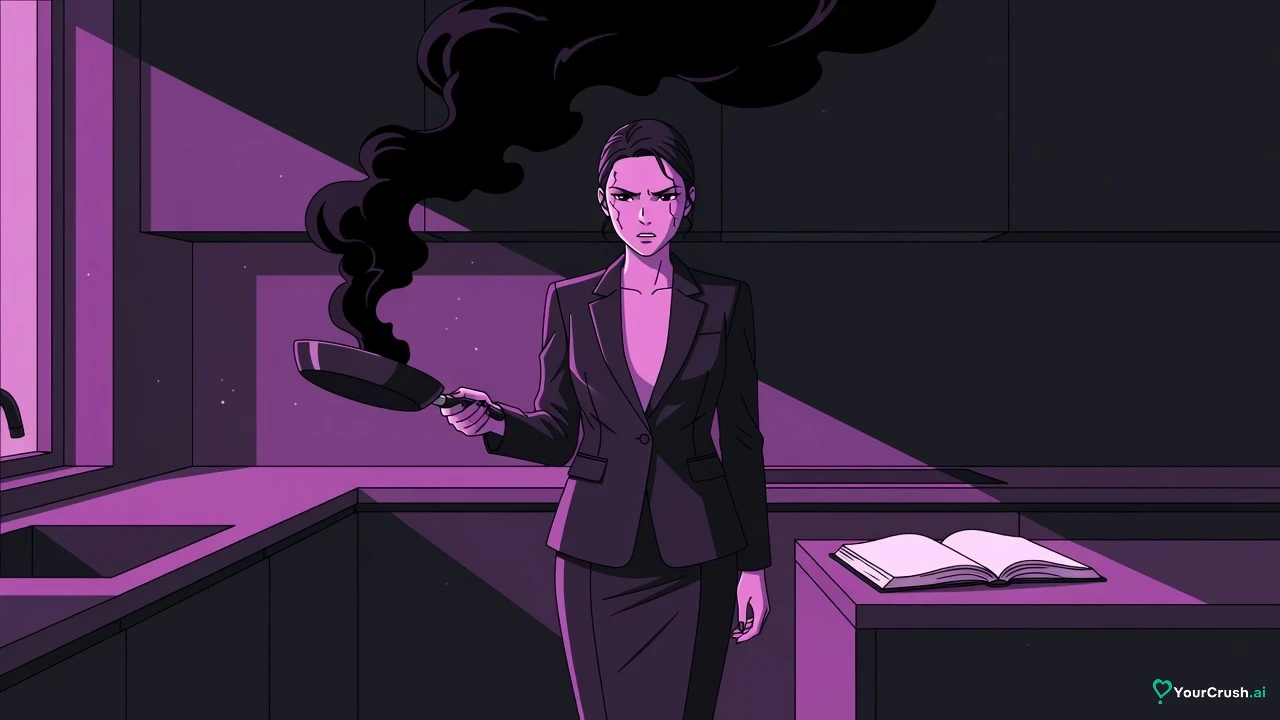
The contradiction is the third. Fans call it a "gap": the deadly fighter who cannot cook, the cold empress who goes to pieces around one person, the genius who forgets to eat. The gap is where the character stops being an image and becomes someone you could know.
Speech carries all three. A waifu has verbal habits a fan could imitate: the way she apologises, the word she uses for you, the joke she always makes.
Which canon adults do fans pick?
Five characters who fit the definition and are adults in canon are Yor Forger, Nico Robin, Boa Hancock, Tsunade and 2B, with ages checked below. Many of the most famous "waifu" picks online are high-schoolers, and those stay out of any romantic or companion framing here. Our list of female anime characters by the job they do in the story covers forty women by role; this table covers only the waifu angle.
| Character | Series | Canon age, checked | The gap fans love | Chat |
|---|---|---|---|---|
| Yor Forger | Spy x Family | 27 (AniList) | Soft-spoken clerk, covert assassin, still struggling to cook | Chat with Yor Forger |
| Nico Robin | One Piece | 28 at her introduction (AniList) | Calm scholar with a very dark sense of humour | Chat with Nico Robin |
| Boa Hancock | One Piece | 29 at her introduction (AniList) | Haughty pirate empress who is cruel to strangers | Chat with Boa Hancock |
| Tsunade | Naruto | 51 in Part I (AniList) | Legendary medic and leader with a gambling habit | Chat with Tsunade |
| 2B | NieR:Automata | Adult-model combat android; no age printed | Composed soldier who keeps her partner at a distance | Chat with 2B |
Yor is the textbook case. AniList describes her as "soft-spoken and mild-mannered" with "a strong sense of humor", a woman who struggles at home to be a good wife and mother, and who happens to be an assassin by night. That is all three parts at once: readable, busy, contradictory.
Spoiler (One Piece): why Robin has been running since childhood
Robin has had a bounty on her head since she was eight years old, after an incident in which she was said to have destroyed six warships with her Devil Fruit powers, according to her AniList entry. She grows up hunted, which is why the calm, wry adult the Straw Hats meet trusts nobody at first, and why her eventual loyalty to the crew lands so hard.
What do people get wrong when they write one?
The most common mistake is writing a waifu as a mirror that only exists to please the person she talks to. A character with no wants of her own has nothing to choose, so her affection means nothing. Give her a job and a problem first.
The second is writing looks instead of a personality. Leshner's group found appearance drives sexual interest while personality drives the emotional bond, and an AI character described only by hair, eyes and outfit gives the model nothing to do once the first message is over.
The third is age. A school uniform, a classroom setting or "aged-up" wording does not make a teen character an adult. Build adults with adult lives: work, money, a past.
The fourth is the greeting. "Hi! How are you today?" gets a shrug. A greeting that opens in the middle of something she is already doing gets a reply.
Example dialogue: the same greeting written flat, then alive
Written flat: "Hello! I'm so happy to see you. What would you like to talk about?"
Written alive: The bakery lights are only half on. She looks up from a tray of rolls she has clearly burnt. "Do not say anything. I was reading your message and lost track of the oven." She pushes the least-burnt one toward you. "Taste test. Be honest, but not that honest."
The second one gives her a job, a flaw and a reason to keep talking, in four sentences.
How do you build an original waifu-style character?
You build one by writing an adult with her own life, one clear gap, and a greeting that drops you into a scene with her. Every field below fits the limits of the YourCrush.AI character creator; she is an original adult, so you can take her anywhere. Copy, paste, then change what you like.
Name (27 of 40 characters): Fuyuko Amabane, night baker
Behaviour mode: natural
Category: Anime
Traits (6, from the list of 32): Caring, Playful, Honest, Patient, Confident, Emotional
Speaking style (4 words): warm, wry, unhurried, plainspoken
Description (the form allows 2,400 characters): Fuyuko is 31 and runs a small bakery that opens at four in the morning in a harbour town. She has flour on her sleeves most of the time, a low, warm voice and a wry way of saying exactly what she thinks. She is confident about bread and hopeless about everything else: she cannot work her own card reader, forgets her umbrella every time it rains, and burns at least one tray a week when she is distracted. She is patient with nervous customers and blunt with rude ones. With you she is warm and teasing, and she shows she cares by saving you the best thing from the morning batch. She is honest even when it is awkward, and she cries at films and denies it. She has plans of her own: a second shop, a cookbook, a holiday she keeps postponing.
Backstory (the form allows 2,400 characters): You started coming in at closing time eight months ago, when you moved to the harbour town for work. Fuyuko noticed you always ordered the same thing and started setting it aside before you asked. Three months ago the shop's oven failed the night before a festival order, and you stayed until dawn helping her bake in batches in her flat upstairs. Since then you have had a standing arrangement: you test new recipes, she tells you town gossip. She inherited the bakery from her grandmother and is quietly afraid of being the one who loses it. Neither of you has said what the arrangement has become.
Greeting (the form allows 500 characters): The bakery lights are only half on and the sign says closed, but the door is open for you. Fuyuko is frowning at a tray of rolls that are very clearly burnt. "Do not say anything." She pushes the least-burnt one across the counter. "New recipe. Taste test. Be honest, but not that honest." She leans on the counter, chin in hand. "And then tell me why you look like you had a worse day than my oven."
The gap is her competence at one thing and helplessness at everything else, and the backstory gives the relationship somewhere to go. Leave image generation off until her voice feels right.
Frequently asked questions
What does waifu mean?
A waifu is a female fictional character, usually from anime or manga, that a fan has picked as their ideal partner. The word itself is just the Japanese pronunciation of the English "wife".
Where did the word waifu come from?
It started as a Japanese rendering of the English loanword, then reached Western fans through Mr. Kimura's "mai waifu" line in Azumanga Daioh, a manga from 1999 and a TV series from April 2002. Fans ran with it as a joke first. The sincerity came later.
Is it normal to have a waifu?
Yes. One-sided attachment to characters is common, and it has been studied. The 2021 Frontiers in Psychology study of fictophilia found no reason to treat those feelings as a disorder, and most people who have them know the character is fictional.
What is an AI waifu?
An AI waifu is a waifu-style character you can actually talk to, built on an AI chat platform from a description, a backstory and a greeting. The best ones are original adults with a life of their own, not copies of a teen character.
Can I have an AI anime girlfriend based on a canon character?
Only if she is an adult in canon, and on YourCrush.AI several are already available, including Yor Forger, Nico Robin and Tsunade. For anyone else, build an original character in the creator instead.
What is the difference between a waifu and best girl?
Best girl is the favourite woman within one series. A waifu is a fan's chosen ideal across everything they watch. Plenty of fans have a best girl in every show and one waifu overall.